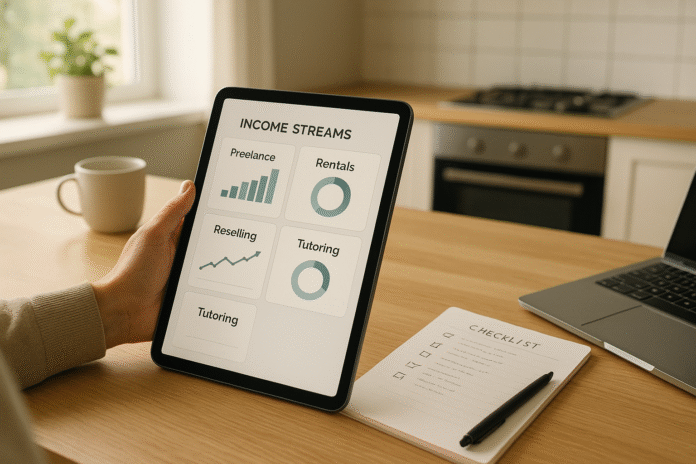
Financial independence means your investments and reliable income streams cover your living expenses without relying on a single employer. The fastest ethical route is usually to stack a few side hustles that produce cash flow you can save and invest. In a sentence: a good side hustle trades your skills or assets for predictable profit with low downside risk and clear guardrails. To get moving quickly, follow this simple sequence: pick a skill or asset you already have, define one narrow offer, land your first paying customer, track your unit economics from day one, and reinvest surplus into what’s working.
Important note: Nothing here is financial, legal, or tax advice. Use this guide for education and planning; consult qualified professionals for decisions about your specific situation.
Fast-start steps you can skim now:
- Choose one hustle from the list below that matches your skills and schedule.
- Define your minimum viable offer (what, for whom, price, delivery time).
- Set up basic tooling (payment method, invoice, simple contract, bookkeeping).
- Launch to a tiny audience (friends, local groups, or a platform).
- Review numbers weekly and double down only on profitable work.
1. Freelance Writing & Content SEO for Businesses
Freelance writing and content SEO are reliable, learnable ways to convert time into cash while building a portable skill set. You help companies attract leads by writing articles, emails, or landing pages aligned with what buyers search for and what sales teams need. The work ranges from blog posts and case studies to product pages and thought-leadership pieces. It’s practical because demand is broad (every industry publishes), projects are modular (you can batch in evenings or weekends), and you can raise rates as your portfolio grows. The key is choosing a niche—like B2B software, personal finance, or healthcare—so your research compounds and your proposals sound specific. Done right, you’ll create assets that bring clients measurable traffic or conversions, which justifies premium pricing and repeat work.
How to do it
- Pick a niche and create 3 portfolio samples that prove you can research and structure a compelling piece.
- Productize one clear offer (e.g., “1,200-word SEO blog post with brief and two revisions”).
- Use a brief template to lock the angle, keywords, and calls to action before drafting.
- Track each draft’s hours to find your effective hourly rate (EHR) and remove time sinks.
- Upsell content refreshes and internal linking to increase client ROI—and your margins.
Numbers & guardrails
- Typical beginner rates: $0.08–$0.20 per word; specialists often command $0.25–$0.60+.
- Mini case: Two 1,500-word posts/week at $0.15/word ≈ $450/week; at $0.30/word ≈ $900/week.
- Guardrails: Charge a 50% deposit, cap revisions (e.g., two rounds), and clarify attribution/ghostwriting in your agreement.
Bottom line: If you like research and can meet deadlines, content writing compounds quickly into a high-EHR side hustle that funds your savings goals.
2. No-Code Website & Landing Page Builds
No-code builders (e.g., Webflow, Squarespace) let you ship professional websites and conversion-focused landing pages without full-stack engineering. Clients are busy founders, consultants, and local businesses that need something clean and fast. Your value is part design, part marketing: designing an on-brand layout, structuring sections around persuasion, and integrating forms, scheduling, and payments. It’s a great fit if you’re visually inclined and comfortable with checklists. You can deliver on evenings or weekends because projects are scoped tightly—one-page landers, brochure sites, or template customizations. Over time you’ll collect components (hero sections, pricing tables) and a stable theme library that speeds up delivery and improves consistency.
How to do it
- Assemble two template stacks (one minimal, one bold) and a 10-point intake questionnaire.
- Offer three tiers: Starter (single-page landing), Site (up to 5 pages), Launch+ (site + analytics + email capture).
- Add simple automations (form to CRM, booking link, email sequence) to boost client outcomes.
- Maintain a design kit (colors, spacing, typography) so builds feel premium and cohesive.
Numbers & guardrails
- Common project fees: $500–$1,500 (landing pages), $1,200–$3,500+ (small sites).
- Mini case: Two $1,200 projects/month after platform fees ≈ $2,300–$2,400 in profit if you reuse components.
- Guardrails: Fixed scope, milestone payments, written change-order policy, and handoff video.
Bottom line: Package speed and clarity into tidy website offers; each successful build can lead to referrals and maintenance retainers.
3. Online Tutoring & Micro-Courses
If you can teach a skill or academic subject, tutoring and micro-courses can produce steady earnings with low overhead. You’re trading clarity and empathy for cash: translating complex topics into step-by-step lessons. Start with one tight promise (e.g., “Master algebra factoring in four sessions” or “Beginner Excel for small-business owners”). Tutoring hours are flexible—early mornings, evenings, or weekends—and virtual tools compress travel and scheduling friction. A natural expansion is small cohorts (4–12 learners) that you run live over a few sessions, then sell later as a recording or worksheet pack. The compounding effect is strong: one curriculum, many cohorts, incremental improvements.
How to do it
- Define a single outcome, syllabus, and practice set.
- Offer a 4-session package (45–60 minutes each) with clear pre-work and feedback.
- Use a booking tool with buffers, and record sessions for students who need replays.
- For micro-courses, script 5–7 short lessons and include quizzes or templates.
Numbers & guardrails
- Common ranges: $25–$80/hour for tutoring depending on subject and credentials.
- Mini case: A 6-hour cohort with 8 learners at $75 each = $600; repeat monthly with minor updates.
- Guardrails: Provide clear disclaimers for exam outcomes, record housekeeping rules, and protect student data.
Bottom line: Teaching is a repeatable engine: refine one curriculum until you can deliver results predictably and profitably.
4. Retail & Online Arbitrage (Reselling)
Arbitrage means buying underpriced goods and reselling them where demand is stronger. You profit from information and logistics rather than product creation. The work: sourcing (clearance aisles, outlet stores, online deals), verifying demand and margin, listing with clear photos, and shipping quickly. Success hinges on data discipline—scanning barcodes, checking sales rank or sell-through rates, and calculating total costs (shipping, marketplace fees, returns). It’s hands-on and can be scaled on weekends. Start with categories you know (toys, books, tools) to reduce bad buys. Over time, build supplier relationships, develop a pricing routine, and create a small lab for prepping shipments efficiently.
How to do it
- Set rules: minimum gross margin, minimum sales velocity, maximum size/weight for shipping.
- Use scanning apps and spreadsheets to estimate all-in cost including fees and packaging.
- Batch listing and shipping in 2–3 hour blocks; photograph everything with consistent lighting.
- Track refunds and defects; refine your buy-box strategy and repricing logic.
Numbers & guardrails
- Typical target margins: 20–40% after marketplace fees; aim for a 2×–3× turnover per month on small inventories.
- Mini case: Buy 100 units at $12, sell at $24; after ~30% fees and $1/unit supplies, net ≈ $7 per item → $700.
- Guardrails: Respect platform policies, keep receipts, and separate business inventory from personal purchases for clean bookkeeping.
Bottom line: With disciplined sourcing and tracking, reselling can create repeatable cash flow you can ramp or pause as life demands.
5. Print-on-Demand Micro-Brands
Print-on-demand (POD) lets you sell designs on apparel, mugs, and posters without holding inventory. You upload art, set pricing, and the provider prints and ships after each sale. This reduces risk and enables thematic micro-brands (e.g., local pride, hobbies, professions). The profit engine is niche clarity and conversion: a memorable design + clean product page + an audience you can reach through search or social. It’s attractive for nights and weekends because you batch design iterations and product launches. Expect iterative testing—most designs won’t hit, but winners can sell for months with minimal upkeep.
How to do it
- Choose one tight niche and a consistent visual style.
- Launch 10–20 designs quickly; prune aggressively based on clicks and add-to-cart rates.
- Use mockups with consistent lighting and angles; write succinct benefit-led descriptions.
- Add simple upsells (bundle two shirts, mug + poster) to lift average order value (AOV).
Numbers & guardrails
- Typical T-shirt base + fees ≈ $10–$15; pricing at $22–$30 yields $8–$15 gross margin before ads.
- Mini case: 100 monthly sales with $10 margin → $1,000 gross; after $300 in ads and $50 apps → $650.
- Guardrails: Avoid trademarked phrases, disclose POD fulfillment times, and test samples for quality before scale.
Bottom line: POD works when you niche down, kill duds fast, and keep your creative pipeline flowing.
6. Affiliate Niche Sites & Email Newsletters
Affiliate marketing pays commissions when readers buy through your tracked links. A modern, durable approach is pairing a narrow-content site with a focused email newsletter. You win by becoming the trusted explainer for a specific problem—think “compact home gym gear,” “beginner astrophotography,” or “budget-friendly espresso.” Articles answer intent-rich queries (how-tos, comparisons, reviews), and the newsletter deepens trust with curated picks and tips. This side hustle has slower ignition but can compound into semi-passive income once content ranks and your list engages. The work is research-heavy upfront: mapping keywords, testing products, and writing honest, skimmable guides.
How to do it
- Pick a sub-niche where you can test products and share credible opinions.
- Publish cornerstone pages (buying guide + top picks + setup tutorial) and interlink them.
- Build an email opt-in with a simple lead magnet (e.g., “7-day setup checklist”).
- Track link clicks by category to double down on high-converting topics.
Numbers & guardrails
- Typical affiliate commission rates vary widely; a blended RPM (revenue/1,000 views) of $10–$40 is common in many niches.
- Mini case: 15,000 pageviews/month × $20 RPM = $300; with 3,000 subscribers and a 1% monthly purchase rate at $5 commission, add $150 → $450 total.
- Guardrails: Disclose affiliate relationships clearly; prioritize reader trust over short-term clicks.
Bottom line: Be the most helpful voice in a small corner of the internet and your commissions grow alongside your credibility.
7. Local Service Micro-Agency (Cleaning, Lawn, Handyman)
Local services are the original side hustles—and they remain resilient. You can start solo or as a “micro-agency” that books jobs and coordinates contractors while retaining a margin. The value proposition is speed, reliability, and excellent communication. Focus on one service and neighborhood to reduce travel time and increase referrals. Clear, flat pricing and punctuality beat fancy branding. This path is ideal if you like tangible work and quick customer feedback. Over time you can layer recurring contracts (e.g., biweekly cleanings), seasonal packages, and small upsells like deep cleans or garden bed refreshes.
How to do it
- Define packages (e.g., “2-bedroom standard clean,” “front-yard maintenance”) with inclusions/exclusions.
- Route days by area to minimize drive time; use a shared calendar and photo checklists.
- Collect before/after photos (with permission) and ask for reviews after successful jobs.
- Keep a simple safety policy and basic liability coverage appropriate to your region.
Numbers & guardrails
- Typical labor costs: $20–$35/hour; client rates often $35–$60/hour equivalent depending on service and market.
- Mini case: A 3-hour standard clean at $150, paying $75 in labor and $10 supplies, nets $65; 20 such jobs/month → $1,300.
- Guardrails: Written scope, cancellation policy, and a checklist to avoid missed tasks.
Bottom line: With tight routes and reliable checklists, local services turn effort into consistent, bankable cash.
8. Rideshare & Delivery Stacking
Driving for rideshare and delivery apps converts flexible hours into cash, especially if you “stack” platforms and optimize for profitable times and zones. Your earnings depend on local demand, incentives, and operating costs (fuel, depreciation, maintenance). The winning approach is data-driven: work high-demand windows, avoid dead miles, and know your real cost per mile. You can combine passenger rides with food or parcel delivery to smooth out slow stretches. While this hustle doesn’t create a portfolio artifact, it can produce dependable cash flow to accelerate debt payoff or investment contributions.
How to do it
- Track each shift’s gross, miles, hours, and net to compute effective hourly rate after costs.
- Work power hours (commutes, weekends, event releases) and avoid low-demand midday lulls.
- Use heat maps and destination filters, and decline unprofitable long pickups.
- Maintain your vehicle proactively to prevent downtime.
Numbers & guardrails
- Many drivers target $18–$30/hour net after expenses in healthy markets; your mileage will vary.
- Mini case: 15 hours/week × $22/hour net ≈ $330/week; set aside cents-per-mile for maintenance and tires.
- Expense snapshot (illustrative):
| Expense type | Typical range (USD) |
|---|---|
| Fuel (per mile) | $0.12–$0.20 |
| Maintenance/tires (per mile) | $0.05–$0.09 |
| Depreciation (per mile) | $0.08–$0.15 |
- Guardrails: Keep a mileage log for taxes, follow platform safety rules, and avoid fatigue driving.
Bottom line: Treat this like a numbers game—optimize routes and hours, know your costs, and the cash flow can be steady and predictable.
9. Airbnb Co-Hosting & Rental Management (No Ownership)
Co-hosting means managing short- or mid-term rentals for owners in exchange for a percentage of booking revenue or a flat fee. You coordinate cleaners, restocking, guest messaging, and minor maintenance. The appeal as a side hustle is strong: no property purchase, operational work batched around turnovers, and earnings tied to occupancy rather than your time alone. Start with one listing for a friend or neighbor to prove your system—checklists, linen closets, labeled bins, automated messages—and collect reviews that mention responsiveness. As you add properties, you can standardize cleaners, inventory, and restocking to keep margins healthy.
How to do it
- Offer a clear package: guest messaging, cleaner scheduling, inventory checks, pricing suggestions.
- Build a turnover checklist and photo standards for before/after verification.
- Use dynamic pricing tools and a backup cleaner to prevent last-minute cancellations.
- Create a simple owner report: occupancy, ADR (average daily rate), issues, and expenses.
Numbers & guardrails
- Typical co-host fees: 10–20% of gross booking revenue or a per-turnover fee (e.g., $25–$60).
- Mini case: 5 listings averaging $1,800/month gross at 15% fee → $1,350/month; costs are mostly software and time.
- Guardrails: Have written responsibility boundaries (no major repairs), confirm local regulations, and maintain 24/7 guest escalation rules.
Bottom line: With reliable cleaners and tight checklists, co-hosting can be a low-capital cash generator that scales by adding quality listings.
10. Photography & Stock Video Licensing
If you have a camera and a practiced eye, licensing photos and short video clips can turn creative sessions into recurring micro-royalties. The model is simple: produce salable, evergreen visuals (workplaces, diverse people, simple textures, lifestyle scenes), upload to reputable marketplaces, and let the catalog sell over time. The work rewards consistency, metadata discipline, and trends awareness. While individual payouts are modest, a deep portfolio can produce meaningful monthly income. You can also layer direct client shoots (portraits, small brand visuals) for upfront cash and repurpose non-exclusive images as stock.
How to do it
- Build shoot lists that reflect real workplaces, tech, and lifestyle moments.
- Aim for clean light, uncluttered compositions, and model/property releases when needed.
- Batch-edit for tonal consistency and keyword with precise, relevant terms.
- Track sales by theme to decide what to produce next.
Numbers & guardrails
- Typical stock photo download royalties: $0.25–$5; stock footage clips: $15–$80+ depending on platform and license.
- Mini case: 500 clips averaging $2/month each → $1,000/month gross; a small subset often drives most revenue.
- Guardrails: Keep meticulous releases, avoid logos and identifiable brand trade dress, and respect local privacy rules.
Bottom line: Portfolio depth and consistent metadata matter more than any single upload; think in themes and build steadily.
11. Virtual Assistant & Online Ops (Including Basic Bookkeeping)
Small businesses and solo creators need reliable help with scheduling, inbox triage, customer support, research, simple bookkeeping, and light project coordination. As a virtual assistant (VA), you sell organization and calm. The work suits people who enjoy checklists and systems; it’s inherently part-time and can be done from home. Start with a narrow package so clients know exactly what to expect, then layer specialized services (e.g., podcast guest outreach, webinar logistics, invoicing). Over time, documentation (SOPs) lets you handle more clients in fewer hours, increasing your effective hourly rate.
How to do it
- Offer a Starter package (10 hours/month) and a Growth package (20 hours/month) with defined tasks.
- Use shared dashboards for priorities, due dates, and status; maintain a weekly summary email.
- For bookkeeping, stick to cash-basis categorization and reconciliations within your competency.
- Protect client data with password managers and clear access boundaries.
Numbers & guardrails
- Common VA rates: $20–$40/hour; specialized ops or bookkeeping can command $35–$60/hour.
- Mini case: Two clients at 15 hours/month each × $30/hour → $900/month; standardized SOPs can cut 20–30% of admin time.
- Guardrails: Use engagement letters, define response-time expectations, and avoid giving tax or legal advice unless qualified.
Bottom line: If you love structure, VA/ops work converts organization into dependable monthly revenue with room to specialize.
FAQs
How do I pick the right side hustle without analysis paralysis?
Match three things: skills you already have, problems people pay to solve, and delivery that fits your schedule. Start with the easiest overlap, launch a small paid test in two weeks or less, and let real numbers—not hypotheticals—guide whether you continue.
How much money should I expect to make at the beginning?
Aim for your first $200–$500 in validated revenue within the first month by scoping a small, repeatable offer. Early wins prove demand and build confidence. Then, use weekly reviews to refine pricing and process.
What percentage of income should I save toward financial independence?
A common approach is to route 50–80% of side-hustle profit to savings or investments while keeping your day-job paycheck for core expenses. Automate transfers to reduce temptation and watch your runway extend.
Should I focus on “passive income” instead?
Most income is active at first. Treat “passive” as the result of systems: once you can deliver consistently, document processes, automate, and productize. Even then, expect ongoing maintenance; truly set-and-forget revenue is rare.
How do I manage taxes from side hustles?
Track income and expenses, keep receipts, and set aside a portion of profit for taxes based on your jurisdiction. Many regions require estimated payments. When in doubt, consult a tax professional familiar with self-employment rules.
What legal or licensing steps do I need?
Requirements vary by location and industry. At minimum, use clear contracts, invoices, and privacy practices, and consider basic liability coverage for in-person services. Local business registration and permits may apply to certain activities.
When is it smart to raise prices?
Raise rates when you deliver faster, better, or more reliably—and when demand exceeds your bandwidth. Signals include repeat clients, referrals, and a calendar booked beyond two weeks. Always pair price increases with scope clarity.
How can I avoid burnout while working a day job?
Set hard boundaries: pre-planned work blocks, one day fully off, and quarterly breaks. Choose hustles that energize you and batch tasks to reduce context switching. If your sleep or relationships suffer, scale back intentionally.
What’s the quickest path to a first client?
Offer a discounted “first 5 customers” package to people already in your network, local groups, or communities where you participate. Keep the scope tight and request a testimonial after completion to fuel future outreach.
Do I need fancy software to start?
No. Begin with free or low-cost tools for payments, invoicing, scheduling, and bookkeeping. Upgrade later when you have consistent revenue and a clear reason (automation, analytics, or collaboration).
Conclusion
Financial independence accelerates when you consistently convert spare hours into surplus cash and direct that surplus toward savings and investments. The side hustles above are chosen for practical reasons: low startup cost, flexible time blocks, clear customer value, and the ability to productize and scale. Your job is to pick one, define a lean offer, and prove demand with a paying customer as soon as possible. From there, operate by numbers: track hours, costs, and outcomes; cut what doesn’t work; standardize what does. The quiet magic is consistency—small weekly deposits add up to a cushion, then a safety net, then freedom.
Ready to move? Choose one hustle, set a two-week launch date, and land your first customer—then reinvest the profit into the next milestone.
References
- Gig Economy Tax Center, Internal Revenue Service, https://www.irs.gov/businesses/gig-economy-tax-center
- Plan Your Business: Guides and Tools, U.S. Small Business Administration, https://www.sba.gov/business-guide/plan-your-business
- Trading Allowance: Property and Trading Income, HM Revenue & Customs, https://www.gov.uk/guidance/tax-free-allowances-on-property-and-trading-income
- Disclosures 101 for Social Media Influencers, Federal Trade Commission, https://www.ftc.gov/business-guidance/resources/disclosures-101-social-media-influencers
- What Is a Co-Host?, Airbnb Help Center, https://www.airbnb.com/help/article/1244/what-is-a-cohost
- Misclassification of Employees as Independent Contractors, U.S. Department of Labor, https://www.dol.gov/agencies/whd/flsa/misclassification
- Copyright Basics, U.S. Copyright Office, https://www.copyright.gov/circs/circ01.pdf
- Budgeting and Saving Tools, Consumer Financial Protection Bureau, https://www.consumerfinance.gov/consumer-tools/budgeting/