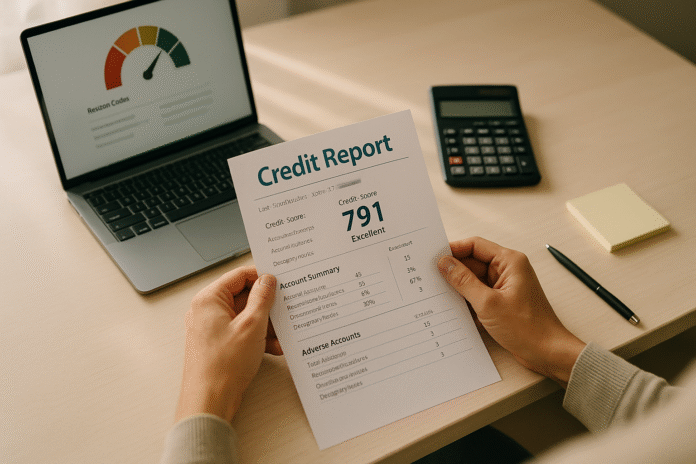
If you’ve ever pulled a score and wondered whether to trust the number or the “reasons” that came with it, this guide is for you. In plain language: credit report scoring refers to the algorithm (like FICO® or VantageScore®) that converts the data on your credit reports into a three-digit number; scoring factors (often shown as “reason codes”) are the short explanations of the top items that kept your score from being higher at that moment. The model computes the score; the factors explain it. Below you’ll find nine research-backed truths that clear up confusion and show you what actually moves the needle. This article is educational, not personal financial advice—use it to ask better questions, fix errors, and choose actions that fit your situation.
Quick definition for skimmers: Credit report scoring = the model that turns report data into a score; scoring factors = the dynamic, ranked reasons your score isn’t higher right now. Factors are outputs from the model—not fixed weights or guarantees—and they change as your report changes.
1. Scoring models create the number; “reason codes” simply explain it
Credit scoring models (such as FICO® and VantageScore®) evaluate your credit report and assign a number predicting likelihood of on-time repayment. Reason codes, sometimes called score factors or adverse action codes, are short, ranked explanations returned with a score to help you understand the top influences holding your score back. They don’t add up to the score and they’re not universal weights; they’re context-dependent messages tied to your current file. You may see up to four codes (sometimes a fifth related to inquiries). The same person can receive different reason codes week to week as balances, payments, or new accounts update—even if their score barely changes. Think of the score as your “grade” and the reason codes as teacher comments about why it’s not higher, prioritized by impact at that moment. That means the smartest way to use reason codes is as a to-do list, not as an encyclopedia of everything that matters.
1.1 Why it matters
- Avoids the common mistake of chasing low-impact issues while ignoring high-impact ones.
- Sets realistic expectations: fixing a top reason code can take a billing cycle or more to reflect in the model.
- Helps you prioritize actions across multiple cards or loans.
1.2 How to use reason codes well
- Log them each time you view a score; track which codes recur.
- Tie each code to an action (e.g., “balances too high” → reduce utilization below a chosen threshold).
- Recheck after statement cuts or disputes resolve.
Mini example: On Monday your top code reads “balances on revolving accounts too high.” You pay two cards before the statement closes; by the following week, your top code switches to “proportion of balances to credit limits is too high on bankcards”—now only one card remains above your threshold. Same model, different explanations as your data changed.
Bottom line: Scores predict; reason codes guide. Use both.
2. The “big five” factors are stable across models—even if the math differs
Across mainstream models, the core categories are remarkably consistent: payment history, amounts owed/utilization, length of credit history, new credit/inquiries, and credit mix. FICO® provides an approximate weighting for the average consumer—35% payment history, 30% amounts owed, 15% length, 10% new credit, 10% mix—while noting that the exact impact varies by file. VantageScore® emphasizes influence levels rather than fixed percentages, but the same family of drivers shows up. This is why advice like “pay on time” and “keep utilization low” never goes out of style: the categories are evergreen, even as model versions evolve (FICO 8/9/10 and VantageScore 3.0/4.0). Newer models may incorporate trended data (how balances move over time) or additional insights, but they don’t abandon the big five. Keep in mind that lenders adopt new versions on their own timelines, so a mortgage lender might use an older FICO® version while a fintech app shows VantageScore® 4.0. The categories stay familiar; the sensitivity and data treatment change.
2.1 Numbers & guardrails
- Payment history: aim for 100% on-time; even a 30-day late can linger.
- Utilization: experts and regulators often cite ≤30% overall as a prudent ceiling; lower is better if manageable.
- Age/length: time is a moat—avoid unnecessary closures of your oldest accounts.
- New credit: batch rate-shopping (see Truth #7) and avoid bursts of unrelated applications.
- Mix: you don’t need every type; maintain only accounts that serve a purpose.
2.2 Tools/examples
- Pull free reports weekly at AnnualCreditReport.com to monitor data freshness.
- Use issuer apps to pay before statement close to manage reported balances.
Bottom line: Different models, same pillars. Focus efforts where the math historically carries the most weight.
3. What doesn’t get scored (and what can still matter to lenders)
Many people assume income, job title, bank balances, or demographics change their credit score. In mainstream scoring, they don’t. FICO® Scores don’t use salary, employer, or occupation; they also exclude race, religion, national origin, and marital status. Age is handled carefully in credit decisions under federal rules; in FICO® scores age itself isn’t an input, though models can segment applicants into different “scorecards” for technical reasons without penalizing older adults. Lenders, however, can separately consider income or employment when deciding terms or limits—they just aren’t part of the score. Also excluded from most scoring models: debit transactions, savings balances, and many utility bills (unless added through programs like rent reporting or telecom boosts). Reason codes can help here, too—if you see only utilization and inquiries cited, chasing pay stubs won’t move your number.
3.1 Common misconceptions (and corrections)
- “My income went up, so my score should rise.” Not directly. Better cash flow can help you pay down balances and avoid lates, which indirectly improves scores.
- “My job change hurt my score.” Not a score input. A lender might reassess your limit, but the number comes from report data.
- “I’m penalized for being older.” U.S. scoring rules and fair lending laws guard against age-based penalties; mainstream FICO® models don’t take age as a feature.
3.2 Smart moves
- Channel energy toward on-time payments and lowering revolving balances.
- If your file is “thin,” consider positive rent reporting or telecom/utility add-ons where available and relevant to the model lenders use.
- Maintain healthy emergency reserves—not for scoring, but to protect on-time payments.
Bottom line: Scores read your credit behavior, not your identity or paycheck. Align your effort with what the model actually sees.
4. Your score is only as accurate as your reports—fix errors methodically
The model can’t distinguish a reporting error from reality. If a lender misreports a late payment or a closed account shows as open with a balance, the score reacts as if it’s true. That’s why consistent report audits and disputes are essential. Start by pulling all three bureau reports (Equifax, Experian, TransUnion), since each may contain different data. Gather documents—statements, payoff letters, identity theft affidavits—and dispute with both the credit bureau and the furnisher (the company that supplied the data). Provide the report number, clearly mark the items you’re challenging, and state the correction you want. Most investigations conclude within about 30–45 days. If you disagree with the outcome, you can add a statement of dispute and escalate via regulator complaint channels. Even small corrections (removing a duplicate collection, fixing a limit that was reported too low) can change utilization math and lift a score.
4.1 Mini-checklist for effective disputes
- Highlight the exact tradeline(s) and the error type (balance, limit, status, dates).
- Attach supporting evidence (e.g., zero-balance statement, payment confirmation).
- Send to both the bureau and the furnisher; keep dated copies and delivery receipts.
- Re-pull reports to verify the correction propagated across all bureaus.
4.2 Why speed matters
- Reporting cycles mean each statement can cement a wrong balance or late into the next month’s score.
- Fixing errors before major applications (mortgage, auto) can improve pricing eligibility.
Bottom line: Clean data → fair scores. Audit regularly and dispute precisely.
5. Utilization is a moving target—optimize both per-card and overall
“Amounts owed” is about relative balance, not just how much debt you have. The most practical lever is revolving utilization: balance ÷ credit limit, measured per card and across all cards. Scores typically look at aggregate utilization and per-card spikes—maxing one card can hurt even if your overall ratio is moderate. Utilization is usually captured at statement cut, so timing payments helps. For instance, if you have three cards with limits of $3,000, $2,000, and $5,000 (total $10,000) and balances of $600, $800, and $1,200, your overall utilization is 26% (2,600 ÷ 10,000), but one card sits at 40%. Reason codes might flag both the aggregate and the single high-utilization card. Many consumers see better outcomes aiming for overall ≤30%, with tighter personal targets (like ≤10%–15%) when applying for major credit—but pick sustainable goals that avoid cash-flow strain.
5.1 How to lower reported utilization
- Pre-statement payments: Pay down balances before the statement closes so the reported amount is lower.
- Distribute balances: Avoid concentrating spend on a single card if it pushes that card above your threshold.
- Right-size limits: Consider responsible limit increases on long-standing accounts to improve the denominator.
- Avoid new debt: A 0% promo is still reported as balance; plan payoff before major applications.
5.2 Numbers & guardrails
- Track both overall and per-card ratios.
- Remember: a $50 balance on a $200 limit equals 25%—small dollar amounts can look large on small limits.
- As of now, trended models (e.g., FICO® 10 T) may consider balance trends over time, rewarding consistent pay-downs.
Bottom line: The model sees ratios, not intentions. Time payments and spread balances to show lower utilization at statement cut.
6. Versions and “scorecards” explain why the same person can see different scores
It’s normal to have multiple scores at once. Different lenders and apps use different model versions (e.g., FICO® 8 vs FICO® 10 vs VantageScore® 4.0), and each bureau may score different underlying data. Beyond versions, models use multiple internal scorecards—sub-models tuned for segments like “thin files,” “serious delinquencies,” or “newly opened accounts.” Scorecards enable better risk ranking but also mean the same action (opening a card, paying down a balance) can move two consumers’ scores differently. This isn’t inconsistency; it’s segmentation. Lenders also adopt new models at their own pace; mortgage guidelines, for instance, have been in transition from older “classic” FICO® versions toward newer options. Reason codes remain your compass across versions: when the top factors repeat (balances, lates, thin history), you’ve found cross-model leverage.
6.1 Practical implications
- Don’t chase one app’s number. Align your prep to the specific loan you’ll apply for (auto, mortgage, card).
- Expect slight differences across bureaus (data and version differences).
- If you’re new to credit, consider rent reporting or a credit-builder loan to graduate off a thin-file scorecard.
6.2 Mini case
Two borrowers each pay down $2,000. One moves off a high-utilization reason code and jumps 20 points; the other, on a different scorecard with long history and no lates, sees a modest change. Same action, different context.
Bottom line: Versions and scorecards shape sensitivity. Use reason codes to find your highest-leverage moves regardless of model.
7. Hard vs. soft inquiries—and how to rate-shop without bruising your score
Inquiries are small signals compared to payment history and utilization, but they matter. Soft inquiries (checking your own credit, prequalification, account reviews) don’t affect scores. Hard inquiries (applications you authorize) may cause a modest, temporary dip. Models recognize rate shopping for installment loans (mortgage, auto, student): multiple inquiries in a window are treated as one for scoring. As of now, typical guidance is up to 45 days for FICO® models and around 14 days for many VantageScore® versions. Group applications by loan type and amount to stay within a single “shopping” event. Credit cards are different—multiple card applications are usually counted individually—so space those out unless you’ve planned a deliberate round.
7.1 Do this when shopping rates
- Cluster mortgage/auto applications within your model’s window (plan paperwork ahead).
- Use soft-pull prequalification to compare offers where available.
- Avoid mixing unrelated applications (e.g., a new card) inside your shopping window.
7.2 Numbers & expectations
- A single hard inquiry might move the score by only a few points, and its impact fades with time.
- Inquiries typically remain on reports for two years; most models weight them only in the last 12 months.
Bottom line: Shop smart, not scared. Cluster installment-loan inquiries and keep card applications intentional.
8. Negative marks have clocks—and recent policy shifts affect medical debt
Most negative items have defined lifespans on your report. Many delinquencies, collections, and most public records appear for up to seven years; Chapter 7 bankruptcies can remain for ten years. Within these clocks, recency and severity matter—recent lates hurt more than older ones. Medical debt has been a special case. The three nationwide bureaus removed paid medical collections and collections under $500 from reports in 2023. In January 2025, the CFPB finalized a rule to ban medical bills from credit reports and restrict creditor use of medical information, but in mid-2025 a federal court overturned that rule; related legal and regulatory activity has been fluid. For day-to-day consumers as of now, the practical effect is: paid medical collections and those under $500 should not appear; larger, unpaid medical collections may still appear unless removed by policy or settlement.
8.1 What you can do
- Validate any medical collection; dispute inaccurate, duplicate, or out-of-date entries.
- If your medical collection was paid or under $500, and it still appears, request removal citing the bureaus’ policies.
- For other negatives, focus on time and positives: maintain perfect payments and low utilization to dilute past damage.
8.2 Region-specific notes
- In the U.S., the FCRA governs reporting windows; state laws may add protections. Always check your state attorney general or regulator for additional rights.
Bottom line: Know the clocks, and know the updates. Medical-debt reporting changed meaningfully; other negative items still follow seven- and ten-year rules.
9. A practical playbook: turn scoring factors into action you can sustain
Bringing it all together, the winning approach is boringly effective: protect payment history, manage utilization, avoid unnecessary new credit, and build thickness over time. Use your top reason codes as a dynamic checklist for the next 60–90 days. If utilization dominates, target balances; if thin history or “too few accounts paid as agreed” appears, consider tools that add positive data responsibly.
9.1 8-step mini-checklist
- Pull all three reports (free, weekly) and save PDFs.
- List top reason codes from your current score(s).
- Map each code → one action (e.g., “balances high” → schedule pre-statement paydowns).
- Pick utilization targets (e.g., overall ≤30%, any single card ≤30%; stretch goal ≤10–15% for major apps).
- Batch rate-shopping for auto/mortgage within the window; avoid extraneous applications.
- Add positive data if thin: secured card, credit-builder loan, or rent/utility reporting that your target lender’s model considers.
- Dispute errors with the bureau and furnisher; follow up in writing and track deadlines.
- Rinse monthly through one statement cycle, then re-read your new reason codes.
9.2 Tools/Examples
- Experian Boost (telecom/utility data) and rent reporting can help some profiles and models.
- UltraFICO® allows certain applicants to permission deposit-account history—useful for thin files in select contexts.
- Issuer autopay + calendar reminders safeguard payment history—the single biggest driver.
Bottom line: Your reason codes are a monthly scoreboard. Tackle the top item, verify progress, and repeat.
FAQs
1) What’s the single biggest difference between “credit report scoring” and “scoring factors”?
Scoring is the calculation—a model (FICO®, VantageScore®) turns report data into a number that predicts repayment risk. Scoring factors (reason codes) are explanations the model returns to show why your score isn’t higher right now. They’re ranked by impact and change as your report changes.
2) Do reason codes equal fixed percentages like “35% payment history”?
No. Fixed percentages are illustrative of category importance in FICO® education; your reason codes aren’t weights. They’re dynamic messages about your file on that day. A utilization code today might drop off next month if you pay before the statement cut.
3) How fast can a score change after paying down a card?
Often after the next statement reports the lower balance to the bureaus, though some issuers report at other times. Many consumers see changes within weeks, but exact timing depends on when lenders update data and when a score is pulled.
4) How many points is one hard inquiry?
There’s no universal number. Many see only a small, short-lived dip. For installment-loan shopping (mortgage/auto/student), models group multiple inquiries within a window into one for scoring. Card inquiries usually count individually.
5) Does rent help my credit?
It can, but only if your rent data is reported and the lender’s model considers it. VantageScore® broadly incorporated rental data earlier; recent FICO® versions can use it, but lender adoption varies. If your top reason code is “thin file,” rent reporting may help.
6) Should I close old cards I don’t use?
Usually not. Closing an old card can reduce your average age of accounts and shrink your total limit, raising utilization. If a fee is the issue, consider a product change to a no-fee variant to preserve history.
7) What if a medical collection under $500 still shows up?
As of now, the three bureaus committed to removing medical collections with an initial reported balance under $500 and paid medical collections. If such an item remains, dispute it and reference the bureaus’ public policy change.
8) Can I get negatives removed if they’re accurate?
Generally, no. Accurate negative information remains for the allowed period (often seven years, ten for Chapter 7 bankruptcy). You can add a brief consumer statement and focus on building new positive history.
9) Why are my scores different across apps?
Apps use different models and sometimes different bureaus. Even the same model can produce different results if the underlying report data differs. Focus on the trend of your top reason codes, not matching exact numbers.
10) How often should I check my credit reports?
Weekly access is free via AnnualCreditReport.com. Frequent checks don’t affect your score and help you spot errors, fraud, or balance spikes before they cost you points or money.
11) Does income affect my score?
Not directly. Mainstream scoring models don’t include income. Lenders still evaluate income for approval amounts or limits, but your reported credit behavior drives the score.
12) Will paying a collection improve my score?
Paying can help in several ways: it may remove or reduce damage in some models and can improve lender perceptions even when the item remains. Medical collections have special policies (see Truth #8). Always document payoff and verify updated reporting.
Conclusion
When you separate the engine (the scoring model) from the headlights (the reason codes), your choices get clearer. Credit report scoring reduces complex histories into a single risk signal; scoring factors translate that signal into plain-English next steps. In practice, it’s a monthly loop: read your top reasons, take one targeted action (lower a balance, clean an error, add positive data), and verify the change after statements report. Along the way, respect the big levers—on-time payments, utilization, and patient account age—and avoid chasing myths about income or job titles. Policy changes, like those affecting medical collections, can shift details, but the fundamentals stay stable. Put this playbook on repeat and you’ll spend less energy worrying about the number and more time using it to secure better terms, lower rates, and less stress.
Ready to act? Pull your reports, list your top two reason codes, and make a 30-day plan to address each—then check your progress.
References
- What’s in my FICO® Scores? — myFICO (educational page with category weights), updated 2018, https://www.myfico.com/credit-education/whats-in-your-credit-score
- What is a credit score? — Consumer Financial Protection Bureau, updated Oct 2023, https://www.consumerfinance.gov/ask-cfpb/what-is-a-credit-score-en-315/
- How long does negative information remain on my credit report? — CFPB, updated Jun 6, 2023, https://www.consumerfinance.gov/ask-cfpb/how-long-does-negative-information-remain-on-my-credit-report-en-323/
- What Are Reason Codes? — myFICO (reason codes explainer), Feb 22, 2022, https://www.myfico.com/credit-education/blog/reason-codes
- Credit scoring 101: Factors that affect your VantageScore credit score — VantageScore, Aug 14, 2024, https://vantagescore.com/resources/knowledge-center/credit-scoring-101-factors-that-affect-your-vantagescore-credit-score
- Understanding your credit score — CFPB consumer tools (on utilization and long history), Jun 4, 2025, https://www.consumerfinance.gov/consumer-tools/credit-reports-and-scores/understand-your-credit-score/
- Do Credit Inquiries Lower Your FICO® Score? — myFICO (rate-shopping windows), https://www.myfico.com/credit-education/credit-reports/does-checking-credit-score-lower-it
- Understanding Hard Inquiries on Your Credit Report — Equifax, accessed Sep 2025, https://www.equifax.com/personal/education/credit/report/articles/-/learn/understanding-hard-inquiries-on-your-credit-report/
- CFPB Finalizes Rule to Remove Medical Bills from Credit Reports — CFPB Newsroom, Jan 7, 2025, https://www.consumerfinance.gov/about-us/newsroom/cfpb-finalizes-rule-to-remove-medical-bills-from-credit-reports/
- Federal judge reverses rule that would have removed medical debt from credit reports — Associated Press, Jul 2025, https://apnews.com/article/41f212ee6b89f9902deb267d75ab8443
- Equifax, Experian and TransUnion Remove Medical Collections Debt Under $500 from U.S. Credit Reports — TransUnion Newsroom, Apr 11, 2023, https://newsroom.transunion.com/equifax-experian-and-transunion-remove-medical-collections-debt-under-500-from-us-credit-reports/
- FICO® Score 10 and 10 T: Model Assessment — FICO (white paper overview), https://www.fico.com/en/latest-thinking/white-paper/fico-score-10-and-fico-score-10-t-model-assessment
- AnnualCreditReport.com — Official Free Reports — AnnualCreditReport.com (official site), accessed Sep 2025, https://www.annualcreditreport.com/index.action
- List of consumer reporting companies — CFPB (notes on free Equifax reports), Jan 30, 2025, https://www.consumerfinance.gov/consumer-tools/credit-reports-and-scores/consumer-reporting-companies/
- VantageScore Data Shows That Rent Reporting Can Positively Impact Credit Score — VantageScore, Jun 20, 2025, https://vantagescore.com/consumers/blog/vantagescore-data-shows-that-rent-reporting-can-positively-impact-credit-score-the-new-york-times
- Understanding FICO® Score Versions: Why They Matter — myFICO, https://www.myfico.com/credit-education/credit-scores/fico-score-versions