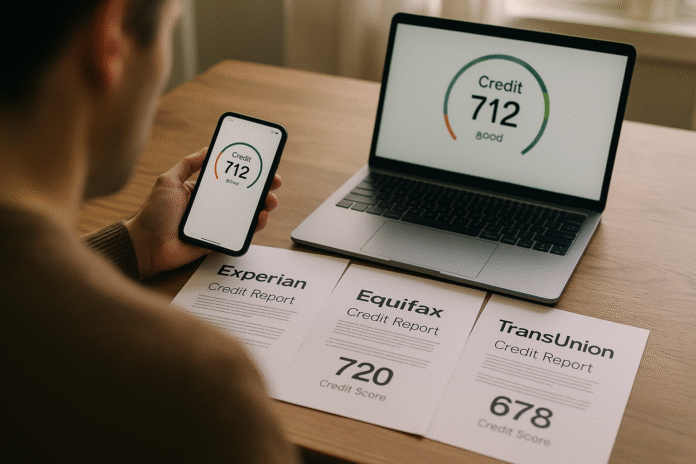
If you’ve ever checked your credit reports and wondered why the numbers don’t match, you’re not alone. The credit scores on your credit report can differ for perfectly normal reasons tied to the scoring model, which bureau’s data was used, and the timing of updates. In short: credit scores vary because different models analyze different data snapshots at different times. As of now, most broad-based scores still range from 300–850, and lenders may use versions you don’t regularly see.
This guide is educational and for general information only—not individualized financial, legal, or tax advice. Below you’ll find the 9 most common reasons the scores on your credit report don’t match—and exactly what to do about each one. Fixes include checking all three bureaus weekly (free), timing payments around statement dates, and understanding which score versions lenders actually use.
1. Different Scoring Models (FICO vs. VantageScore—and Versions)
Credit scores differ because you’re often seeing different scoring models (and versions). FICO® and VantageScore® both produce 300–850 scores, but their algorithms and version histories diverge. You might see a FICO 8 on one site, a FICO 9 from a lender, or a VantageScore 3.0 or 4.0 somewhere else. Lenders also adopt new versions at different speeds. That means the “same” credit file can produce meaningfully different numbers depending on the model and version used, which is why a score from your consumer app can be higher or lower than the one a lender pulls.
1.1 Why it matters
- Version shifts change factor weightings. For example, FICO 9 treats paid collections differently than older models; VantageScore 4.0 leverages trended data and machine learning.
- Availability varies. Some scores are sold to lenders but not to consumers, and vice versa—so you may never see the exact model your lender uses.
1.2 How to fix it
- Identify the model and version next to any score you view.
- Ask your lender which score and version they’ll use.
- Track progress consistently by comparing like-with-like (e.g., FICO 8 vs FICO 8).
Bottom line: Model and version differences alone can explain tens of points of variance across the scores you see.
2. Different Bureaus, Different Data (Experian vs. Equifax vs. TransUnion)
The three nationwide consumer reporting agencies—Equifax, Experian, and TransUnion—don’t always hold identical information on you. Some lenders report to all three bureaus; others report to only one or two, and furnishers send updates on different days. If a score is calculated from a bureau that’s missing an account—or shows a balance that another bureau has already updated—your scores will diverge. The Consumer Financial Protection Bureau (CFPB) notes that scores may differ by model, data source, loan type, and even calculation date. Consumer Financial Protection Bureau
2.1 Numbers & guardrails
- Most scores update frequently—sometimes multiple times per month—because lenders update at different times and not all furnish to every bureau.
- Free weekly credit reports are permanent, so you can check each bureau often at no cost.
2.2 How to fix it
- Pull all three reports at AnnualCreditReport.com weekly and compare line-by-line.
- Dispute errors (wrong balances, duplicate tradelines, misattributed accounts) with the bureau that shows the issue.
- Ask key creditors where they report; if an important positive account reports to only one bureau, expect cross-bureau score gaps.
Bottom line: Bureau data mismatches are a leading reason your credit scores on different reports don’t match—and they’re fixable once you see the specific discrepancies.
3. Timing Differences and Point-in-Time Snapshots
Even when the model and bureau match, timing can make scores drift. Most card issuers report around the statement closing date, not your due date, so a card paid to $0 after the cycle closes still shows last month’s higher balance until the next update. The result: one score reflects a 35% utilization, another shows 5%, and they’ll differ. Lenders and apps may also pull your report on different days, creating natural snapshot variance.
3.1 How to fix it (and when to expect changes)
- Pay-down timing: Make an extra payment 3–5 days before the statement close to lower the reported balance.
- Multiple updates per month: Expect frequent score changes since updates arrive as furnishers send them; there isn’t a universal “update day.”
- Rapid rescore for mortgages: If you’re close to approval thresholds, some lenders can rapidly refresh data after documentation.
Bottom line: Two scores can be “right” for their respective dates. Control what gets reported by timing payments around statement close when you’re preparing to apply.
4. Industry-Specific Scores vs. “Educational” Scores
Many lenders don’t use the same broad-based score you see in apps. Industry-specific FICO versions (e.g., FICO Auto Score, Bankcard Score) tweak weightings to predict risk for that product. Meanwhile, educational scores shown to consumers may use a different model or version that’s not used in that market. The CFPB found that about 1 in 5 consumers would likely see a meaningfully different score than a lender does.
4.1 Why it matters
- Auto and bankcard lenders may use industry-optimized FICO scores rather than your base FICO.
- Mortgages: Historically, lenders sold to Fannie Mae/Freddie Mac used older “Classic FICO” models; as of mid-2025, FHFA policy work continues to broaden approved models, including VantageScore 4.0, with implementation timing subject to updates. Always verify what your lender pulls.
4.2 How to fix it
- Ask which score will be used (model + version).
- Focus on universal behaviors (on-time payments, low revolving utilization), which help across most models.
Bottom line: If your “app score” doesn’t match the lender’s, it’s likely an apples-to-oranges comparison by design.
5. Inquiry Treatment and the “Rate-Shopping” Window
Hard inquiries can nudge scores down slightly, but models treat rate-shopping differently for certain loans. Recent FICO versions deduplicate similar inquiries for mortgages, autos, and student loans within a 45-day window, and ignore inquiries less than 30 days old. Older FICO versions may use a shorter 14-day window. VantageScore uses a rolling 14-day window for certain loan types. If your score was calculated on day 15 or outside the window, you may see a lower number than a score calculated during the window.
5.1 Guardrails
- Plan your applications within 14 days to be conservative across models; 45 days may apply to newer FICO versions, but lenders can use older ones.
- Soft inquiries (checking your own report, prequalifications) don’t affect scores and are visible only to you.
5.2 How to fix it
- Batch mortgage/auto/student loan applications tightly.
- Avoid card applications during rate-shopping—card inquiries don’t benefit from deduplication.
Bottom line: Inquiry windows are model- and version-dependent; timing your applications can prevent unnecessary multi-point swings.
6. Collections and Medical Debt Are Scored Differently by Version
Paid collections and medical collections are treated differently across versions—and that changes your score. For example, FICO 9 excludes paid third-party collections from scoring; newer VantageScore models (3.0/4.0) disregard paid and some medical collections more broadly. If one score version still counts a collection and another doesn’t, expect divergence. Policies continue to evolve, so check the model/version notes any time you see a big jump.
6.1 How to fix it
- Verify the debt and negotiate pay-for-delete or pay-in-full where appropriate (then confirm the update posts).
- Recheck your score after the bureau shows the debt as paid—the impact depends on the specific model/version used going forward.
6.2 Additional nuance
- Non-medical collections and charge-offs can still hurt even when paid, depending on version; medical debt treatment varies. Check what your target lender’s model counts.
Bottom line: Two scores can diverge by dozens of points simply because one model penalizes a collection that another ignores.
7. Newer Data Types and Trended Data (FICO® 10T, VantageScore® 4.0, and BNPL)
Modern models use trended data (your balance and payment patterns over time, not just a single snapshot). FICO 10T and VantageScore 4.0 both incorporate trended data, and VantageScore 4.0 uses machine learning and has features designed to score more consumers with limited histories. Depending on whether a lender uses a trended-data model, your revolving balances and payment trajectories over prior months can matter more, shifting your score relative to older models.
7.1 What’s changing
- Mortgage ecosystem: FHFA policy work continues around approved models, including VantageScore 4.0; timelines have shifted in recent years. Always confirm the current requirement with your lender.
- BNPL: News outlets report FICO’s move to incorporate Buy Now, Pay Later loans into new models rolling out in fall 2025; adoption depends on bureau reporting and lender usage.
7.2 How to fix it
- Show trends lenders like: consecutive on-time payments and declining balances month-over-month.
- Opt in to rent/utility reporting if available and relevant—some models consider it when furnished.
Bottom line: If your report’s score uses trended data (or includes new data types), it can look different from an older snapshot-based score—even with the same balances today.
8. Thin Files, Authorized User (AU) Tradelines, and File Composition
File composition changes score math. Being an authorized user on a seasoned, well-managed card can help some scores, but newer FICO versions tamp down AU influence relative to primary accounts to deter tradeline “renting.” If one score version gives more weight to an AU account and another discounts it, numbers will diverge. Thin files (few accounts, short histories) also produce wider swings because each new datapoint carries more weight.
8.1 How to fix it
- Build primary tradelines (secured card, credit-builder loan) so you’re not relying on AU status.
- Choose AU accounts carefully: On-time history, low utilization, and long age.
- Keep utilization low on your own cards; that benefit carries across models.
8.2 Mini-checklist
- At least one open primary revolving and one open installment account.
- Payment history spotless for 12+ months.
- Overall utilization under 10–30%, with no individual card spiking. myFICO
Bottom line: Two scores can disagree because one leans on your AU trade more than another—or because a thin file magnifies small differences.
9. Consumer (“Educational”) Scores vs. Lender-Purchased Scores
Finally, you and your lender may simply be looking at different products. The CFPB found that some scores sold to consumers are not used by lenders (or used infrequently), while many lender-purchased scores aren’t sold to consumers at all. That asymmetry alone explains why your app’s number doesn’t match the lender’s pull on the same day. Consumer Financial Protection Bureau
9.1 How to fix it
- Before you apply, ask: “Which score and version will you use?”
- Test your readiness by focusing on universally important behaviors (on-time payments, lower utilization, avoiding new debt), which move most models in the right direction.
Bottom line: A different product—not a mistake—is often why your score and the lender’s score don’t match. Consumer Financial Protection Bureau
FAQs
1) Why do FICO and VantageScore give me different numbers on the same day?
They’re different algorithms trained on different datasets and versions. Even with the same bureau data, each model weighs factors—like utilization, recent inquiries, and past delinquencies—differently. As of now, both typically use 300–850 ranges, but version-to-version differences (e.g., FICO 9 vs VantageScore 4.0) can easily shift your score. Focus on behavior that helps across models: on-time payments and low utilization.
2) Which credit score do mortgage lenders use?
It depends on the lender and current GSE requirements. Historically, many lenders used older “Classic FICO” models, but FHFA has been working to allow newer models (including VantageScore 4.0) with shifting timelines. As of mid-2025, FHFA policy materials note lenders may choose between Classic FICO and VantageScore 4.0 for loans sold to the Enterprises, but implementation timing continues to evolve—ask your lender what they’ll pull today.
3) How often do credit scores update?
There’s no universal update day. Scores can change multiple times a month as creditors report to the bureaus on their own schedules, then scoring systems recalculate. That’s why two scores from the same model can differ if they were calculated a few days apart.
4) Will checking my own credit score lower it?
No. Checking your own credit generates a soft inquiry, which doesn’t affect your score and is visible only to you on your reports. Hard inquiries, by contrast, may cause a small, temporary dip.
5) What’s the best credit utilization target?
Lower is better. Many lenders and educators point to keeping overall and per-card utilization under 30%, and many consumers aim for under 10% for optimization. Remember, your statement balance is what’s usually reported, so pay before the statement closes to control what’s seen.
6) Why did my score drop after I paid off a collection?
Depending on the model, paid collections may still appear and affect older versions, while FICO 9 and VantageScore 3.0/4.0 handle paid and medical collections more leniently. If your lender uses an older model, you might not see the bounce you expected. Verify the model and allow time for the bureau to update.
7) Does rate-shopping hurt my scores?
It can be minimized. Recent FICO versions deduplicate mortgage/auto/student-loan inquiries within a 45-day window (and ignore under-30-days), while VantageScore uses a 14-day rolling window. Group applications tightly and avoid unrelated new credit during this period.
8) Why are my three bureau scores not the same?
Because the underlying data can differ. A creditor might report to Equifax and TransUnion but not Experian, or report on different days. That makes the snapshots different and the scores different. Pull all three reports for comparison and dispute any errors.
9) Do rent and utilities help my score?
They can—if reported and if the model counts them. Some newer FICO/VantageScore versions can consider rental data when furnished. Programs that report rent can help thin files, but impact varies by model and bureau adoption.
10) Will Buy Now, Pay Later (BNPL) start to affect my scores?
News reports indicate FICO will incorporate BNPL into a new model starting in fall 2025, but practical impact depends on which lenders adopt the model and which BNPL firms and bureaus share data. Expect gradual effects rather than an overnight shift.
11) How can I see the most “lender-like” score?
Many banks and card issuers provide FICO Scores to customers; some apps show VantageScores. Neither guarantees a match to your lender’s version, but FICO from your card issuer may be closer for many credit products. Always ask the lender which score they’ll use before you apply. FICO
12) What’s the cheapest way to monitor for differences and errors?
Use free weekly credit reports from all three bureaus through AnnualCreditReport.com. Create a simple checklist to compare balances, limits, and derogatories across reports every month. Escalate disputes promptly if you spot inaccuracies.
Conclusion
Differences between the credit scores on your credit report are normal—and understandable once you know where they come from. The model and version can weigh the same information differently. Bureau data can be out of sync for perfectly ordinary reasons. Timing creates snapshot variance, especially around statement closes. Industry-specific scores and rate-shopping rules add more legitimate variation. Newer approaches—like trended data and evolving treatment of collections and BNPL—can widen the gap between what you see and what a lender uses.
Your path forward is practical and repeatable: pull all three reports weekly (free), align your payment timing to statement closes, keep utilization low, build primary tradelines, and ask lenders which score and version they’ll use—then plan accordingly. Do those consistently and you won’t just reconcile the numbers; you’ll improve them. Ready to start? Pull your three free reports today and pick one fix to implement this week.
References
- Credit reports and scores (basics hub) — Consumer Financial Protection Bureau (CFPB), updated July 14, 2025. Consumer Financial Protection Bureau
- Key terms: why scores differ — CFPB, accessed 2025. Consumer Financial Protection Bureau
- Understanding your credit score — CFPB, updated June 4, 2025. Consumer Financial Protection Bureau
- Consumer vs. lender scores (study & news release) — CFPB, Sept. 25, 2012. and report page. Consumer Financial Protection Bureau
- FICO Score versions & industry-specific scores — myFICO, accessed 2025.
- Why bureau scores differ — myFICO, accessed 2025. myFICO
- Free weekly credit reports (permanent) — Federal Trade Commission (FTC), Jan. 4, 2024. Consumer Advice
- Score update frequency & rapid rescoring explainer — TransUnion, 2025. TransUnion
- Rate-shopping windows (FICO & VantageScore) — myFICO blog, July 5, 2023, and VantageScore, 2023. and https://vantagescore.com/resources/knowledge-center/thinking-about-applying-for-a-loan-shop-around-to-find-the-best-offer myFICO
- Paid/medical collections treatment — myFICO (FICO 9 features) and Experian (medical debt & VantageScore). and https://www.experian.com/blogs/ask-experian/what-type-of-debt-can-go-to-collections/ myFICO
- Modern models & trended data (FICO 10T, VantageScore 4.0) — FHFA policy page (July 15, 2025) and VantageScore 4.0 overview. and https://vantagescore.com/insights/vantagescore-4/ FHFA.gov
- BNPL inclusion news (2025) — Wall Street Journal and Associated Press reports, July 2025. and https://apnews.com/article/6accd61da7b34c09407f5bdb0ac3100d The Wall Street Journal
- Soft inquiries don’t affect scores — CFPB Ask CFPB, Sept. 11, 2025. Consumer Financial Protection Bureau
- Statement closing date context — Bankrate explainer, Apr. 10, 2025; NerdWallet closing date basics. and https://www.nerdwallet.com/article/credit-cards/what-is-a-credit-card-closing-date Bankrate
- Utilization importance — myFICO (Amounts Owed ~30% of FICO) and Experian utilization basics. and https://www.experian.com/blogs/ask-experian/credit-education/score-basics/credit-utilization-rate/ myFICO
- Authorized user impact — myFICO AU explainer, accessed 2025. myFICO