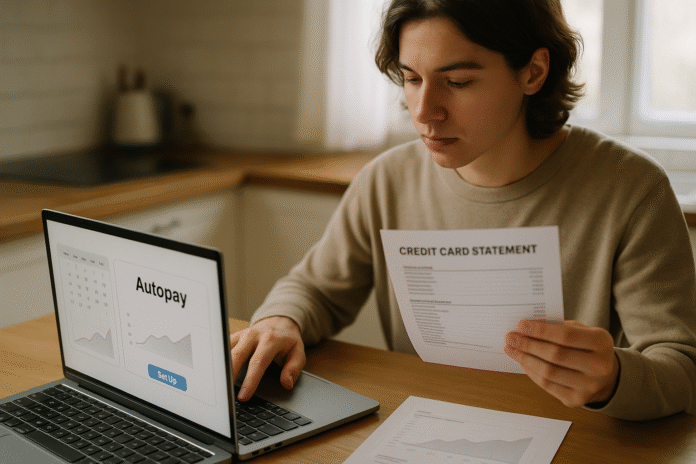
Using credit cards the right way can be the fastest, simplest path to a stronger credit profile. This guide is for anyone starting from scratch or rebuilding after setbacks. You’ll learn how on-time payments and low balances do most of the heavy lifting, plus specific habits that compound over time. In short: to build your credit score with credit cards, pay every bill on time and keep your balances low relative to your limits; those two behaviors drive the majority of modern scoring models.
Quick start steps: turn on autopay (at least the minimum), aim for <30% utilization overall and per card (under 10% is even better), pay before the statement closes, avoid unnecessary applications, and monitor your reports weekly for errors.
Friendly reminder: This article offers general education—not personalized financial advice. Card terms, reporting practices, and laws vary by issuer and country; when in doubt, confirm details with your issuer and local regulations.
1. Pay On Time—Every Time
The single most important move is to make every payment on time; in FICO models, payment history carries the heaviest weight. A payment that’s 30 days late can be reported to the credit bureaus and damage your score, and deeper delinquencies (60/90+ days) hurt more. The practical fix is to make on-time payments automatic and frictionless: enable autopay for at least the minimum due, set calendar reminders a few days ahead, and align due dates with your cash-flow. U.S. rules also require issuers to mail or deliver statements well before the due date, giving you time to pay—so if a statement arrives late, contact your issuer. When life happens, call your issuer before a due date to ask about hardship options or a one-time late-fee waiver (policies vary).
1.1 Why it matters
- Payment history = 35% of FICO. Even a single 30-day late can move scores sharply.
- Reporting timing. Late payments are generally reported when you’re 30+ days past due.
- Statement timing. Card issuers must use procedures to send statements at least 21 days before the due date (U.S.). Consumer Financial Protection Bureau
1.2 How to do it
- Turn on autopay for at least the minimum; add a separate manual payment for the rest.
- Change your due date to match payday if needed. Consumer Financial Protection Bureau
- Set two reminders: statement ready + 3 days before due.
Bottom line: Make “never late” your identity. Autopay + reminders + aligned due dates removes most risk and protects the most valuable part of your score.
2. Keep Your Credit Utilization Low
Keep your reported balance low relative to your limit—ideally under 30% on each card and across all cards; under 10% is even better for top scores. Credit utilization (amounts owed) is the second-biggest FICO factor, and scoring models look at both overall and per-card ratios. You don’t need to carry a balance (and shouldn’t—interest isn’t required for building credit). Instead, plan payments to keep reported balances modest while using the card normally. If you’re temporarily high, make an extra payment before the statement closes (more on that in Strategy 3).
2.1 Numbers & guardrails
- Targets: <30% utilization is widely recommended; <10% is optimal.
- Scope: Models consider overall and per-card utilization.
- Myth: You do not need to carry a balance to build credit. Consumer Financial Protection Bureau
2.2 Mini-checklist
- Track balances weekly (your bank app or a budgeting tool).
- If a large purchase pushes you over 30%, pay mid-cycle.
- Avoid maxing out a single card even if your overall ratio is low.
Bottom line: Low utilization signals you’re not overextended, which improves risk metrics and your score trajectory.
3. Pay Before the Statement Closes (Reporting Date Tactics)
For many issuers, the balance that appears on your statement closing date is what’s reported to the bureaus—so paying before that date can lower the number that’s reported and shrink utilization. Due dates are typically around three weeks after the statement closes, but the reporting snapshot often happens at close; not all issuers report on the same day or to all bureaus. Practical move: note each card’s statement closing date; then schedule an extra payment 2–3 days beforehand, especially during months with larger purchases.
3.1 How to do it
- Check your app for statement closing date (or call the issuer).
- Automate a mid-cycle payment if your spending is lumpy.
- If you need a very low report for an upcoming loan, make a “statement-eve” payment.
3.2 Common pitfalls
- Assuming every issuer reports at the same time (they don’t), and thinking all issuers report to all three bureaus (many don’t).
Bottom line: Manage the number that’s reported, not just what you owe—paying before the statement closes can materially improve the data that feeds your score. Experian
4. Pay in Full to Use the Grace Period (and Avoid Interest)
Most cards offer a grace period on purchases: if you pay the full statement balance by the due date, you won’t owe interest on those purchases. Paying in full also keeps utilization low without costing you extra. Watch out for deferred interest store promos; missing the payoff deadline can trigger retroactive interest on the original amount. If you do carry a balance, understand how payments above the minimum are allocated—by law, any amount over the minimum generally goes to the highest APR balances first, which helps reduce interest faster.
4.1 Numbers & guardrails
- Grace period: time between statement close and due date; interest typically waived if you pay the full statement balance on time.
- Deferred interest cautions: know the end date; pay more than the minimum to retire promo balances in time. Consumer Financial Protection Bureau
- Payment allocation: amounts over the minimum target the highest APR first (exceptions apply). Consumer Financial Protection Bureau
4.2 Mini-checklist
- Set autopay to full statement balance if cash-flow allows.
- For promos, calculate the exact monthly amount to finish early.
- Avoid cash advances (no grace period, higher APRs).
Bottom line: Paying in full exploits the grace period, keeps utilization low, and eliminates interest—three wins for building credit safely.
5. Start with the Right Card (Secured, Student, or Entry-Level)
If you’re new to credit or rebuilding, a secured credit card or student/entry-level card is often the best on-ramp. Secured cards require a refundable deposit (e.g., $200–$500) that becomes your limit; use it lightly and pay on time to graduate to an unsecured card. Issuers and bureaus generally treat secured cards like any other revolving line for scoring purposes, so consistent on-time use builds history. If you already have active collections or very thin credit, consider pairing a secured card with a credit-builder loan or a rent/utility reporting program (e.g., Experian Boost) to add positive data—understanding that not every program reports to all bureaus or affects all scores equally.
5.1 Tools/Examples
- Secured card: refundable deposit; ask about graduation timeline and whether the issuer reports to all three bureaus.
- Credit-builder add-ons: Experian Boost adds eligible bills to your Experian file only; impact varies. Experian
5.2 Mini-checklist
- Confirm fees and whether the card reports monthly to all three bureaus. Experian
- Set a small recurring bill (e.g., $15 subscription) + autopay.
- Re-evaluate after 6–12 months for graduation or a second card.
Bottom line: Choose a starter product built for building—then use it lightly and predictably to establish a pristine track record. Experian
6. Ask for a Higher Limit (or Add a Second Card) Strategically
A higher credit limit lowers your utilization—if your spending stays the same. Many issuers allow soft-pull limit increases; others require a hard inquiry, which can nick your score briefly. Ask your issuer how they handle it before you request. If your profile supports it, opening a second no-fee card can also help utilization and provide redundancy—just avoid a burst of applications. Over time, aging accounts with larger limits can stabilize utilization even during higher-spend months.
6.1 How to do it
- Request a soft-pull CLI through your app or by phone; if they require a hard pull, weigh the small, short-term score dip.
- Space new accounts months apart; one well-timed addition can reduce utilization and add payment history.
6.2 Numbers & guardrails
- Hard-inquiry effect is usually small and fades in 12 months, though it remains on reports for 24 months.
Bottom line: Bigger limits (and a second, well-chosen card) make it easier to keep utilization low—provided you hold spending steady.
7. Be Picky About New Applications (Know the Rate-Shopping Windows)
Every new card application can generate a hard inquiry, and a cluster of inquiries can weigh on your score temporarily. Unlike installment loans, credit card inquiries don’t get grouped under rate-shopping logic—so avoid shotgun applying. For auto, mortgage, or student loans, many scoring models treat multiple inquiries within a 14–45 day window as one; plan big loan shopping inside that span. Space card applications by several months, and consider pre-qualification (soft pull) first. myFICO
7.1 Numbers & guardrails
- FICO: newer models use a 45-day window for auto/mortgage/student loan rate shopping; older models use 14 days.
- VantageScore: typically a 14-day window. VantageScore
- Credit cards: no rate-shopping grouping—each inquiry stands alone. ficoforums.myfico.com
7.2 Mini-checklist
- Time loan applications within one window.
- Use pre-qual tools for cards to avoid unnecessary hard pulls.
- Avoid opening several new cards in a short timeframe.
Bottom line: Apply with intention—batch installment-loan shopping, but trickle credit card applications.
8. Leverage Authorized-User Status (Carefully)
Being added as an authorized user on a well-managed, older card can thicken your file and potentially improve your score—if the issuer reports authorized users and the primary keeps utilization low and payments flawless. Before joining, confirm the issuer reports AU data to the bureaus and that the account’s age, limit, and balance won’t hurt utilization. If you’re the primary cardholder adding someone else, you’re responsible for charges; set spending controls and alerts.
8.1 How to do it
- Verify the card reports AU data to the bureaus. Not all issuers do.
- Ensure the card’s utilization stays low (ideally <10%). Experian
- Use issuer controls (spending limits, alerts) to reduce risk.
8.2 Mini case
- Example: You’re added to a 7-year-old card with a $10,000 limit and a typical reported balance under $500 (~5%). That history and low utilization can help your profile—provided no late payments occur.
Bottom line: AU status can be a fast boost, but only with the right account and reporting—choose carefully and monitor closely. Consumer Financial Protection Bureau
9. Keep Old Accounts Open and Active
Length of credit history matters in FICO models; closing an old card can shorten average age and raise utilization by removing available credit. If a no-fee card is tempting to close, consider keeping it open with a tiny recurring charge and autopay to avoid inactivity closures. If you must simplify, close newer cards first and ensure utilization stays healthy afterward.
9.1 Why it matters
- Length of history = 15% of FICO. Older, positive accounts are valuable.
- Closing a card can increase utilization (less available credit) and potentially lower scores.
9.2 Mini-checklist
- Keep one small subscription on older no-fee cards.
- If a fee card no longer fits, product-change to a no-fee version instead of closing (when available).
- Review utilization after any closure to confirm it stays <30%.
Bottom line: Age is an asset—protect it by keeping good, low-maintenance accounts open.
10. Monitor Your Reports Weekly and Dispute Errors
Errors happen. Because the three bureaus don’t always receive the same data, you should check all three reports regularly and dispute inaccuracies. The good news: in the U.S., weekly credit reports from each bureau via AnnualCreditReport.com are permanently free. Dispute inaccurate information directly with the bureau(s) and the furnisher; furnishers must investigate. Use disputes to correct late payments reported in error, wrong balances, or accounts that aren’t yours.
10.1 How to do it
- Pull all three reports at AnnualCreditReport.com (the official site). Annual Credit Report
- Dispute errors online or by mail; furnishers have obligations under the FCRA to investigate. Consumer Financial Protection Bureau
- Keep records; follow up if corrections don’t post.
10.2 Mini-checklist
- Set a monthly reminder to check at least one bureau’s report.
- After big changes (payoff, new account), check again within 30–60 days.
- If you see signs of identity theft, place a fraud alert or freeze (see Strategy 12).
Bottom line: You can’t manage what you don’t measure—use your free weekly access and fix errors quickly to protect your progress.
11. Recover Fast from Slip-Ups (and Minimize Damage)
If you miss a payment, act immediately. Pay as soon as possible to reduce the severity (30, 60, 90+ day buckets). Call your issuer to ask about waiving a first-time late fee or removing a penalty APR; practices vary, and legal caps on late fees have changed over time. As of now, a federal court struck down the CFPB’s 2024 $8 late-fee cap, so late-fee amounts now vary by issuer again—another reason to avoid them entirely. If you’re carrying balances at different APRs, remember that extra dollars above the minimum target the highest APR first, helping you unwind faster.
11.1 Steps to take
- Bring the account current quickly (before 30 days if you can).
- Call your issuer: ask about hardship programs, payment plans, or a courtesy waiver.
- Autopay: switch on at least the minimum to prevent repeats. Consumer Financial Protection Bureau
11.2 Mini-checklist
- Verify the next due date and statement cycle.
- Check your report after 30–45 days to confirm correct reporting.
- If financial strain continues, consider nonprofit credit counseling.
Bottom line: Move fast, communicate, and automate—quick action can prevent one mistake from becoming a lasting score drag.
12. Protect Your Credit While You Build (Fraud Alerts & Freezes)
Security is part of credit building. If you suspect fraud, place a fraud alert (free) by contacting any one bureau; that bureau must notify the others. For stronger protection, place a credit freeze with each bureau—freezes block new creditors from accessing your file until you thaw it. Online or phone requests are typically processed within one hour; mail requests take up to three business days. Keep your IdentityTheft.gov recovery plan handy if your data is exposed.
12.1 How to do it
- Fraud alert: contact any one of Equifax, Experian, or TransUnion; they’ll relay to the others.
- Freeze: place or lift with each bureau online/phone/mail (free).
- Recover: build a personalized plan at IdentityTheft.gov.
12.2 Mini-checklist
- Use strong passwords and 2FA on banking/credit apps.
- Shred documents with personal data.
- Monitor your reports weekly (Strategy 10).
Bottom line: Defense prevents score-sapping fraud—use alerts, freezes, and monitoring to keep your progress safe.
FAQs
1) What are the biggest factors in my credit score?
In FICO models, five categories matter: payment history (35%), amounts owed/credit utilization (30%), length of credit history (15%), new credit (10%), and credit mix (10%). That’s why on-time payments and low utilization do most of the work. VantageScore weighs similar themes, though exact weights may differ.
2) Do I need to carry a balance to build credit?
No—carrying a balance costs interest and isn’t required for scoring. Paying your full statement balance by the due date preserves the grace period (on most cards) and avoids interest while still reporting positive activity and low utilization.
3) What utilization ratio should I target?
As a rule of thumb, keep overall and per-card utilization under 30%; if you’re aiming for top-tier scores, under 10% is even better. You can achieve this by paying mid-cycle—before the statement closing date—so the reported balance is low.
4) When is a late payment reported to the bureaus?
Issuers typically report a payment as late when it’s 30 days past due (not the day after the due date). The impact escalates at 60/90+ days. Avoiding a reportable late is critical; set autopay for at least the minimum and call your issuer immediately if you’ll be late. Consumer Financial Protection Bureau
5) How many cards should I have to build credit?
There’s no magic number. Many people build well with 1–2 low-fee cards used lightly and paid in full. A second card can help lower utilization and provide redundancy, but avoid opening several at once; every card application adds a hard inquiry and may lower the average age of accounts. myFICO
6) Will a credit limit increase hurt my score?
It depends on whether the issuer uses a soft or hard inquiry. Soft-pull increases don’t affect scores; hard-pull increases may cause a small, temporary dip. Ask your issuer which they use before requesting. The long-term utilization benefit often outweighs a small, short-term inquiry impact. Consumer Financial Protection Bureau
7) Can being an authorized user help me build credit?
Yes—if the issuer reports authorized-user data and the primary cardholder keeps low utilization and perfect payment history. Not all issuers report AU data, so confirm first. It’s a powerful tactic if done responsibly. Consumer Financial Protection Bureau
8) How often should I check my credit reports?
In the U.S., you can access free weekly reports from each bureau via AnnualCreditReport.com permanently. Weekly checks help you spot errors or fraud quickly and verify that positive changes (payoffs, disputes) are reflected.
9) What’s the “rate-shopping window,” and does it apply to credit cards?
For mortgage/auto/student loans, newer FICO models group multiple inquiries within 45 days as one; some older models use 14 days. VantageScore generally uses 14 days. Credit cards don’t get grouped—each inquiry counts separately—so apply selectively.
10) Is it bad to close a credit card I don’t use?
Closing can reduce available credit (raising utilization) and shorten your average age of accounts. Consider product-changing to a no-fee version and keeping a tiny recurring charge with autopay instead. If you must close cards, prioritize newer ones to protect age. Consumer Financial Protection Bureau
11) Do all lenders report to all three bureaus?
No. Reporting is voluntary, and some lenders report to only one or two bureaus or on different schedules. That’s why your three reports can differ and why you should monitor all of them. Consumer Financial Protection Bureau
12) What should I do if I suspect identity theft?
Create a recovery plan at IdentityTheft.gov, place a fraud alert (one bureau notifies the others), and consider a credit freeze with each bureau. Freezes can be placed or lifted quickly online/phone, often within one hour. Keep monitoring your reports while you resolve issues. IdentityTheft.govConsumer Advice
Conclusion
Building your credit score with credit cards is less about tricks and more about repeatable systems. Automate on-time payments, keep utilization low, and pay before the statement closes to control what’s reported. Add thoughtfully chosen products (secured or entry-level cards, or a strategic second card) to stabilize utilization, and avoid bursts of new applications—especially for credit cards, which don’t benefit from rate-shopping rules. Monitor your reports weekly so you can fix errors fast and protect your identity with alerts or freezes if needed. These habits compound: within a few months, you’ll usually see steady improvement; within a year or two, you can reach tiers that meaningfully improve loan approvals and interest costs. Start today: turn on autopay, make a mid-cycle payment, and pull your free weekly reports—your future self will thank you. CTA: Set autopay and schedule a “statement-eve” payment on your main card right now.
References
- What’s in my FICO® Scores?, myFICO, accessed Jul 2025. https://www.myfico.com/credit-education/whats-in-your-credit-score
- Is 30% a Good Credit Utilization Ratio?, Experian, Nov 5, 2023. https://www.experian.com/blogs/ask-experian/credit-education/score-basics/credit-utilization-rate/
- How do I get and keep a good credit score?, Consumer Financial Protection Bureau, Dec 18, 2024. https://www.consumerfinance.gov/ask-cfpb/how-do-i-get-and-keep-a-good-credit-score-en-318/
- What is a grace period for a credit card?, Consumer Financial Protection Bureau, Sep 25, 2024. https://www.consumerfinance.gov/ask-cfpb/what-is-a-grace-period-for-a-credit-card-en-47/
- When do credit card companies report to the credit bureaus?, Experian, Jul 16, 2018. https://www.experian.com/blogs/ask-experian/when-do-credit-card-companies-report-to-credit-bureaus/
- When Will a Late Payment Appear on My Credit Reports?, Experian, Feb 28, 2024. https://www.experian.com/blogs/ask-experian/when-will-a-late-payment-appear-on-my-credit-reports/
- You now have permanent access to free weekly credit reports, Federal Trade Commission, Jan 4, 2024. https://consumer.ftc.gov/consumer-alerts/2023/10/you-now-have-permanent-access-free-weekly-credit-reports
- 12 CFR §1026.53 – Allocation of payments, Consumer Financial Protection Bureau (Regulation Z), accessed Sep 2025. https://www.consumerfinance.gov/rules-policy/regulations/1026/53
- What exactly happens when a mortgage lender checks my credit?, Consumer Financial Protection Bureau, Aug 30, 2023. https://www.consumerfinance.gov/ask-cfpb/what-exactly-happens-when-a-mortgage-lender-checks-my-credit-en-2005/
- Rate Shopping Window (14 vs 45 days), myFICO, accessed Sep 2025. https://www.myfico.com/credit-education/credit-reports/does-checking-credit-score-lower-it
- Fraud alert vs. Credit Freeze guidance, Federal Trade Commission & USA.gov, various dates. https://consumer.ftc.gov/articles/credit-freeze-or-fraud-alert-whats-right-your-credit-report and https://www.usa.gov/credit-freeze
- Judge scraps US rule capping credit card late fees at $8, Reuters, Apr 15, 2025. https://www.reuters.com/business/finance/judge-scraps-us-rule-capping-credit-card-late-fees-8-2025-04-15/
- Becoming an Authorized User: does it help your credit?, Consumer Financial Protection Bureau & Experian, various dates. https://www.consumerfinance.gov/consumer-tools/credit-reports-and-scores/ and https://www.experian.com/blogs/ask-experian/can-being-added-as-an-authorized-user-help-credit/