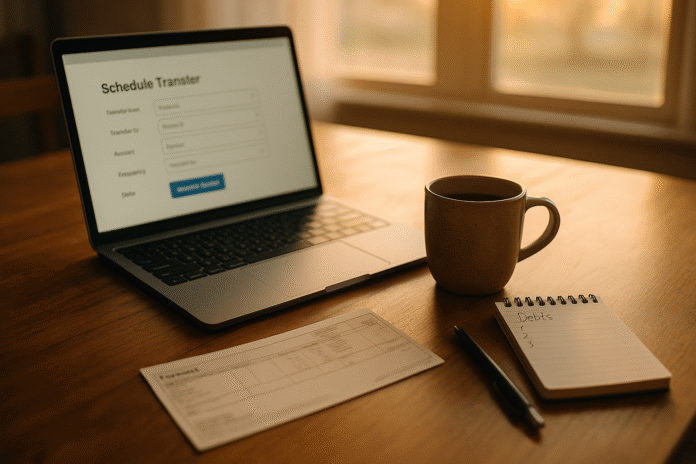
Automating debt payments means setting up recurring transfers or bill pay so money leaves your account for debt before you have a chance to spend it. Done right, this “pay yourself first” system shrinks balances on autopilot, lowers interest, and reduces missed-payment risk. Below you’ll learn a practical, step-by-step framework to map your debts, pick a payoff strategy, align transfers with payday, and guard against overdrafts or errors. Quick disclaimer: this article is educational, not individualized financial, legal, or tax advice—double-check details with your bank, lender, and local regulations.
Fast how-to (for skimmers): (1) Pick a payoff method (snowball or avalanche). (2) List all debts with APRs/due dates. (3) Route income to a “Bills” account first. (4) Set autopay: minimums + one fixed extra to your target debt. (5) Keep a one-month buffer to avoid overdrafts. (6) Time payments to minimize interest. (7) Add rules for variable income. (8) Monitor and audit monthly. (9) Handle promos/BNPL carefully. (10) Reallocate freed-up cash as you hit milestones.
1. Choose Your Payoff Method and Lock in a Monthly Number
The fastest way to start automating debt payments is to decide what you’ll pay, in what order, and how much every month. Pick a strategy—avalanche (highest APR first) to minimize interest, or snowball (smallest balance first) for quick wins. Then lock in one fixed “extra” amount you’ll send beyond minimums to the current target debt. The decision matters because your automations will mirror it: money will flow to minimums on every account, and the “extra” will sweep to just one balance until it’s gone, then roll to the next. If you’re unsure, avalanche usually saves more interest; snowball can be more motivating—motivation drives consistency. As of now, revolving credit rates remain high and card delinquencies elevated, so a systematic plan is your defense against expensive interest and late fees. Federal Reserve
1.1 How to do it
- Avalanche: order debts by APR high→low; send extra to the top.
- Snowball: order by smallest balance→largest; send extra to the smallest.
- Hybrid: start with 1–2 quick snowball wins, then switch to avalanche.
- Pick a fixed “extra” (e.g., $200/month) to automate toward the target.
- Add a trigger: when one debt is paid, the extra automatically rolls to the next.
1.2 Numbers & guardrails
- If your average APR is ~22% and you add $200/month to a $3,000 card at 22% APR, you can shave 10+ months off payoff vs. minimums-only (illustrative).
- Missed payments hurt credit because payment history is the largest FICO factor (35%), so stability beats aggressive but brittle plans.
Bottom line: pick a method you’ll stick with and set a fixed extra—it becomes the engine your automations run on.
2. Inventory Every Debt, Due Date, and Rule
Automation is only as good as the map it follows. Create a one-page debt roster listing for each account: lender, account number (masked), balance, APR, minimum payment, statement cut date, due date, autopay options, promo terms (e.g., 0% intro), and whether there are autopay discounts. Capture any quirks, like deferred interest rules or variable APRs. Add contact info and portal links so you can fix issues quickly. This inventory prevents surprises, ensures minimums are covered, and helps you time extra payments to reduce interest. It also surfaces risks like expiring promos or balance transfer fees.
Mini-checklist
- Card/loan APR and whether it’s variable.
- Statement cut date vs. due date (used later for timing).
- Promo details: 0% length, balance transfer fee %, loss of promo if late. (Promos must last at least 6 months; 3–5% transfer fees are common.) Consumer Financial Protection Bureau
- Autopay discounts (e.g., many student loans offer 0.25% off for Auto Pay).
- Grace period rules: pay the statement balance by due date to avoid purchase interest when eligible.
Example table fields (for your spreadsheet)
Lender | Balance | APR | Minimum | Due date | Cut date | Promo ends | Autopay set? | Notes
Bottom line: a clean roster lets you automate confidently and spot timing tricks that save interest.
3. Design Your “Pay Yourself First” Flow With Two Accounts
To “pay yourself first,” route income to a Bills checking account where all autopays run, and keep a separate Spend account for daily transactions. If your employer supports split direct deposit, send a set amount or percentage to Bills and the remainder to Spend. This creates a firewall: debts and essentials get paid automatically from Bills while day-to-day swipes in Spend can’t endanger payments. Many employers do allow split deposits (or multiple accounts) and direct deposit generally arrives faster and with fewer fees than paper checks. Check your HR portal; details vary by employer and state.
How to build it
- Bills account: receives pay, holds one month of minimums + fixed extra.
- Spend account: receives your allowance for groceries, fuel, etc.
- Split direct deposit (if offered) so Bills is funded first.
- Bill calendar: list each autopay date in the Bills account.
- Alerts: set low-balance and payment alerts on both accounts.
Mini case
- Net pay $3,200 biweekly. Route $1,900 → Bills (covers minimums + $400 extra), $1,300 → Spend. Bills autopays run on the 2nd and 16th; Spend covers everyday purchases.
Bottom line: separating bills from spending keeps automated debt payments safe from lifestyle creep and card swipes.
4. Set Up Autopay and Scheduled Transfers the Smart Way
Now implement the flows. For each debt, enable autopay at least for the minimum plus set a separate recurring transfer for your fixed “extra” to the current target debt. Schedule both to run right after each payday to reduce “cash drag” and avoid accidental spending. Use lender portals for autopay (to ensure on-time crediting) and bank bill pay or scheduled ACH transfers for your extra. Know your rights: you can revoke or stop an automatic debit; under Reg E, banks must honor a stop-payment order given at least three business days before the debit, and institutions must follow error-resolution timelines. Network rules (Nacha) and CFPB guidance also discuss 60-day windows related to unauthorized EFTs—watch those clocks.
Setup checklist
- Turn on autopay: minimum for every balance.
- Schedule extra transfer to target debt each payday.
- Align dates with statement cuts if optimizing interest (see Step 6).
- Save copies/screenshots of your authorization details.
- Know how to revoke/cancel autopay and where to file complaints.
Why it matters
Automations remove willpower from the equation and protect credit because on-time payment history weighs most in FICO. If a debit goes wrong, timely stop-payment and dispute steps help limit losses.
Bottom line: automate minimums and the fixed extra, time them to payday, and understand your cancellation and dispute rights.
5. Build a 30-Day Buffer to Avoid Overdraft Surprises
Autopay is powerful, but it can overdraw an account if income or timing slips. A simple safeguard is to keep a one-month buffer in your Bills account equal to all minimums plus your fixed extra. Overdrafts can still trigger fees or overdraft credit—even with various reforms. In late 2024, the CFPB finalized rules affecting overdraft lending at very large institutions; typical legacy fees around $35 have faced scrutiny, and practices are changing. The safest move is to avoid overdraft altogether by holding a buffer, using low-balance alerts, and spacing payments a couple of days after payday.
Guardrails
- Target buffer: 1× monthly minimums + fixed extra (e.g., if minimums total $620 and your extra is $400, hold $1,020).
- Alerts: enable low-balance and upcoming-payment notifications.
- Order of ops: fund the buffer before increasing your extra payment.
- Fallback: if cash is tight, keep autopay at minimums only for a cycle.
Region notes
Fee rules differ outside the U.S.; if you’re not in an ACH/Reg E environment, check your local payment system and consumer-protection timelines.
Bottom line: a month-buffer turns autopay from risky to robust—small cushion, big peace of mind.
6. Time Payments to Cut Interest (and Keep Grace Periods)
Interest on most credit cards uses average daily balance math. That means mid-cycle or early payments can reduce the days your balance accrues interest, lowering finance charges. If you pay the statement balance in full by the due date, you typically avoid purchase interest thanks to the grace period; once you carry a balance, new purchases often accrue interest immediately. Strategy: keep autopay for the statement balance (or at least the minimum), and add an extra mid-cycle payment to lower the average balance.
How to do it
- Note your statement cut date; schedule a small payment right after it to keep the new cycle’s balance low.
- If you carry a balance, consider no new purchases on that card to prevent immediate interest on new charges.
- For installment loans, earlier-in-cycle payments reduce outstanding principal slightly sooner—small but cumulative.
Numeric example
- Card APR 24% (~0.0658% daily), statement cut on the 5th, due on the 30th.
- You autopay the statement balance on the 30th and drop an extra $300 on the 7th; those dollars reduce the balance for ~23 days, trimming interest this cycle.
Bottom line: timing matters—pair autopay with one mid-cycle push to shrink average daily balance and interest.
7. Make It Work on Variable Income (Gig/Commission/Freelance)
Irregular paychecks shouldn’t block automation. Use percent-based rules and thresholds instead of fixed dollars. First, calculate your true baseline: what’s the lowest income month in the last year? Set autopay to minimums only plus a small fixed extra you can always cover. Then add a sweep rule: when the Bills account balance exceeds your buffer by a set amount (say, $500), trigger a one-off extra payment to the current target debt. Finally, revisit your averages quarterly; if net income trends up, increase your fixed extra.
Tools & tactics
- Split deposits (when employer allows), or manually move a fixed % of each inflow to Bills. Consumer Financial Protection Bureau
- Rules-based sweeps: many banks let you auto-transfer when balances exceed a threshold.
- Calendar batching: run all debt autopays 2–3 days after your typical paydays.
Mini-checklist
- Minimums on autopay always.
- Extra “percentage of inflow” or balance-threshold sweep.
- Quarterly tune-up: raise extra if 3-month average supports it.
Bottom line: let fixed minimums protect your credit, and use percentage-based extras and sweeps to accelerate payoff when income hits.
8. Monitor, Audit, and Fix Errors Fast
Automation is not “set and forget.” Review your Bills account monthly to confirm every autopay landed and every extra went to the right debt. If a company pulls the wrong amount or after cancellation, act quickly: you can revoke authorization with the company and give your bank a stop-payment order at least three business days before the next scheduled debit. For unauthorized EFTs, Reg E outlines timelines for error resolution, and Nacha and CFPB materials discuss 60-day windows (note the nuances between Reg E’s 60 days after your statement vs. certain network-rule clocks). Document everything with screenshots and confirmations.
Audit routine
- Monthly: reconcile each autopay and transfer to your roster.
- Quarterly: re-rank debts (avalanche/snowball) and check for promo expiries.
- Annually: review bank and card fee schedules; changes are common.
If something goes wrong
- File a dispute/complaint if needed; CFPB lists consumer complaint channels. Consumer Financial Protection Bureau
- Follow bank instructions for unauthorized transactions and keep written records.
Bottom line: trust your automations, but verify; quick action keeps small mistakes from becoming costly.
9. Handle Promos, Balance Transfers, and BNPL Without Traps
Promos can help—but only with clear rules. Balance transfers often carry 3–5% fees and promos must last at least 6 months; one late payment can end the deal. If you carry any balance, new purchases typically accrue interest immediately, so consider using a separate card for spending. For deferred-interest plans or BNPL, set calendar reminders well before the promo ends, and ensure autopay covers the full required amount. The CFPB has been increasing attention on BNPL disclosures and supervision, so expect evolving practices; always read the updated terms.
Practical playbook
- Keep the promo card purchase-free until the transfer is gone.
- Autopay at least the promo-required amount plus a cushion.
- Track promo end dates and the revert APR.
- If using BNPL, verify where autopay pulls from and the reschedule process.
Mini example
- Transfer $5,000 with a 4% fee ($200) to a 0% card for 18 months. Autopay $300/month—project payoff in ~18 months if no extra charges; one late payment could forfeit 0% and trigger a high revert APR.
Bottom line: promos can accelerate payoff if your automations are airtight; if not, fees and interest can backfire.
10. Celebrate Milestones and Re-Route Money Automatically
When a debt is paid off, do not let the extra vanish into spending. Immediately redirect the freed-up payment to the next target (your automation should already be set to roll over). Once all high-APR debt is gone, reallocate that cash flow to your emergency fund and investing. Expect credit score tailwinds from consistent on-time payments: payment history is ~35% of FICO, and amounts owed/credit utilization is ~30%. Lower balances and punctual payments typically help over time. For federal student loans, many servicers offer a 0.25% autopay discount, and IDR plans normally require annual recertification—though as of 2025, policy details have been fluid; always check StudentAid.gov for current status.
Milestone checklist
- Confirm $0 balance and account closure (if closing) or keep card open for utilization.
- Update your roster and roll the extra to the next target automatically.
- Reassess emergency fund and investment automations.
- For student loans, verify autopay discount still applied and whether recertification is due.
Bottom line: momentum compounds—lock in each win by rolling payments forward and upgrading your broader financial automations.
FAQs
1) Is bank bill pay better than lender autopay?
Use lender autopay for the minimum to ensure on-time crediting and qualify for any autopay discounts (e.g., many student loans offer 0.25%). Then use bank transfers for your extra to keep control and flexibility. This hybrid reduces late-posting risk while preserving your avalanche/snowball flow.
2) How big should my buffer be to avoid overdrafts?
Aim for one month of minimums plus your fixed extra in the Bills account. Overdraft rules and fees are changing for large institutions, but the surest way to avoid fees is to not trigger overdraft at all—alerts plus a buffer work best.
3) What happens if an autopay pulls the wrong amount?
Contact the company to revoke authorization if needed and tell your bank to place a stop-payment (give at least three business days before the next debit). For unauthorized transfers, Reg E outlines error-resolution timelines; act quickly and document everything.
4) I carry a balance—do new purchases get interest right away?
Often yes. If you carry a balance month-to-month, new purchases typically accrue interest from the transaction date, even if a different part of your balance is on promo. Consider using a separate “everyday” card you pay in full monthly. Consumer Financial Protection Bureau
5) Do mid-cycle payments actually reduce interest?
With average daily balance math, earlier payments lower the number of days a higher balance accrues interest, reducing finance charges. Pair a mid-cycle payment with autopay of the statement balance for best effect. Investopedia
6) Should I choose snowball or avalanche?
Avalanche minimizes total interest (highest APR first). Snowball maximizes momentum (smallest balance first). The “best” is whichever keeps you consistent; you can start snowball for motivation, then pivot to avalanche once habits solidify.
7) How do I automate on irregular income?
Automate minimums and set your extra as a percentage of each inflow or via a threshold sweep when the Bills account balance exceeds your buffer. Review quarterly and adjust your fixed extra upward as averages rise.
8) Are balance transfers worth it?
They can be—if you factor the 3–5% transfer fee, avoid new purchases on that card, and set autopay to clear the balance before the promo ends. One late payment can end the promo early. Investopedia
9) What about BNPL autopay plans?
Set reminders for due dates, confirm the funding source, and understand reschedule/cancellation rules. The CFPB has been stepping up scrutiny; terms and disclosures are evolving—read the latest updates.
10) Will automating debt payments help my credit score?
Consistent on-time payments support the payment history portion of FICO (~35%), and paying down balances helps amounts owed/credit utilization (~30%). Over months and years, this discipline can contribute to healthier scores.
Conclusion
When you automate debt payments, you replace fragile willpower with a durable system: income lands, minimums get paid, extra cash attacks the highest-priority balance, and your day-to-day spending never jeopardizes progress. The two-account Bills/Spend setup protects payments from lifestyle creep, while a one-month buffer keeps overdrafts at bay. By timing payments around statement cuts and aligning them to payday, you squeeze interest and prevent expensive slips. Layer in quarterly reviews and milestone rollovers and your plan becomes self-reinforcing—each paid-off balance funds the next victory. Start small: list debts, choose avalanche or snowball, and automate the first transfer today. CTA: Set one autopay and one extra transfer now—future you will thank you.
References
- How Are FICO® Scores Calculated? — myFICO, n.d. https://www.myfico.com/credit-education/whats-in-your-credit-score
- What Is Payment History? — myFICO, n.d. https://www.myfico.com/credit-education/credit-scores/payment-history
- How do I stop automatic payments from my bank account? — CFPB, Aug 30, 2023. https://www.consumerfinance.gov/ask-cfpb/how-do-i-stop-automatic-payments-from-my-bank-account-en-2023/
- 12 CFR §1005.10 — Preauthorized transfers — CFPB (Regulation E), n.d. https://www.consumerfinance.gov/rules-policy/regulations/1005/10
- Electronic Fund Transfers FAQs — CFPB, n.d. https://www.consumerfinance.gov/compliance/compliance-resources/deposit-accounts-resources/electronic-fund-transfers/electronic-fund-transfers-faqs/
- Which 60 Days Is It? Understanding the Different Periods in Regulation E and Nacha Rules — Nacha, Aug 17, 2021. https://www.nacha.org/news/which-60-days-it-understanding-different-periods-regulation-e-and-nacha-rules
- Check Auto Pay for Monthly Student Loan Payment — StudentAid.gov, n.d. https://studentaid.gov/help-center/answers/article/check-autopay-monthly-student-loan-payment
- Do I Need to Recertify My Income-Driven Repayment (IDR) Plan Every Year? — StudentAid.gov, n.d. https://studentaid.gov/help-center/answers/article/recertify-my-idr-plan-every-year
- How Does Credit Card Interest Work? — U.S. Bank, July 23, 2025. https://www.usbank.com/credit-cards/credit-card-insider/credit-card-basics/how-does-credit-card-interest-work.html
- If I pay off my credit card balance when it is due, is the company allowed to charge me interest for that month? — CFPB, Jan 22, 2025. https://www.consumerfinance.gov/ask-cfpb/if-i-pay-off-my-credit-card-balance-when-it-is-due-is-the-company-allowed-to-charge-me-interest-for-that-month-en-48/
- Household Debt Growth Remains Steady; Q2 2025 Report — Federal Reserve Bank of New York, Aug 5, 2025. https://www.newyorkfed.org/newsevents/news/research/2025/20250805
- Very Large Financial Institutions (Final Rulemaking) — Overdraft — CFPB, Dec 2024. https://files.consumerfinance.gov/f/documents/cfpb_overdraft-final-rule_2024-12.pdf
- What is a balance transfer fee? — CFPB, Sep 25, 2024. https://www.consumerfinance.gov/ask-cfpb/what-is-a-balance-transfer-fee-can-a-balance-transfer-fee-be-charged-on-a-zero-percent-interest-rate-offer-en-53/
- You Could Still End Up Paying Interest on a Zero Percent Offer — CFPB, Sep 3, 2014. https://www.consumerfinance.gov/about-us/blog/you-could-still-end-up-paying-interest-on-a-zero-percent-interest-credit-card-offer/
- What BNPL Lenders Are Doing to Be Upfront with Borrowers — CFPB, Aug 16, 2024. https://www.consumerfinance.gov/about-us/blog/what-buy-now-pay-later-lenders-are-doing-to-be-upfront-with-borrowers/