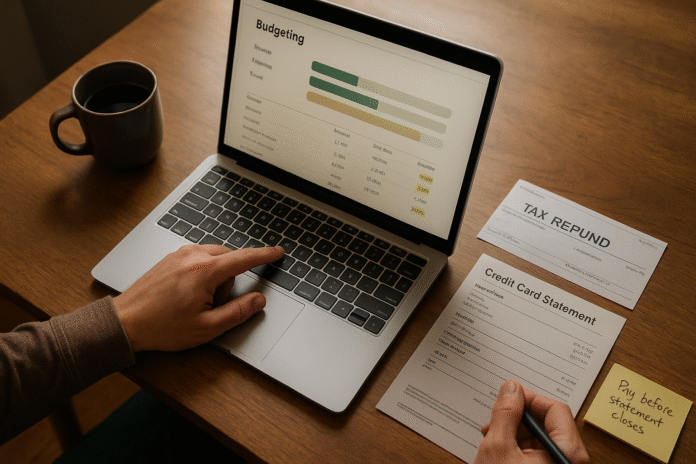
You’ve got a bonus or tax refund landing—great. Now make it count. This guide shows how to use bulk payment strategies to aim one-time cash at your highest-interest balances, cut months off payoff timelines, and lower the total interest you’ll ever pay. It’s written for anyone juggling revolving debts (like credit cards) and installment loans (like auto, student, or mortgage). Quick answer: bulk payment strategies are methods for applying lump sums—such as bonuses and tax refunds—at the right accounts and the right moments in the billing cycle to maximize interest saved and reduce risk. We’ll walk through practical timing moves, guardrails, and math you can copy-paste into your plan. This is educational information, not individualized financial advice; consider your situation and local regulations.
1. Aim the Lump Sum at the Highest APR First (the “Debt Avalanche”)
The single most effective move is to send your lump sum to the balance with the highest interest rate first while making minimums on everything else. That’s the “debt avalanche,” and it typically saves the most interest over time compared with other approaches. Because credit card interest usually accrues daily on the average daily balance, reducing a high-APR balance sooner produces outsized savings relative to lower-rate debts. If your cards have multiple balance categories (purchases, cash advances, promos), the law generally requires dollars above the minimum to go to the highest-APR bucket first—another reason to target your most expensive debt. This method works across credit cards, personal loans, and variable-rate lines, but it shines where APRs exceed ~20% as of now.
1.1 Why it works
- Compound cost: Daily accrual means each day you carry a high-APR balance, interest snowballs. Shrink it early to slow the snowball.
- Payment allocation: Amounts paid over the minimum must generally be applied to the highest-APR portion first on multi-APR cards.
- Current backdrop: Average credit card APRs have hovered around ~21% in 2025—so high-APR targeting delivers meaningful savings.
1.2 How to do it (mini-checklist)
- List every debt with APR, balance, and type.
- Pick the highest APR (often a credit card) as the primary target.
- Pay minimums on all others; send the entire lump sum to the target.
- Keep doing this until that balance hits zero, then roll the freed-up cash to the next highest APR.
- Re-run the list if rates change (variable-rate lines can move).
1.3 Numeric example
You have Card A at 24% APR with a $3,000 balance and Card B at 12% APR with $3,000. A $1,500 lump sum to Card A lowers daily accrual by roughly $0.99/day (24%/365 × $1,500), or about $30/month—triple the ~$15/month saved if you’d sent it to Card B—accelerating the payoff curve.
Bottom line: When in doubt, avalanche wins on math; save “snowball” psychology (smallest balance first) for motivation, not maximum dollar savings.
2. Pay Before the Statement Closes to Slash Average Daily Balance
If the money is already in your account, pay immediately—earlier beats later. When timing is an option (e.g., you’re coordinating with a payday or refund date), paying before the statement closing date reduces the balance used to compute interest for that entire cycle, cutting costs even if you can’t pay in full. For cards where you don’t enjoy a grace period (because you carried a balance), earlier payments trim more days of accrual. If you do regain a grace period by paying the full statement balance on time, the next cycle’s new purchases may avoid interest—another reason to align funds to the statement cycle. Understanding your card’s grace period and average daily balance math transforms timing into tangible savings.
2.1 Numbers & guardrails
- Average daily balance: Issuers total each day’s balance in the cycle and divide by days; lower balances earlier shrink that average.
- Grace period: Many cards offer it, but only if you pay in full; carrying a balance often cancels the grace on new purchases.
- Allocation: Any dollars above the minimum must be applied first to the highest-APR balance category.
2.2 Practical steps
- Find your statement closing date in the app; set a reminder 3–5 days before.
- If your refund hits on the 10th but your statement closes the 15th, pay on the 10th, not the due date a month later.
- If cash is tight mid-cycle, send a split payment—half now, half before close—to cut more days of interest.
- Avoid purchases on a card you’re trying to pay off; mixing new charges complicates payoff and may forfeit any grace.
Bottom line: With daily accrual, “the earlier, the better” is a rule that never goes out of season.
3. Split Big Sums Across the Cycle—But Only If It Beats “Pay Now”
If your bonus or refund isn’t in your account yet, plan the flow so each dollar spends maximum days lowering principal. The gold standard is still: pay as soon as funds clear. But if your cash arrives in chunks (e.g., bonus now, profit-share next week), split payments—one immediately and one just before the statement closes—to minimize the average daily balance across more days. For cards where you’re rebuilding the grace period, a single full payment of the statement balance by the due date can be optimal; once grace returns, new purchases may avoid interest. The nuance is matching your deposit cadence to your billing cadence so cash doesn’t sit idle while interest compounds.
3.1 When splitting helps
- You don’t have the full lump sum yet; partials now + later > one later payment.
- You’re juggling multiple cards and can front-load the highest APR today, then revisit others pre-close.
- You want to lower utilization before the statement reports (often to bureaus), which can help your score optics.
3.2 Mini playbook
- Deposit timing: As cash lands, immediately pay the highest APR card.
- Pre-close top-up: Schedule a second payment 1–2 days before the statement closes.
- Due-date sweep: If rebuilding grace, ensure the full statement balance is paid by the due date.
- Auto-pay safety: Keep minimums on auto-pay to avoid late fees while you orchestrate extra payments.
3.3 Quick example
You expect $2,400 over two Fridays. Your statement closes the 25th. Pay $1,200 on the first Friday (the 12th), then $1,200 on the 24th. Compared with paying the full $2,400 on the 26th, you shaved two weeks of interest on half the money and a day on the rest—small moves, real dollars.
Bottom line: If you can pay now, do it. If money arrives in parts, split-and-time beats lump-and-late.
4. Keep (or Build) a Right-Sized Emergency Fund Before You Go All-In
Before you fire every dollar at debt, set aside a starter emergency fund so an unexpected bill doesn’t push you right back onto a card. There’s no one-size number: some households start with $500–$1,500, others prefer one month of essential expenses before accelerating debts. Even a small buffer reduces the odds of re-borrowing at 20%+ APR. Park it in a high-yield savings account you won’t touch for normal spending. Once the buffer is in place, resume avalanche targeting. Research consistently shows many households are financially fragile without accessible savings, and small cushions can meaningfully improve stability.
4.1 How to size it
- Volatile income (commissions, freelancing): Aim for a larger buffer (e.g., one month of must-pay bills).
- Stable income + high APR debt: Start smaller (e.g., $1,000), then redirect future windfalls to debt until APRs fall.
- Multiple dependents or single income: Skew higher for resilience.
4.2 Mini-checklist
- Open a separate savings account (nicknamed “Buffer”).
- Auto-transfer a small amount each payday.
- Use only for surprise essentials (car repair, medical co-pay), not for planned purchases.
- Refill it after any withdrawal before resuming extra debt payments.
Bottom line: A modest buffer is a debt-prevention tool; it protects your plan from life’s potholes as you accelerate balances.
5. Prioritize Variable-Rate Debt in High-Rate Periods
When rates are elevated or volatile, variable-rate debts (credit cards, lines of credit, some private student loans) can become more expensive without warning. Because these rates float with benchmarks (e.g., prime), they can stay high even as fixed loans remain steady. In such environments, sending windfalls to variable-rate balances first can hedge against future hikes and lock in certain savings—interest you’ll never pay again. Fixed-rate loans at lower APRs (e.g., older car loans or mortgages) often rank lower in the sequence, except where prepayment yields big guaranteed savings or fits your risk tolerance.
5.1 Numbers & context
- Revolving credit growth and higher card APRs through 2025 mean variable balances are typically your costliest dollars. Federal Reserve
- Some installment loans accrue per-diem interest as well, but their APRs are often lower than credit cards; run the math.
5.2 Quick framework
- List debts by APR and rate type (fixed vs variable).
- Tackle variable, highest-APR first.
- Re-evaluate after any rate changes from your lender.
Bottom line: In a high-rate world, killing variable-rate balances first is both math-smart and risk-aware.
6. Consider Balance Transfers—Only When the Math (and Behavior) Work
A 0% balance transfer can turbocharge a lump sum by giving it interest-free runway—but only if you finish the job before the promo ends and the fees don’t wipe out savings. Typical balance transfer fees run 3%–5%; missing a payment can void the promo and kick in penalty APRs. Plan backwards from the promo end date: can your lump sum plus scheduled payments retire the balance in time? If yes, consider it; if not, the fee may be wasted. Keep the old card open (utilization optics), but freeze spending to avoid mixing new purchases with transferred debt.
6.1 How to vet an offer
- Compute total fees (e.g., 3% of $8,000 = $240) vs interest you’d otherwise pay.
- Confirm promo length (e.g., 12–21 months) and goto APR after.
- Set auto-pay at least the minimum to avoid losing the promo.
- Avoid swiping the transfer card; purchases may accrue at regular APR and complicate payoff. Consumer Financial Protection Bureau
6.2 Mini case
You owe $6,000 at 24% APR. Interest over 12 months could top ~$800 if you only chip away slowly. A 0% transfer with a 3% fee costs $180. If your lump sum ($2,500) plus 11 monthly payments of ~$320 retires the balance within the promo, you save several hundred dollars net of the fee. If you can’t finish on time, you may end up worse off.
Bottom line: Transfers are a tool, not a cure. Use them with a payoff schedule, not as an excuse to delay. Investopedia
7. Use Principal-Only Curtailments on Mortgages and Auto Loans (Check for Penalties)
If you’ve tamed the high-APR cards, consider principal-only payments on installment loans with no prepayment penalty. Mortgages and auto loans typically amortize interest heavily upfront; small curtailments early can shave years and thousands in interest. But some loans charge prepayment penalties—always check your note or ask your servicer. When you send extra, mark it “apply to principal” and confirm it posts correctly. For mortgages, payoff, escrow, and per-diem interest rules are technical—request a payoff quote when retiring a loan to avoid under- or overpaying.
7.1 How to do it
- Read your loan docs for prepayment clauses; many have none, but some do.
- In your servicer portal, choose principal-only for extra payments.
- Verify the posting on the next statement.
- For full payoff, request a dated payoff statement (often “10-day payoff”) that includes per-diem interest. Vantage West Credit Union
7.2 Numeric example
On a $300,000 30-year mortgage at 6.25%, sending a one-time $5,000 principal curtailment in year two can save several hundred dollars of interest in the next year alone and shorten the schedule—because each subsequent month calculates interest on a smaller base.
Bottom line: Extra to principal = guaranteed, risk-free return equal to your loan’s APR; just mind penalties and payoff math. Consumer Financial Protection Bureau
8. For Student Loans, Give Explicit Instructions: “Don’t Advance My Due Date—Apply to Principal”
With federal and many private student loans, any payment above the amount due may be used to advance your due date instead of reducing principal—unless you tell the servicer otherwise. When you make a lump sum, select or write “Do not advance due date; apply to current bill then principal.” This keeps your schedule intact while shrinking the balance immediately, which reduces future interest and total cost. Also watch for interest capitalization rules; paying accrued interest before capitalization events prevents interest from being added to principal.
8.1 How to set it up
- In the servicer portal (MOHELA, Nelnet, Edfinancial, etc.), choose the option not to advance your due date when you overpay.
- Make extra payments on or near your regular due date so the standard payment covers that month’s interest, and the extra goes to principal. SoFi
- If paying off a loan entirely or refinancing, request a 10-day payoff to capture per-diem interest. earnest.com
8.2 Guardrails
- If pursuing PSLF or on an IDR plan, confirm how “paid ahead” status interacts with qualifying payments. edfinancial.studentaid.gov
- Learn capitalization triggers; pay accrued interest beforehand to avoid balance jumps.
Bottom line: One sentence to your servicer—don’t advance my due date—can convert your lump sum into true principal reduction and real interest savings.
9. Lock In Gains: Lower Utilization, Keep Minimums on Auto-Pay, and Rebuild a Safer Budget
After you deploy the lump sum, lock in the benefits: keep minimums on auto-pay to protect your credit history, stop adding balances, and harness your lower utilization. Credit score models generally reward utilization below 30%, with under 10% often best; timing a pre-statement payment can help reported utilization immediately. Then redirect the freed-up cash flow into a repeatable payoff schedule or toward your emergency fund. Finally, calendar the next windfalls—annual bonus months, typical refund windows—so this becomes a system, not a one-off.
9.1 Post-payment checklist
- Keep auto-pay minimums on to avoid late fees and preserve on-time history.
- Remove stored cards from shopping sites; friction helps curb new charges.
- Schedule a utilization check before each statement closes on remaining cards.
- Revisit your budget; reallocate the freed payment amounts to the next target or savings.
9.2 Refund timing tip
E-file + direct deposit is typically the fastest way to receive a U.S. federal refund; most refunds are issued in <21 days (status updates are available in “Where’s My Refund?”). If your plan depends on that cash, aligning expectations with the IRS’s timeline helps you schedule pre-statement payments with confidence.
Bottom line: The win isn’t just today’s lump sum—it’s the habits you put on rails for the next cycles.
FAQs
1) What are “bulk payment strategies,” exactly?
They’re ways to apply one-time cash—bonuses, tax refunds, side-gig payouts—to debts at the right targets (highest APR first) and at the right times (preferably before statement close) so interest saved is maximized. On credit cards, daily accrual and average daily balance math mean earlier, bigger payments save more. If you’re carrying a balance, you generally don’t have a grace period; paying now reduces today’s interest and tomorrow’s.
2) Should I ever use the debt snowball instead of avalanche?
Avalanche (highest APR first) saves more money in most cases. Snowball (smallest balance first) can be motivational and may help some people stick with the plan. If behavior is the bottleneck, snowball is acceptable—just know you’re likely spending more in interest than avalanche. Hybrid approach: knock out a tiny “nuisance” balance for momentum, then swap to avalanche.
3) Is it better to wait for the due date or pay right away?
If you can pay now, pay now. With average daily balance methods, earlier payments lower the balance over more days, reducing interest. Sometimes you might time a payment just before the statement closes to affect reported utilization and next cycle’s grace period, but waiting until the due date usually burns money on daily interest.
4) I’m expecting a refund—how soon can I rely on it?
For U.S. federal taxes, most refunds are issued in less than 21 days when you e-file and choose direct deposit. You can check status at the IRS “Where’s My Refund?” tool. Plan your card payments for right after the refund lands, not before, to avoid overdrafts.
5) Do extra mortgage or auto payments always go to principal?
Only if you specify it and your loan doesn’t have a prepayment penalty. In servicer portals, choose principal-only for extra payments and verify it posts correctly. For full payoff, ask for a dated payoff statement including per-diem interest so you don’t underpay.
6) Are balance transfers worth it for a lump sum?
Sometimes. Balance transfer fees are often 3%–5%. If your lump sum plus scheduled payments will clear the balance within the promo, the net savings can be large; if not, you risk paying fees and still facing a high APR when the promo ends. Missing one payment can void the promo—set auto-pay.
7) How does “do not advance my due date” help with student loans?
If you don’t specify, many servicers apply overpayments to future payments (advancing the due date), which doesn’t reduce principal as quickly. Telling them not to advance the due date ensures your extra dollars lower principal right now, reducing total interest. Most major servicers offer this instruction online.
8) Will paying before the statement closes help my credit score?
It can. Credit card utilization (balances vs limits) reported around the statement close influences scores. Keeping utilization below 30% is broadly acceptable; under 10% is often optimal. A pre-close payment can lower the balance that gets reported.
9) I carry multiple cards with similar APRs. Which gets the lump sum?
When APRs are close, target the card that reports a higher utilization or the one whose statement closes soonest, so your payment reduces both interest and the balance reported. If one card has cash advance or penalty APR portions, tackle that one first.
10) Could the rate environment change the order later?
Yes. Variable-rate debts can reprice; revisit your list quarterly or whenever your issuer notifies you of changes. If a fixed loan’s rate is unusually low and cards remain 20%+, the avalanche priority likely won’t change—cards stay first. Watch issuer messages and update your plan.
Conclusion
A bonus or tax refund is more than found money—it’s leverage. By combining which debt you target (highest APR, variable-rate first) with when you send cash (as early as possible, ideally before statement close), you can turn a lump sum into months of saved time and hundreds—sometimes thousands—of dollars kept in your pocket. Layer on a small emergency buffer so a random flat tire doesn’t boomerang you back into debt. Use balance transfers only when the math is firmly in your favor, and for installment loans, make principal-only instructions your default. For student loans, tell your servicer not to advance your due date so every extra dollar crushes principal. Finally, lock in gains with auto-pay minimums, lower utilization, and a budget that funnels freed-up cash to the next target. Put these nine moves on repeat at every windfall, and your debts become a solvable, scheduled project—not a mystery.
CTA: Map your debts, pick the highest APR, and schedule your first pre-statement payment today.
References
- How does my credit card company calculate the amount of interest I owe? Consumer Financial Protection Bureau (CFPB), Jan 22, 2024 — https://www.consumerfinance.gov/ask-cfpb/how-does-my-credit-card-company-calculate-the-amount-of-interest-i-owe-en-51/
- What is a grace period for a credit card? CFPB, Sep 25, 2024 — https://www.consumerfinance.gov/ask-cfpb/what-is-a-grace-period-for-a-credit-card-en-47/
- Credit card contract definitions (Average Daily Balance). CFPB, Feb 10, 2023 — https://www.consumerfinance.gov/data-research/credit-card-data/know-you-owe-credit-cards/credit-card-contract-definitions/
- Where’s My Refund? Internal Revenue Service, Jul 23, 2025 — https://www.irs.gov/wheres-my-refund
- Tax Time Guide: Use ‘Where’s My Refund?’ tool to track refund status. Internal Revenue Service, Aug 21, 2025 — https://www.irs.gov/newsroom/tax-time-guide-use-wheres-my-refund-tool-to-track-refund-status
- Commercial Bank Interest Rate on Credit Card Plans, All Accounts (TERMCBCCALLNS). Federal Reserve Bank of St. Louis (FRED), updated Jul 8, 2025 — https://fred.stlouisfed.org/series/TERMCBCCALLNS
- Debt snowball method vs. debt avalanche method. Fidelity Learning Center, n.d. — https://www.fidelity.com/learning-center/personal-finance/avalanche-snowball-debt
- What is a ‘daily periodic rate’ on a credit card? CFPB, Sep 25, 2024 — https://www.consumerfinance.gov/ask-cfpb/what-is-a-daily-periodic-rate-on-a-credit-card-en-46/
- What is a prepayment penalty? CFPB, Sep 13, 2024 — https://www.consumerfinance.gov/ask-cfpb/what-is-a-prepayment-penalty-en-1957/
- Mortgages—Key Terms (bi-weekly & extra principal). CFPB, Jun 26, 2025 — https://www.consumerfinance.gov/language/cfpb-in-english/mortgages-key-terms/
- How payments are applied (instructions not to advance due date). MOHELA (Federal Student Aid), n.d. — https://mohela.studentaid.gov/DL/resourceCenter/HowPaymentsAreApplied.aspx
- How Payments Are Allocated / Special Payment Instructions. Nelnet (Federal Student Aid), n.d. — https://nelnet.studentaid.gov/content/how-payments-are-allocated and https://nelnet.studentaid.gov/content/faq/faqspecialpaymentinstructions
- Interest capitalization—What it is and how to avoid it. Federal Student Aid (CRI & Help Center), n.d. — https://cri.studentaid.gov/content/interestcapitalization and https://studentaid.gov/help-center/answers/article/what-is-loan-capitalized-interest
- Balance transfer mistakes & typical 3%–5% fees. NerdWallet, Aug 29, 2023 & Aug 11, 2025 — https://www.nerdwallet.com/article/credit-cards/balance-transfer-credit-card-mistakes-and-how-to-avoid-them and https://www.nerdwallet.com/article/credit-cards/balance-transfer-bad-idea
- What affects your credit scores / utilization guidance. Experian, Jul 30, 2025 & Sep 4, 2025 — https://www.experian.com/blogs/ask-experian/credit-education/score-basics/what-affects-your-credit-scores/ and https://www.experian.com/blogs/ask-experian/ways-to-keep-credit-utilization-low/
- An essential guide to building an emergency fund. CFPB, Dec 12, 2024 — https://www.consumerfinance.gov/an-essential-guide-to-building-an-emergency-fund/