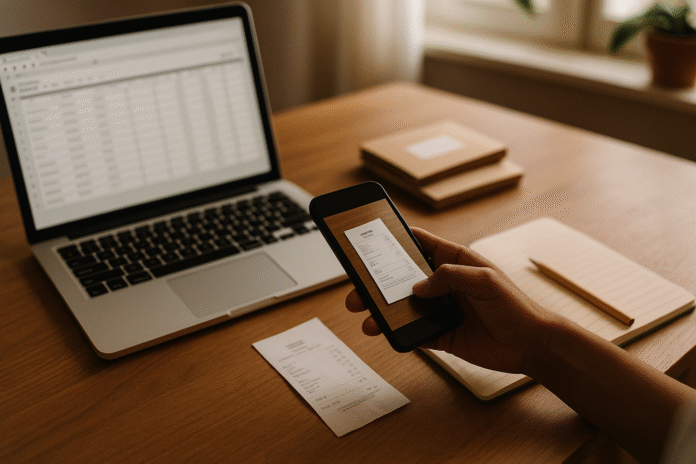
If you’re freelancing, expense tracking is the backbone of paying the right amount of tax—not a rupee, pound, or dollar more. In plain terms, expense tracking for freelancers means capturing every business cost with proof, purpose, and category so it’s claimable and defensible at tax time. Done right, it reduces your taxable income, smooths cash flow for quarterly payments, and keeps you calm if the tax office asks questions. This guide gives you 12 practical rules—receipts to reconciliation, mileage to home office, small assets to contractor forms—so you can run a clean, audit-ready system. Quick note: this is general education, not legal or tax advice; confirm details for your country and current year.
Fast definition (for skimmers): Expense tracking for freelancers is a consistent workflow to document, categorize, and reconcile every legitimate business cost with dated proof and a business purpose so you can claim lawful deductions and comply with tax rules.
1. Separate Your Money and Lock a Simple Accounting Method
Keep your business cash streams totally separate from personal spending. Open a dedicated business current account and card, and route all client payments and business costs through them. This single move simplifies reconciliation, helps you avoid missed deductions, and gives you a clear audit trail. For most freelancers, the cash method of accounting is simplest because you book income when paid and expenses when spent; it aligns with how money moves in your bank and makes quarterly tax estimates more predictable. In the U.S., many freelancers qualify to use cash accounting as “small business taxpayers,” and the gross-receipts test is inflation-adjusted (for 2025, widely cited at around $31 million in receipts—well above freelance levels). Choose a short, sensible chart of accounts tailored to freelance work (Income, Refunds/Chargebacks, Merchant/Platform Fees, Advertising, Software, Subscriptions, Supplies, Travel, Meals, Home Office, Contract Labor, Phone/Internet, Equipment, Depreciation, Taxes Paid).
1.1 Why it matters
A clean separation prevents “mixed-use” ambiguity that disallows deductions. It also means bank statements + receipts = your auto-reconciliation backbone, which a tax authority can follow without guessing.
1.2 Numbers & guardrails
- U.S.: Small businesses under the gross-receipts threshold may use cash method; confirm each year’s threshold and other tests.
- UK: Cash basis reforms expanded access; always weigh cash vs accrual with your accountant if you carry invoices spanning periods. IRS
Synthesis: One bank, one card, one method. That’s the foundation every other rule builds on.
2. Capture Every Receipt the Day You Spend (and Keep It Legally)
The most common way freelancers lose money is by losing receipts. Build a same-day capture habit: snap a photo, forward e-receipts to a dedicated inbox, and label with merchant, amount, category, client/project, and purpose. In the U.S., the IRS accepts electronic records if they’re accurate, legible, and retrievable; Publication 583 and Publication 463 outline what proofs must show (date, amount, business purpose, and so on). In the UK, keep Self Assessment records at least 5 years after the 31 January deadline; HMRC can check within that window. In Australia, the ATO’s baseline is 5 years from lodgment (longer for assets/capital gains). In Pakistan, the FBR says keep income tax return records six years.
2.1 Mini-checklist (daily workflow)
- Snap the receipt immediately (front + any tip/notes).
- Rename to
YYYY-MM-DD_merchant_amount_category_project. - Tag business purpose in the app memo.
- File to cloud storage in
/Year/Month/Category/. - Attach to the transaction in your bookkeeping app.
2.2 Tools/Examples
Receipt capture: Dext, Expensify, Shoeboxed; email rules: from:receipt@ → “Receipts” folder; storage: Google Drive/Dropbox/OneDrive.
Region notes: Digital copies are fine if they meet your authority’s integrity and readability standards—test retrieval quarterly.
Synthesis: No proof, no deduction. Make “same-day capture” a reflex, not a chore.
3. Reconcile Platform Payouts (1099-K/1099-NEC) and Bank Feeds to the Penny
Freelancers often get paid via marketplaces or processors (Stripe, PayPal, Upwork). Those systems usually pay net of fees, but tax forms report gross. Your workflow must capture gross income and book fees separately (Merchant/Platform Fees) so revenue and costs aren’t understated. In the U.S., payment networks issue Form 1099-K once your transactions meet annual thresholds; after a gradual phase-in, the IRS indicates a $5,000 threshold for 2024 and $2,500 for 2025, with $600 expected in 2026 unless changed. If clients pay you directly, you may receive 1099-NEC when payments reach $600 in a year.
3.1 How to do it
- For each payout, record gross sales and fees as separate lines; the bank deposit equals gross – fees.
- Monthly, tie your platform’s statements (gross, refunds, chargebacks) to your books.
- Confirm that annual platform totals match your books to avoid mismatches with 1099-K.
3.2 Numeric example
If Stripe shows $10,000 gross and $290 fees, you’ll book Income $10,000 and Merchant Fees $290; the bank deposit of $9,710 reconciles automatically.
Synthesis: Treat processors as sub-ledgers; reconcile gross, not just net deposits, so tax forms and your books agree.
4. Track Business Miles, Travel, and Meals with Compliant Methods
Vehicle and travel deductions can be significant—but only with contemporaneous logs. In the U.S., the standard mileage rate for 2025 is 70¢ per mile (business use), set annually by the IRS; apps like Everlance, MileIQ, and TripLog automate logs. For travel, self-employed people may use the standard meal allowance (per diem for meals and incidentals) but not a standard lodging amount—lodging is actual cost. GSA publishes M&IE and lodging per-diem tables by city; FY2025 increased the standard M&IE from $59 to $68 (FY2026 remains at FY2025 levels). Meals are generally 50% deductible when not lavish, with you present.
4.1 Region notes
- UK: HMRC Approved Mileage Allowance Payments remain 45p/mile for cars/vans for the first 10,000 miles, then 25p/mile; motorcycles 24p, bicycles 20p. Keep a log.
- Australia: ATO cents-per-kilometre method is $0.88/km for 2024–25 and 2025–26 (up to 5,000 km per car).
4.2 Mini-checklist
- Log every trip with date, purpose, start/stop locations, and distance.
- Keep itemized hotel/transport receipts; annotate client/project.
- Use per diem for meals where allowed; keep travel itinerary as backup.
Synthesis: Choose one compliant method, log in real time, and your mileage and travel deductions become low-friction and defensible.
5. Claim the Home-Office Deduction the Smart Way (and Don’t Overreach)
If you regularly and exclusively use a space for work, you may claim a home-office deduction. In the U.S., a simplified method allows $5 per square foot up to 300 sq ft ($1,500 max); the regular method allocates actual costs (rent, utilities, insurance) by business-use percentage. Document the space (photos, floorplan), measure square footage, and keep utility statements. For the UK self-employed, HMRC’s simplified expenses offer a monthly flat rate if you work 25+ hours/month from home: £10 (25–50 hours), £18 (51–100), £26 (101+). Phone/internet are claimed separately on actual business proportion.
5.1 How to decide
- Low costs or small space? Simplified methods are easy and safe.
- High costs or big space? Actual-cost method often yields more—track carefully.
5.2 Mini-checklist
- Evidence exclusivity (no guest room or mixed personal use).
- Document start date of use; keep utility statements and rent/mortgage docs.
- Recalculate if you move or change the room’s size.
Synthesis: Pick the method that fits your footprint and admin appetite—then document like an auditor would.
6. Categorize Consistently: Build a Freelance-Ready Chart of Accounts
A short, consistent category list reduces errors and speeds filing. Typical buckets: Advertising/Marketing, Software & Subscriptions, Supplies, Equipment, Contract Labor, Travel, Meals (50%), Phone/Internet, Training/Education, Home Office, Bank/Payment Fees, Taxes & Licenses. Map your categories to your tax return lines (e.g., U.S. Schedule C) so year-end is push-button.
6.1 Common mistakes
- Dumping everything into “Miscellaneous.”
- Double-counting platform fees (netted in payouts and again as expenses).
- Mixing personal and business on the same card.
6.2 Mini-checklist
- Lock names now; don’t rename mid-year.
- Add tags for client/project to enable job profitability views.
- Review uncategorized transactions weekly.
Synthesis: Categories are your reporting language; keep them short, stable, and mapped to your return.
7. Small Assets: Expense vs. Depreciate (Know Section 179 and Local Rules)
For gear like cameras, laptops, or audio interfaces, you’ll either expense them immediately or depreciate over time. In the U.S., Section 179 lets eligible businesses expense qualifying property up to indexed limits ($1,250,000 max, phase-out starting at $3,130,000 for tax years beginning in 2025, per IRS Publication 946). You can always choose regular depreciation instead if it’s better for your tax profile. Keep invoices, serial numbers, and an asset register with purchase date, cost, method (179/bonus/regular), and business-use percentage.
7.1 How to decide
- Low-cost items (e.g., a $180 mic): expense immediately.
- Higher-cost gear: run a tax projection—sometimes smoothing deductions helps qualify for credits or avoid spikes.
7.2 Region notes
- Depreciation periods and immediate write-off thresholds vary by country; check your authority’s current rules each year and keep asset evidence with receipts.
Synthesis: Track assets separately and document your expensing method choice; future-you (and your accountant) will thank you.
8. Contractors, Forms, and Paper Trail (W-9s, 1099-NEC, and More)
If you pay other freelancers, collect paperwork before the first invoice. In the U.S., request a Form W-9 to capture legal name and TIN; if you pay $600+ for services in a calendar year, you generally must file Form 1099-NEC by January 31. Keep invoices, payment confirmations, and contracts organized by contractor name and year. Many accounting apps can auto-track totals and e-file forms.
8.1 Mini-checklist
- Collect W-9 (or W-8BEN for foreign payees) before payment.
- Tag each payment as “Contract Labor.”
- Reconcile totals in December; confirm addresses/emails.
- E-file 1099-NEC by Jan 31; store confirmations.
Synthesis: Clean vendor files prevent January chaos and penalties; make it part of onboarding.
9. Quarterly Estimated Taxes: Forecast, Set Aside, and Pay on Time
Freelancers shoulder both income tax and self-employment tax. In the U.S., most self-employed people make quarterly estimated payments using Form 1040-ES. For 2025, the due dates are Apr 15, Jun 16, Sep 15, 2025, and Jan 15, 2026 (or file by early February to skip the Jan payment). A simple guardrail is to park 25–35% of each payout in a tax-reserve sub-account, then true-up quarterly. The IRS has pages explaining who must pay estimates and how to calculate them. IRS
9.1 Region notes
- UK: Payments on account may apply; HMRC Self Assessment rules govern amounts and timing.
- Australia: You may receive PAYG instalments; the ATO explains methods and timing.
- Pakistan: Check FBR advance tax provisions for your activity type.
9.2 Mini-checklist
- Build a rolling 12-month forecast from your P&L.
- Re-estimate in June and September with year-to-date results.
- Pay online and keep confirmations with your records.
Synthesis: Estimates are easier when your books are current; your reserve account turns scary bills into boring routine.
10. Travel Per Diem, Lodging, and Documentation—No Gaps
If you travel, keep a trip folder for each journey: itinerary, tickets, hotel folios, client meeting notes, and your meal per diem calculations. In the U.S., self-employed people can use the standard meal allowance (per diem) but must use actual costs for lodging; consult Publication 463 for rules and examples. Use GSA’s database to look up city-specific rates; FY2025 raised standard M&IE to $68, and FY2026 holds FY2025 levels.
10.1 Mini-checklist
- Record business purpose for the trip, not just receipts.
- For meals per diem, save the GSA rate screenshot or PDF for the dates and city.
- If mixing business/personal days, prorate carefully and document the split.
Synthesis: Trips are easy to defend when you can show the who/what/when/where/why in one place.
11. Apportion Mixed-Use Costs (Phone, Internet, Software) with Rational Percentages
Many freelancer expenses are partly personal. That’s fine—apportion them with a reasonable, documented basis. For example, if your mobile plan is used 70% for business, claim 70% and note how you computed it (call logs, hours, or usage breakdown). Apply the same discipline to internet service and shared software seats. Reassess percentages annually or when your work pattern changes.
11.1 How to document
- Keep one sample month of detailed logs each quarter.
- Save carrier bills and router/internet statements.
- For software, export usage reports if available.
11.2 Region notes
- UK: Phone/internet are not covered by the home-office simplified flat rate; claim a business portion separately.
Synthesis: Reasonable, consistent percentages + evidence beat guesswork every time.
12. Close the Books Monthly; Year-End Is Then a Non-Event
A 60-minute month-end close avoids April panic. Reconcile bank/processor feeds, clear uncategorized transactions, tag client/project, export your P&L and Balance Sheet to PDF, and update your tax reserve. In December, run a pre-close: verify contractor totals (1099-NEC), confirm mileage totals, photograph the home-office space, validate asset purchases, and export a year-to-date general ledger.
12.1 Mini-checklist (monthly)
- Bank and card reconciled to $0 difference.
- Receipts attached to 100% of transactions.
- Exceptions list resolved (duplicates, splits, refunds).
- Backup to cloud + offline copy.
Synthesis: A predictable close turns tax season into “upload and done,” not a forensic mystery.
FAQs
1) Do I need paper receipts, or are photos enough?
In most jurisdictions, clear electronic copies are acceptable if they accurately capture the original and are retrievable on request. In the U.S., IRS guidance confirms electronic records are acceptable; keep them organized and backed up. In the UK and Australia, digital is fine as long as records are complete and legible for the required retention period.
2) What’s the 2025 U.S. mileage rate, and can I switch methods mid-year?
For 2025, the IRS standard business mileage rate is 70¢ per mile. You can generally choose between the standard mileage rate and actual expense method, but there are rules about when you can switch (especially if you’ve depreciated the car). Check Publication 463 for specifics.
3) Are business meals fully deductible again?
No. As of 2025, the general rule is 50% deductibility for business meals when you’re present and the expense isn’t lavish. Entertainment remains non-deductible. IRS
4) I get paid via Stripe and PayPal—how do I handle 1099-K vs. 1099-NEC?
Treat processors’ gross as income and fees as expenses so totals match 1099-K where applicable. Clients who pay you directly may issue 1099-NEC at $600+. Reconcile platform statements to your books and keep copies of annual summaries.
5) How long should I keep records?
Baseline rules: U.S.—keep as long as needed to support returns (often 3–7 years, longer for assets); UK—5 years after the 31 January deadline; Australia—5 years from lodgment; Pakistan—6 years. Keep longer if there are assets or disputes. LinkedInIRSGOV.UK
6) Is the home-office deduction risky?
It’s legitimate if you meet regular and exclusive use tests and document your space and costs. The U.S. simplified method ($5/sq ft up to 300 sq ft) reduces admin; the UK flat-rate method depends on hours worked from home. Keep photos and calculations. IRS
7) What if I forget to log a receipt?
Recreate it ASAP: get a duplicate from the merchant, annotate the transaction with purpose, and keep the bank line as corroboration. Consistent, timely capture prevents this scramble.
8) How do per diem rates work for freelancers?
In the U.S., self-employed can use the standard meal allowance (M&IE) but not a standard lodging amount; lodging must be actual cost. GSA publishes city-specific rates that change annually. Keep your itinerary and rate lookup.
9) When are U.S. estimated tax payments due for 2025?
Apr 15, Jun 16, Sep 15, 2025, and Jan 15, 2026. If you file early enough in January, you may not need the fourth payment. Use Form 1040-ES to compute.
10) Do I need to issue 1099-NEC to subcontractors?
Generally yes, if you paid $600+ for services in the year. File with the IRS and furnish to the contractor by January 31. Track totals monthly to avoid January surprises.
Conclusion
Freelance tax stress usually isn’t about complex rules—it’s about disorganized proofs and late decisions. The cure is operational: one clean bank/card, same-day receipt capture, weekly categorization, and a monthly close. Do that and everything else—the mileage, the home office, the small-asset decisions, the contractor forms, the quarterly estimates—falls into place because your books already tell the story an auditor wants to hear. Use simplified methods where they make sense (U.S. home-office simplified, meals per diem; UK simplified expenses; ATO cents-per-kilometre), and choose actual-cost methods when the numbers justify the extra admin. Finally, schedule two calendar habits: a 30-minute Friday review and a 60-minute month-end close. That’s how you convert tax season from drama to routine.
Copy-ready next step: Block 60 minutes this week to (1) open/confirm your dedicated business account, (2) install a receipt-capture app, (3) set up categories, and (4) process the last 30 days of transactions end-to-end.
References
- Publication 463: Travel, Gift, and Car Expenses, Internal Revenue Service, updated July 30, 2025. https://www.irs.gov/publications/p463 IRS
- Notice 2025-5: Standard Mileage Rates, Internal Revenue Service, 2025. https://www.irs.gov/newsroom/irs-issues-standard-mileage-rates-for-2025 IRS
- Understanding your Form 1099-K, Internal Revenue Service, updated March 6, 2025. https://www.irs.gov/credits-deductions/understanding-your-form-1099-k IRS
- About Form 1099-NEC, Nonemployee Compensation, Internal Revenue Service, June 6, 2025. IRS
- 2025 Form 1040-ES, Estimated Tax for Individuals, Internal Revenue Service, 2025. IRS
- Publication 946: How to Depreciate Property — What’s New for 2025 (Section 179 limits), Internal Revenue Service, 2025. IRS
- Publication 583: Starting a Business and Keeping Records, Internal Revenue Service, 2024. https://www.irs.gov/publications/p583 IRS
- Self-employed: How long to keep your records, HMRC (GOV.UK), accessed 2025. GOV.UK
- Simplified expenses if you’re self-employed (working from home rates), HMRC (GOV.UK), accessed 2025. GOV.UK
- Approved Mileage Allowance Payments (rates overview), Association of Taxation Technicians, July 16, 2025. att.org.uk
- Cents per kilometre method (88c/km 2024–25 & 2025–26), Australian Taxation Office, June 2, 2025. Australian Taxation Office
- Overview of record-keeping rules for business (5-year rule), Australian Taxation Office, June 20, 2025. Australian Taxation Office
- How long do I need to keep records? Federal Board of Revenue (Pakistan), accessed 2025. https://fbr.gov.pk/FAQs/3/132 LinkedIn
- GSA releases FY 2025 CONUS per diem rates (M&IE increase), U.S. General Services Administration, August 16, 2024. U.S. General Services Administration
- Small business taxpayer threshold (cash method) — 2025 update, KPMG Tax News, 2025. https://home.kpmg/us/en/home/insights/2025/01/taxnews-irs-2025-inflation-adjustments.html U.S. General Services Administration