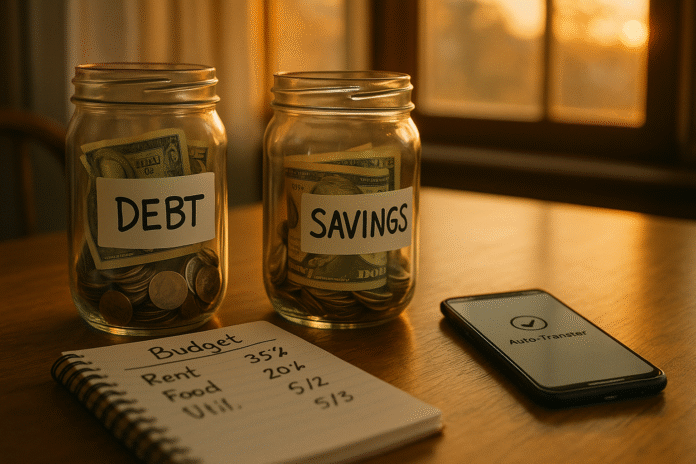
If you’ve ever wondered whether to throw every spare dollar at your balances or stash cash for the future, you’re not alone. This guide makes Debt vs. Saving practical with 12 research-based rules you can apply in any income range. You’ll learn how to build a protective cash cushion, attack expensive debt efficiently, and still make steady progress on long-term goals. Quick answer: start with a small emergency fund, always pay all minimums on time, prioritize high-interest debt while capturing any “guaranteed return” (like an employer match), and split extra cash between payoff and savings based on interest rates, risk, and life stage. Use the rules below to set percentages, choose tools, and adapt as rates and income change. This is general education—not individualized financial advice; consider consulting a qualified professional for your specific situation.
Fast path (overview): Build a starter emergency fund → pay every bill on time → take any safe, guaranteed return (e.g., employer match) → direct most extra cash to toxic, high-APR debt → keep saving a small, automatic amount for resilience → review monthly and rebalance.
1. Build a Starter Emergency Fund Before Aggressive Payoff
Build a small, dedicated emergency fund first so you don’t fall back on credit when life happens. The direct answer: set aside a starter cushion—often one month of essential expenses or a fixed starter target (for many households, $500–$1,500 as a minimum) in a separate high-yield savings account—before you accelerate debt repayment. This buffer prevents a single car repair or medical copay from wiping out progress and pushing you into new borrowing. It also reduces anxiety, which makes it easier to stick with your plan. As of now, major consumer-finance bodies continue to emphasize emergency savings as an early step; treat it like an insurance policy on your debt-free journey.
1.1 Why it matters
Without a cash buffer, every surprise expense becomes new debt. That compounds the problem: interest and fees increase monthly costs, and you spend more time treading water. A small cushion absorbs volatility—job shifts, billing errors, seasonal spikes—so your plan survives reality.
1.2 Numbers & guardrails
- Target (starter): one month of essentials (rent/mortgage, utilities, basic food, transport, minimum debt payments).
- Parking spot: a separate high-yield savings or money market account labeled “Emergency Only.”
- Automation: set a fixed auto-transfer on payday (e.g., 5–10% of net income) until you reach the starter target.
1.3 Mini-checklist
- Open a separate account; nickname it “Emergency.”
- Turn on payday auto-transfer.
- Track balance visibly in your budget app.
- Use only for genuine emergencies; refill immediately after use.
Synthesis: A starter fund stabilizes your cash flow and keeps you out of the debt spiral, allowing every later rule to stick.
2. Pay All Minimums on Time and Triage “Priority Debts”
The direct answer: never miss a minimum payment and prioritize legally or practically urgent bills (e.g., rent/mortgage, utilities, taxes, court fines) to prevent cascading fees, service cutoffs, or eviction. This sits before any extra payoff or saving because late fees and penalties generate immediate, high-cost drag, and priority debts can carry severe consequences unrelated to APR. If you’re in arrears, contact creditors early to discuss hardship programs or payment plans.
2.1 How to do it
- Calendarize due dates and align them with your pay cycle (call lenders to change dates if needed).
- Set autopay for minimums on every credit account.
- Use a bill-prioritizer approach: housing and utilities first, then secured loans (e.g., car), then unsecured debt.
2.2 Tools/Examples
- Apps: YNAB, Tiller, Monarch Money, or a simple spreadsheet.
- Bank features: bill-pay, due-date alerts, and autopay for minimums.
- If behind, consult reputable nonprofit resources (consumer-protection agencies and debt-advice services).
2.3 Mini-checklist
- Autopay on all minimums (today).
- Due-dates synced to payday (this week).
- Priority list documented in your budget.
Synthesis: On-time minimums plus a clear priority order stops leaks and protects essentials while you implement your payoff/saving split.
3. Tackle Toxic, High-APR Debt First (Debt Avalanche Wins on Math)
Answer: after minimums and emergency starter, direct most extra cash to the balance with the highest APR (the debt avalanche) because it reduces total interest cost and shortens payoff time. Use the debt snowball (smallest balance first) only if you need fast wins to stick with the plan. For many households, credit cards and certain personal loans have APRs far exceeding any safe savings yield, so mathematically they’re the first target.
3.1 Numbers & guardrails
- If a debt’s APR exceeds your after-tax, low-risk return (e.g., savings APY), avalanche it.
- Keep $25–$50/month auto-saving alive for resilience while you attack high APRs.
- Reassess when a balance is gone; roll the freed payment onto the next highest APR.
3.2 Tools/Examples
- Debt calculators (avalanche vs. snowball).
- Spreadsheet with columns: APR, balance, minimum, extra payment; sort by APR descending.
- Visual payoff trackers to maintain motivation.
3.3 Common mistakes
- Chasing points or 0% promos without a payoff plan.
- Ignoring fees and penalty APRs after a late payment.
Synthesis: The avalanche method minimizes total interest—freeing cash faster to redirect toward savings and investments.
4. Capture “Guaranteed Returns” Before Extra Payoff (Employer Match, Safe Incentives)
Answer: always take free money (e.g., an employer retirement match or a statutory savings incentive) before sending every extra dollar to debt. A dollar-for-dollar match up to a cap is an instant, risk-free 50–100% return on that contribution, which outperforms even high APR payoff in many cases. The catch: contribute only up to the match while you’re tackling high-APR balances; don’t overextend cash flow or skip minimums.
4.1 How to do it
- Check your benefits: note match percentage and cap.
- Adjust contributions to exactly capture the full match.
- Keep emergency fund and minimums intact; don’t break Rule 1 or 2.
4.2 Numeric example
- If your employer matches 50% up to 6% and you earn $4,000/month, contribute $240 to get $120 free—$1,440 free per year—while still directing most extra cash to high-APR debt.
4.3 Mini-checklist
- Verify vesting and eligibility.
- Set contribution to match threshold.
- Revisit annually or when income changes.
Synthesis: Grabbing guaranteed returns compounds your long-term wealth even as you aggressively reduce expensive debt.
5. Choose a Single Payoff Framework and Automate It
Answer: pick one method (avalanche or snowball), commit, and automate the extra payment so motivation swings don’t derail you. Switching back and forth costs momentum and attention. Use automation to eliminate decision fatigue: the extra payment should leave your account the moment you get paid.
5.1 How to do it
- Pick your method: avalanche (math-optimal) or snowball (behavior-optimal).
- Automate: set a separate auto-transfer to a “debt hub” account or directly to the targeted card/loan.
- Name the payment in your calendar (“Avalanche Payment – Card A”).
5.2 Tools/Examples
- Bank rules: paycheck → split: necessities, emergency, debt extra, sinking funds.
- App automations and reminders; spreadsheet habit tracker.
5.3 Common mistakes
- Paying extras mid-month after discretionary spending has already eaten the surplus.
- Forgetting to re-aim the extra payment the day a targeted balance hits zero.
Synthesis: A single, automated framework creates reliable progress—your plan works even on chaotic months.
6. Use a Split-Pay Strategy (e.g., 70/30) With Clear Triggers
Answer: if you’re torn between speed and security, use a split of your available surplus—e.g., 70% to high-APR debt, 30% to savings—until you hit defined milestones. This balances psychological safety (watching savings grow) with the math of interest reduction. Change the ratio as risks fall and balances shrink.
6.1 Numbers & guardrails
- Starter phase: 50/50 until the starter emergency fund is reached.
- Attack phase: 70/30 (debt/savings) while any APR >12–15% exists.
- Stability phase: 60/40 or 50/50 if all remaining debt APRs are single-digit and stable.
6.2 Mini case
- Surplus $600/month; with 70/30 split, $420 attacks Card A (23% APR), $180 goes to savings. When Card A is gone, roll the $420 to the next debt; keep $180 building a bigger cushion.
6.3 Mini-checklist
- Define your split and write it in your budget.
- Automate two transfers each payday: “Debt extra” and “Savings.”
- Set triggers to change the split (e.g., when emergency fund hits 1 month → switch to 70/30).
Synthesis: A rules-based split gives you progress on both fronts without decision fatigue or second-guessing.
7. Lower the Cost of Debt (Refinance, Consolidate, or Use 0% Windows Carefully)
Answer: reduce APR where possible to tilt the math in your favor, then keep payments the same to accelerate payoff. Options include refinancing (e.g., personal loan at a lower rate), consolidation into a fixed-rate installment, or time-boxed 0% balance-transfer promotions. The goal isn’t lower monthly payments for more spending room; it’s lower interest with the same payment, compounding your progress.
7.1 How to do it
- Get quotes from multiple lenders; compare APR, total cost, fees, and term.
- If using 0% balance transfers, create a payoff schedule that zeroes the balance before the promo ends; account for any transfer fee.
- Avoid extending terms so far that total interest paid increases despite a lower APR.
7.2 Tools/Examples
- Comparison tools and calculators that show total interest with current vs. new loan.
- Calendar reminders for promo end dates.
7.3 Common mistakes
- Consolidating and then re-running up the old cards.
- Choosing a longer term that lowers payments but increases total interest.
Synthesis: When you push APR down and hold your payment steady, you shorten the path to debt-free and free cash for savings sooner.
8. Park Cash in the Right Place and Label It Clearly
Answer: keep emergency and near-term savings in safe, liquid accounts—typically a high-yield savings or money market account—separate from daily spending. Labeling accounts by purpose (“Emergency,” “Sinking Funds,” “Home Repair”) boosts follow-through and prevents accidental spending. Consider CDs or Treasury bills only when your time horizon and penalty rules align; avoid risking emergency funds in volatile assets.
8.1 Numbers & guardrails
- Liquidity first: Emergencies demand same-day or next-day access.
- Yield second: Compare APYs and account requirements; ensure no hoops threaten access.
- Segmentation: One account for emergencies, separate ones (or sub-accounts) for near-term goals.
8.2 Mini-checklist
- Open a high-yield savings; nickname it “Emergency.”
- Create goal-based sub-accounts for upcoming expenses.
- Turn on payday auto-transfers aligned with your split strategy.
8.3 Region-specific notes
- Account names and product labels differ by country, but the principles—safety, liquidity, clarity—are universal. Check local deposit-insurance rules and caps.
Synthesis: The right “home” for your cash keeps it safe, accessible, and psychologically off-limits until truly needed.
9. Create Sinking Funds to Avoid New Debt
Answer: while paying off balances, simultaneously fund small, predictable future costs (car maintenance, insurance premiums, holidays) so you don’t need to swipe a card when they arrive. Sinking funds turn lumpy expenses into monthly line items, eliminating budget shocks.
9.1 How to do it
- List annual/irregular expenses with due dates and amounts.
- Divide each by the number of months until due; auto-save that amount monthly into labeled sub-accounts.
- Use the funds only for their purpose; refill after use.
9.2 Numeric example
- Car maintenance estimate $600/year → save $50/month.
- Insurance premium $1,200 every 6 months → save $200/month.
9.3 Mini-checklist
- Add sinking funds to your split plan (they come from the “savings” slice).
- Review categories quarterly; adjust as prices change.
Synthesis: Sinking funds protect your plan from “surprise” expenses you actually can predict—so your avalanche payments keep flowing.
10. When (and When Not) to Invest While Carrying Debt
Answer: invest only when (a) you’ve captured any guaranteed match, (b) your emergency cushion is in place, and (c) your remaining debt APRs are low enough that expected after-tax investment returns plausibly exceed them given your risk tolerance and horizon. If your card APR is in the high teens, prioritizing payoff almost always wins on risk-adjusted math. If your remaining debts are low-rate (e.g., subsidized student loans or a prime mortgage), a balanced approach—continuing investments while paying down principal—can make sense.
10.1 Numbers & guardrails
- High-APR (double-digit): favor debt payoff.
- Single-digit fixed rates: consider investing alongside payoff once emergency fund ≥ one month, ideally growing toward 3–6 months.
- Volatility reality: market returns vary; never invest money you might need within 3–5 years.
10.2 Mini-checklist
- Capture employer match (Rule 4).
- Confirm emergency fund (Rule 1).
- Compare after-tax expected return vs. APR; decide your split.
Synthesis: Invest deliberately only when your downside is protected and the math, risk, and time horizon justify it.
11. Engineer Behavior: Friction, Defaults, and Windfalls
Answer: small behavioral design tweaks make or break your plan. Increase friction for spending and decrease friction for saving and paying debt. Decide in advance how you’ll allocate windfalls (tax refunds, bonuses, gifts) so you don’t lose momentum.
11.1 How to do it
- Default to saving/paying first: paycheck splitting at the employer or bank.
- Friction for spending: keep credit cards out of sight; delete saved cards from browsers.
- Windfall policy: pre-decide a ratio (e.g., 80% to debt, 20% to fun).
11.2 Tools/Examples
- Envelope method for discretionary categories.
- “No-spend” days and weekly caps.
- Visual debt thermometers and savings goal trackers.
11.3 Mini-checklist
- Set windfall split in writing.
- Remove stored cards from e-commerce.
- Turn on account alerts for large transactions.
Synthesis: By engineering your environment, you rely less on willpower and more on systems that run reliably in the background.
12. Review Monthly, Reallocate as Conditions Change, and Celebrate Milestones
Answer: run a 30-minute monthly review to check progress, adjust your split, and re-aim extra payments as balances fall. Interest rates, income, and expenses change; so should your plan. Celebrate milestones to maintain motivation—each paid-off account and each month of emergency savings is a real win.
12.1 Numbers & guardrails
- Monthly cadence: review dates on the calendar; tie to payday or the end of your billing cycle.
- Metrics to track: total debt, weighted average APR, months of emergency savings, on-time payment streak, and debt-to-income (DTI).
- Triggers to change split: when a high-APR balance is gone, or when emergency savings hits 1→3→6 months.
12.2 Mini-checklist
- Update balances and APRs.
- Reassign the extra payment to the next target.
- Log one small celebration per milestone (free or low-cost).
Synthesis: Regular, lightweight reviews keep your plan current, resilient, and emotionally sustainable.
FAQs
1) Should I ever save and pay off debt at the same time?
Yes—most people should. Keep minimums current, build a small emergency fund, and then split your surplus (e.g., 70% to high-APR debt, 30% to savings). This ensures resilience while still minimizing interest. As your risk declines and balances fall, tilt more toward savings and investing.
2) How big should my emergency fund be?
Start with one month of essentials, then grow toward 3–6 months as your situation allows. Use a dedicated high-yield savings or money market account for liquidity and safety. Build it gradually with automatic transfers so you don’t stall debt progress.
3) Avalanche vs. snowball: which is better?
Avalanche (highest APR first) wins on total interest saved; snowball (smallest balance first) can boost motivation. Pick one method and automate it. If you switch, do so deliberately—e.g., start with snowball to build momentum, then switch to avalanche.
4) What about 0% balance transfers?
They can help if you pay the balance off before the promo ends and the fee doesn’t erase the benefit. Use a calendar to track the end date and a fixed monthly payment that zeros the balance on time. Avoid new spending on the transfer card.
5) Should I pause retirement contributions until debt is gone?
Generally don’t skip an employer match—that’s free, guaranteed money. Beyond the match, prioritize high-APR debt until it’s gone, then increase retirement contributions as cash flow opens up.
6) Is paying off my mortgage early a good idea?
It depends on your rate, taxes, and alternative returns. With a low, fixed rate and other high-APR debts outstanding, mortgage prepayment is usually lower priority. Once high-APR debts are gone and your emergency fund is solid, extra principal payments can be part of a balanced plan.
7) How do I stop new debt while I’m paying off old debt?
Use sinking funds for predictable expenses, build a small emergency cushion, and limit card use for discretionary categories. Add friction (no saved cards, spending alerts) and set category caps so cash flow isn’t blindsided by “expected surprises.”
8) What if I’m already behind on bills?
Focus on priority debts (housing, utilities, taxes, court fines) and communicate with creditors quickly. Ask about hardship programs, reduced payments, or temporary forbearance. Get reputable, free guidance from consumer-protection and debt-advice organizations.
9) When is it okay to invest while still in debt?
After you’ve taken any employer match and your emergency fund is started, investing can make sense only if remaining debt rates are low and your horizon is long. If you have double-digit APRs, prioritize payoff first for a risk-free “return.”
10) Which tools should I use to manage all this?
Any system you’ll actually use: budgeting apps like YNAB, spreadsheets like Tiller, or a simple bank-account split with automatic transfers. The best tool is the one that keeps your plan visible, automated, and adjustable.
11) How do I set my payoff/saving split?
Base it on risk and rates. While any APR >12–15% exists, push more to debt (e.g., 70/30). As APRs fall and your cushion grows, move toward balance (60/40 or 50/50). Revisit monthly with a quick review.
12) What’s the most important first step today?
Open a separate emergency account, set a small payday auto-transfer, turn on autopay for all minimums, and list debts by APR. Those four actions put the plan on rails in under an hour.
Conclusion
Balancing Debt vs. Saving isn’t about picking one side forever—it’s about sequencing and percentages that change as your risks change. Start by protecting cash flow with a small, dedicated emergency fund and paying every bill on time. Then aim most extra cash at high-APR balances while capturing any safe, guaranteed returns like an employer match. Use a simple split (e.g., 70/30) to make consistent progress on both fronts, and strengthen your system with automation, sinking funds, and behavioral guardrails. Finally, schedule a fast monthly review to re-aim payments and update your split as rates, income, and goals evolve. Done consistently, these 12 rules reduce interest cost, prevent backsliding, and grow your financial resilience and wealth—without all-or-nothing tradeoffs. Your next step: automate a starter transfer to your emergency account and a fixed extra payment to your highest-APR debt today.
References
- How to Reduce Your Debt — Consumer Financial Protection Bureau (CFPB), July 16, 2019. https://www.consumerfinance.gov/about-us/blog/how-reduce-your-debt/
- Tool: Reducing Debt Worksheet (Avalanche vs. Snowball) — CFPB, 2017. https://files.consumerfinance.gov/f/documents/cfpb_ymyg-toolkit_reducing-debt-worksheet.pdf
- An Essential Guide to Building an Emergency Fund — CFPB, Dec 12, 2024. https://www.consumerfinance.gov/an-essential-guide-to-building-an-emergency-fund/
- Report on the Economic Well-Being of U.S. Households in 2024 — Emergency Savings — Board of Governors of the Federal Reserve System, 2025 data portal. https://www.federalreserve.gov/consumerscommunities/sheddataviz/emergency-savings.html
- High-Yield Checking Accounts: Know the Rules — Federal Deposit Insurance Corporation (FDIC), May 8, 2023. https://www.fdic.gov/bank-examinations/high-yield-checking-accounts-know-rules
- How to Prioritise Your Debts — MoneyHelper (UK), updated 2025. https://www.moneyhelper.org.uk/en/everyday-money/credit/how-to-prioritise-your-debts
- Dealing with the Financial Impact of Rising Costs of Living (Prioritising Debts) — Financial Conduct Authority (UK), guidance page, 2020–2025 updates. https://www.fca.org.uk/consumers/financial-impact-rising-costs-living
- Priority Debts and Bills: What Debts to Pay First — StepChange Debt Charity (UK), 2025. https://www.stepchange.org/debt-info/dealing-with-debt-problems/what-debts-to-pay-first.aspx
- Vanguard’s Guide to Financial Wellness (Employer Match Illustration) — Vanguard Research, 2024. https://corporate.vanguard.com/content/dam/corp/research/pdf/vanguards_guide_to_financial_wellness.pdf
- Debt Avalanche Method: How It Works — NerdWallet, Aug 1, 2025. https://www.nerdwallet.com/article/finance/what-is-a-debt-avalanche
- Financial Preparedness: Emergency Financial First Aid Kit (EFFAK) — FEMA/Ready.gov, Aug 21, 2025. https://www.ready.gov/financial-preparedness
- Household Debt — Definition and Indicator — OECD Data, current explainer page. https://www.oecd.org/en/data/indicators/household-debt.html