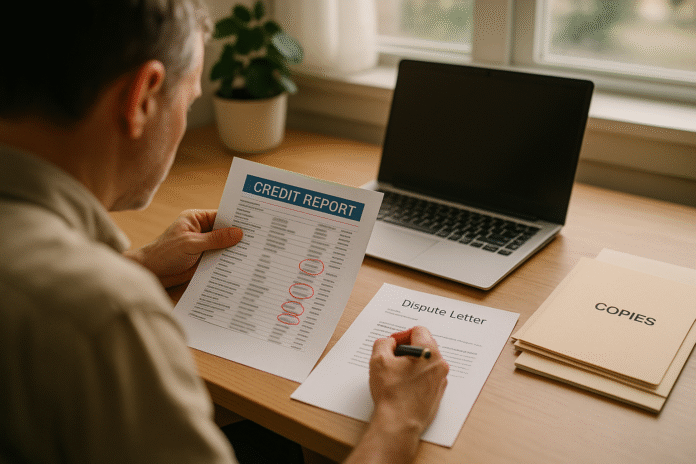
If your credit report lists an account you don’t recognize, a balance that’s wrong, or an item that should have aged off, a well-built dispute letter can fix the record and protect your score. This guide shows you how to write a credit dispute letter that works—what to say, what to include, where to send it, and how to track outcomes. It’s written for U.S. consumers; rules differ elsewhere. Brief note: this is educational information, not legal advice—talk to a qualified professional if you need advice for your situation.
Quick answer: A credit dispute letter is a written notice to a credit bureau or the company that furnished the data (the “furnisher”) identifying specific errors and asking for correction under the Fair Credit Reporting Act (FCRA). Bureaus generally must investigate within 30 days and notify you of results within five business days after finishing, with up to 45 days in certain circumstances.
Fast path (the 9 steps):
- Verify the error and know your rights.
- Gather proof and annotate your report.
- Choose your dispute channel (online vs. mail vs. direct to furnisher).
- Draft a clear, factual dispute letter (use the templates).
- Send it to the right places—bureaus and the furnisher.
- Track deadlines and log responses.
- Respond to outcomes and escalate when needed.
- Clean up after a correction (or non-correction).
- Handle special cases (ID theft, medical debt, mixed files, obsolete items).
1. Verify the error and know your rights
Start by confirming that what you’re disputing is truly inaccurate, incomplete, or not verifiable. Pull your free credit reports from all three nationwide bureaus—Equifax, Experian, and TransUnion—at AnnualCreditReport.com. As of now, you can access free weekly reports permanently, which makes it easier to spot discrepancies across bureaus and time your disputes. Double-check account numbers, dates of first delinquency, balances, and personal info. Knowing the basics of your rights will keep your letter precise and persuasive: under FCRA §611, bureaus must conduct a reasonable reinvestigation within 30 days of receiving your dispute (45 days in some cases), and furnishers must investigate when you dispute with them directly under Regulation V §1022.43. If a bureau deems a dispute “frivolous,” it must tell you why and what else it needs. Finally, if an investigation doesn’t resolve the issue, you may add a brief statement of dispute to your file.
Why it matters
- Weekly reports are free at AnnualCreditReport.com; use them to confirm the error appears and to screenshot/print the evidence.
- Timelines exist: 30 days (generally), 45 in certain cases; results notice within five business days after completion.
- Legal anchors: FCRA §611 for bureau duties; Regulation V §1022.43 for direct disputes with furnishers.
Mini-checklist
- Download all three reports (save PDFs; print key pages).
- Circle errors and write margin notes for each.
- List what you know is wrong and why.
- Note the clock start date you’ll use for deadlines.
Close the loop by committing to a single, documented story: the same facts and exhibits will appear in your letter and any online form you use.
2. Gather proof and annotate your report
Your dispute succeeds or fails on documentation. Before you write the letter, assemble copies (not originals) of materials that directly support your claim. That can include billing statements, payment confirmations, payoff letters, settlement agreements, identity theft reports or police reports, mail showing your address at relevant dates, or court records showing a judgment was vacated. Print the pages of your credit report with the error and circle the item. Create a simple exhibit list (Exhibit A, B, C…) and write a one-line caption for each.
How to do it
- Match evidence to claim: If you say a balance is wrong, include the statement that proves it; if you say the account isn’t yours, include an ID theft report and any correspondence with the lender.
- Prove identity and address: Most bureaus request ID and proof of address with mailed disputes (e.g., license + utility bill). Their dispute forms spell out accepted documents. assets.equifax.com
- Keep originals safe: Send copies only; preserve originals in a folder or cloud drive.
- Redact sensitive data: Mask account numbers except last four digits.
Mini case
Jordan finds a collection for $1,137 that isn’t hers. She pulls weekly reports and sees it only on TransUnion. She attaches her IdentityTheft.gov recovery plan, a police report, and an email from the provider confirming a mis-keyed SSN. Her exhibits make it easy for the bureau and the furnisher to see the mismatch.
Wrap by numbering every page (“Exhibit B—p.2/3”) so nothing goes missing in scanning.
3. Choose your dispute channel (online, mail, phone, or direct to furnisher)
You can dispute online with each bureau, send a letter by mail, or call (least recommended). Online forms are fast; mail (certified) creates a paper trail and lets you control narrative and exhibits. You may also dispute directly with the furnisher (the lender/collector), which triggers its own duty to investigate under Regulation V §1022.43. For best results with complex issues, combine methods: mail the bureaus and send a direct dispute to the furnisher.
Numbers & guardrails
- Bureau options: Online portals and mailing addresses are listed on official pages; the FTC also publishes the dispute addresses (Equifax: P.O. Box 740256, Atlanta, GA 30348; Experian: P.O. Box 4500, Allen, TX 75013; TransUnion: P.O. Box 2000, Chester, PA 19016). Send by certified mail with return receipt for tracking.
- Direct dispute duty: When you write to the furnisher about your account accuracy, it generally must reasonably investigate covered disputes.
- 30–45 day window: Same 30-day timeline applies; may extend to 45 days in certain cases.
Tools/Examples
- Equifax dispute hub (online and mail options).
- Experian dispute portal and mail form.
Synthesize by picking the path that fits your case: online for speed, certified mail for control, and a direct furnisher dispute when the creditor’s records are the bottleneck.
4. Draft a clear, factual dispute letter (templates inside)
Your letter should be short, specific, and evidence-driven. In the first paragraph, identify yourself and the exact items you dispute. In the second, state why each item is inaccurate, incomplete, or unverified and what you want done (delete, correct balance/date, remove duplicate line, etc.). In the third, list exhibits and request a copy of the revised report and the description of the investigation procedure (you’re entitled to it upon request). Keep the tone neutral; avoid legal threats or boilerplate jargon.
4.1 Template: Dispute letter to a credit bureau
[Your Name]
[Your Address]
[City, State ZIP]
[Email] [Phone]
[Date]

[Equifax/Experian/TransUnion Address for Disputes]

Re: Dispute of inaccurate information on my credit report (Report Date: [MM/DD/YYYY])

To Whom It May Concern:

I am disputing the accuracy/completeness of the following item(s) on my [Equifax/Experian/TransUnion] credit report:

1) Creditor/Collector: [Name] — Account No.: [XXXX1234]
   What’s wrong: [e.g., Not my account/not authorized/paid in full/incorrect balance/wrong date of first delinquency].
   Requested action: [Delete the tradeline/Correct the balance to $___/Update the date to ___].

I have enclosed copies of documents that support my position, including [list exhibits]. I have also enclosed a copy of the relevant report page with the disputed item(s) circled.

Please conduct a reasonable reinvestigation and correct or delete the disputed information as required by the Fair Credit Reporting Act. After completing your reinvestigation, please send me written results and a free copy of my updated credit report. If you verify any item, please also provide (upon request) a description of the procedure used to determine the accuracy, including the business name, address, and telephone number of any furnisher contacted.

Sincerely,
[Signature]
[Printed Name]
Enclosures: [Exhibit list]
(Certified mail with return receipt recommended.)
4.2 Template: Direct dispute letter to a furnisher
[Your Info — same as above]
[Creditor/Collector Dispute Address]
Re: Direct dispute of account reporting — [Account No. XXXX1234]

I am disputing the accuracy/completeness of information your company is furnishing to the credit reporting agencies regarding the account referenced above.

Issue(s): [briefly describe].
Evidence: [identify attached exhibits].

Under 12 CFR §1022.43, please conduct a reasonable investigation and correct or delete any inaccurate or unverifiable information with all credit reporting agencies to which you furnish.

Please respond in writing with your findings and any corrections you have made.

Sincerely,
[Signature]
This section is your control room—tight facts, clear asks, and organized exhibits are what move a dispute forward.
5. Send it to the right places—bureaus and the furnisher
Dispatch your dispute to each bureau reporting the error and to the furnisher simultaneously. If the same account is wrong on Experian and TransUnion but correct on Equifax, send letters to Experian and TransUnion only—and to the creditor/collector. Mail disputes by certified mail with return receipt so you can prove delivery and calculate deadlines. Use the dispute addresses and forms each bureau lists; include copies of ID and proof of address if requested.
Steps (mailing best practices)
- Use separate envelopes for each bureau and the furnisher.
- Put your report pages with circles on top; number exhibits.
- Add ID and address proof per the bureau’s form; never send originals.
- Keep a dispute log: dates sent, USPS tracking, expected deadline, responses.
- Save digital scans of everything in a cloud folder.
H3: Where to find official addresses and portals
- FTC’s Disputing Errors page (lists addresses and gives sample letters; advises certified mail with return receipt).
- Equifax dispute page (online and mail options).
- Experian dispute page and mail form (P.O. Box 4500, Allen, TX 75013).
- TransUnion mail info (P.O. Box 2000, Chester, PA 19016).
A small execution detail—separate packets, numbered exhibits, and certified tracking—often makes the biggest difference in speed and outcomes.
6. Track deadlines and manage the 30–45 day investigation window
Once your dispute arrives, the clock starts. Bureaus generally have 30 days to investigate and must notify you within five business days after they finish. The period can extend to 45 days if you disputed items from a free annual report or if you submit additional documents mid-investigation. You’ll get written results and, if changes are made, a free copy of your updated report (this doesn’t count against your AnnualCreditReport allotment). If the bureau calls a dispute “frivolous,” it must explain why and what else it needs.
Numbers & guardrails
- 30 days standard; 45 with extensions; results notice within five business days after completion.
- Right to updated report and to a description of the procedure used to verify any item.
Mini-checklist
- Put the delivery date (from USPS) into your calendar.
- Set reminders for Day 30 and Day 45.
- When results arrive, compare each bureau’s outcome to your ask.
- If verified but wrong, note exactly what the bureau/furnisher says they used.
Close by keeping momentum: timely follow-ups and clean records are your leverage.
7. Respond to outcomes and escalate when needed
When you get results, there are typically three outcomes: deleted, corrected, or verified as accurate. If the data is corrected or deleted, confirm the update appears on all reports within 2–4 weeks. If the bureau “verifies” an item you believe is wrong, you can resubmit with better evidence, dispute directly with the furnisher (if you haven’t already), or escalate externally. You may also add a 100-word statement to your file so future creditors see your side, and request that the bureau notify recent recipients of your report about corrections.
H3: Escalation options
- File a complaint with the CFPB (attach your letters, receipts, and exhibits). Regulators can pressure companies to respond substantively.
- Re-dispute with new evidence (not duplicative) so it isn’t dismissed as frivolous. GovInfo
- Direct dispute to the furnisher under §1022.43 if the bureau path stalls.
- Statement of dispute if unresolved; the bureau may limit it to ~100 words but must help you summarize clearly. Justia Law
Mini case
After a “verified” result on a paid collection, Priya sends the furnisher a direct dispute with her zero-balance letter and bank proof, then re-disputes at the bureau with the new exhibit. The collector concedes its error; the bureau deletes the line across all agencies. The key was new, specific documentation and parallel disputes.
End with a note: be persistent, not repetitive—each escalation should add something the investigator hasn’t seen.
8. Clean up after a correction—and keep errors from coming back
Even after a win, you’re not done. Check all three reports again to confirm changes propagated. If a furnisher keeps reporting the wrong data, the bureau must note that the item is disputed, and the furnisher must update or delete inaccurate info. Consider placing a fraud alert (free) or credit freeze if your dispute stemmed from identity theft. Keep your file organized for at least a year so you can quickly prove past outcomes if a tradeline reappears.
How to do it
- Monitor weekly (free) for a month or two after a successful dispute. Consumer Advice
- Fraud alerts and freezes: An extended fraud alert (with an IdentityTheft.gov report) lasts seven years and forces extra identity checks; freezes block new credit unless you lift them. Consumer Advice
- Ask bureaus to notify recipients: You can request the bureau send corrections to those who pulled your report in the prior six months (two years for employment).
Close by building a preventive habit: calendar a quarterly report review and store verified outcome letters in one labeled PDF.
9. Handle special cases (ID theft, medical debt, mixed files, obsolete items)
Some disputes need targeted moves. Identity theft disputes travel faster with an FTC IdentityTheft.gov report and a police report; use the FTC’s sample letters to block fraudulent accounts. Medical debt has changed: the CRAs removed medical collections under $500 in April 2023 and stopped reporting many paid/younger medical collections—but a separate CFPB rule finalized in January 2025 to fully exclude medical bills from reports was vacated by a federal court in July 2025. As of now, rely on the CRAs’ voluntary policies; always verify how a specific item is being treated. Finally, watch for mixed files (someone else’s data in your report) and obsolete items that should drop after seven years (ten for bankruptcy). When in doubt, cite dates and ask for deletion based on the FCRA reporting limits.
H3: Tools/Examples
- IdentityTheft.gov recovery plan and sample letters to bureaus and furnishers.
- Medical debt status: sub-$500 medical collections removed (CRAs’ joint move) and 2025 CFPB rule vacated by a Texas federal judge.
- Negative info timelines: most derogatories 7 years; bankruptcy up to 10.
Synthesize by naming the special case in your first sentence (“This is fraud/medical/mixed/obsolete”), attaching the right proof, and asking for the legally correct remedy.
FAQs
1) What exactly should I include with my dispute letter?
Include a copy of the report page with the item circled; a brief letter listing each error and your requested fix; copies of documents proving your point (statements, payoff letters, court or police reports); and copies of ID + proof of address if you mail it. Number your exhibits so the investigator can follow your story without guesswork. Sending certified mail with return receipt gives you a firm timeline to cite.
2) Do I need to dispute with all three bureaus?
Only dispute with the bureaus that show the error—each maintains its own file. If Experian has the mistake but Equifax and TransUnion don’t, write to Experian and the furnisher. Still, it’s smart to check all three again after you get results to ensure the fix propagated, since furnishers often update all agencies in a single batch cycle.
3) How long will the investigation take?
Expect about 30 days from the date the bureau receives your dispute; they must notify you of the results within five business days after finishing. If you send additional documents mid-investigation or if you disputed items from your free annual report, the bureau may take up to 45 days. Keep your USPS receipt and set calendar reminders for Day 30 and Day 45.
4) What if the bureau calls my dispute “frivolous”?
They can pause if they reasonably determine your dispute lacks enough information, but they must tell you why and what else they need. Respond with the requested details (e.g., clearer documentation, specific dates, or account numbers). A focused re-submission that plugs the gaps usually restarts the clock and avoids another “frivolous” label.
5) Should I dispute online or by mail?
Online is fast and fine for simple corrections. Mail is better if your case is complex, involves identity theft, or you want a detailed narrative and full exhibit list. With mail, send certified with return receipt and keep a dispute log. Many people use both: online for bureau portals and a direct furnisher letter to the creditor.
6) What if the furnisher keeps reporting incorrect data after my dispute?
If the furnisher continues to report information it knows is inaccurate or can’t verify, that can violate the FCRA/Regulation V. Send a direct dispute under §1022.43 with your evidence and ask the furnisher to update or delete with all bureaus. If it still doesn’t fix the item, escalate with a CFPB complaint and consider getting legal advice.
7) How do identity theft disputes differ?
File at IdentityTheft.gov to generate a personalized recovery plan and official Identity Theft Report. Include that report and any police report with your dispute; you can also place an extended fraud alert that lasts seven years, forcing extra verification when new credit is requested. Consider a credit freeze as well.
8) What about medical debt on credit reports—do I need to dispute it?
Medical reporting has been shifting. The CRAs removed medical collections under $500 in April 2023 and stopped reporting many paid/younger medical collections. A 2025 CFPB rule to remove medical bills more broadly was vacated by a federal court in July 2025. As of now, rely on the CRAs’ voluntary policies and dispute any item that remains and appears inaccurate.
9) Can a credit repair company do this for me?
They can’t do anything you can’t. The Credit Repair Organizations Act prohibits advance fees and misleading promises; regulators frequently act against violators. If you hire help, avoid upfront fees and demand a written contract that explains your rights, including a 3-day cancellation window. Most consumers can achieve the same results themselves with a thorough letter and organized exhibits. Federal Trade Commission
10) How long do negative items stay on my report?
Most negative information falls off after seven years; bankruptcies can remain for up to 10 years. If an item is older than allowed or lists the wrong date of first delinquency, dispute it as obsolete and request deletion or correction. Cite dates clearly and attach any statements that show when delinquency began.
Conclusion
A persuasive credit dispute letter is less about eloquence and more about clarity, evidence, and timing. You start by confirming the error across all three reports, then assemble proof that maps one-to-one to each claim. You choose the right channels—often certified mail to the bureaus plus a direct furnisher dispute—and you track the legally significant dates so nothing slips. When a bureau corrects or deletes, you verify the change across all reports and harden your defenses with alerts or a freeze if identity theft played a role. Special cases—medical collections, mixed files, obsolete derogatories—require precise asks anchored in current rules. Above all, keep your file organized, your tone neutral, and your requests specific. Do that, and you’ll turn a confusing process into a clear path to an accurate report—and a stronger score.
Copy-ready CTA: Gather your exhibits, copy the template above, and mail your dispute certified today—then set Day-30 and Day-45 reminders to follow through.
References
- “How do I dispute an error on my credit report?” Consumer Financial Protection Bureau (CFPB), Dec. 18, 2024. Consumer Financial Protection Bureau
- “If a credit reporting error is corrected, how long will it take before I find out the results?” CFPB, June 6, 2023 (updated Sept. 5, 2025). https://www.consumerfinance.gov/ask-cfpb/how-long-does-it-take-to-repair-an-error-on-a-credit-report-en-1339/ Consumer Financial Protection Bureau
- 15 U.S.C. §1681i — “Procedure in case of disputed accuracy.” Legal Information Institute (Cornell Law School), current as of 2025. Legal Information Institute
- “Disputing Errors on Your Credit Reports,” Federal Trade Commission (FTC), updated 2025 (includes dispute addresses and certified-mail guidance). Consumer Advice
- 12 CFR §1022.43 — “Direct disputes.” CFPB Regulation V (current regulation text). Consumer Financial Protection Bureau
- “You now have permanent access to free weekly credit reports,” FTC Consumer Alerts, Jan. 4, 2024. Consumer Advice
- Experian Disputes Portal and Mail-In Form (official resources), accessed Sept. 2025. and https://www.experian.com/blogs/ask-experian/wp-content/themes/exp/pdf/dispute-form.pdf Experian
- Equifax Dispute Center (official resource), accessed Sept. 2025. Equifax
- IdentityTheft.gov (official FTC site) and Sample Letters, accessed Sept. 2025. and https://www.identitytheft.gov/Sample-Letters IdentityTheft.gov
- “Equifax, Experian and TransUnion remove medical collections debt under $500 from U.S. credit reports,” TransUnion Newsroom, Apr. 11, 2023. TransUnion Newsroom
- “Federal judge vacates CFPB medical debt rule,” Associated Press, July 2025. AP News
- “How long does negative information remain on my credit report?” CFPB, June 6, 2023. Consumer Financial Protection Bureau