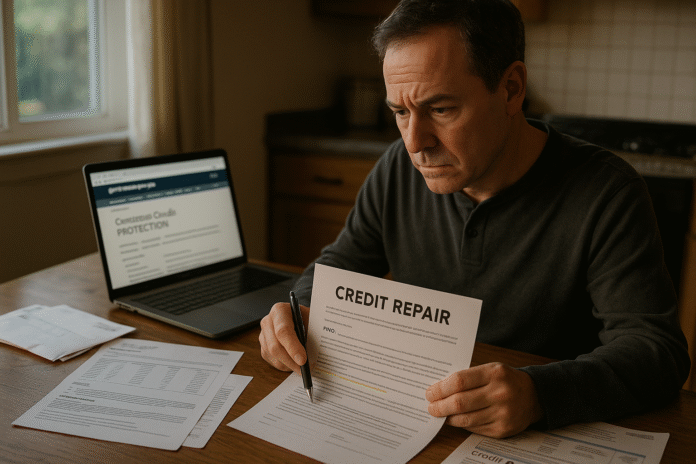
If you’re worried about your credit, you’re exactly the kind of person scammers target. This guide translates the fine print and fear tactics into plain English so you can spot credit repair scams quickly and choose safer, legitimate alternatives. Quick definition: a credit repair scam is any service that promises fast credit score fixes in exchange for money—often up front—using tactics that are illegal, deceptive, or ineffective. To protect yourself, learn the red flags below and the concrete steps you can take today. (This article is educational, not legal advice. U.S. references apply unless noted.)
Fast checklist (skim first, then read deeply):
- Don’t pay any money up front for credit repair.
- Be suspicious of guarantees, “overnight” fixes, or promised score bumps.
- Walk away if they push a CPN/new identity or “credit sweep.”
- Refuse to dispute accurate items or to file fake ID theft reports.
- Demand a written contract, disclosures, and a 3-day cancellation right.
- Avoid telemarketing pressure, impersonations, and “secret loopholes.”
- Don’t buy or rent tradelines; don’t rely on pay-for-delete guarantees.
- Use free weekly credit reports and reputable nonprofit counseling instead.
1. They Ask for Money Up Front (Before Doing Anything)
Legitimate credit repair companies can’t charge advance fees for credit repair services. If a company asks for a setup fee, “membership” payment, or a month or two in advance before they’ve completed work, that’s a red flag. U.S. federal law (the Credit Repair Organizations Act, or CROA) prohibits credit repair firms from demanding or receiving payment before services are fully performed. Telemarketing sales of credit repair also fall under the FTC’s Telemarketing Sales Rule (TSR), which similarly bars advance fees for certain debt-relief services. In short: if they want money first, don’t proceed.
1.1 Why it matters
Advance-fee demands shift all the risk onto you and incentivize minimal or no work. Major enforcement actions have targeted companies for illegal upfront fees and deceptive claims—showing that the pattern is common, not rare. In 2023, for example, regulators alleged widespread advance-fee violations by big players; the consequences included large settlements and bans from telemarketing credit repair services.
1.2 Mini-checklist: pay only after results
- A written contract must spell out services and timelines.
- No fees until services are completed.
- Avoid “monthly subscriptions” that start before any verified results.
- Keep receipts and communications in writing.
Bottom line: If a company insists on upfront payment, walk away and report it.
2. They Guarantee Score Increases or Promise to Remove Accurate Negatives
No one can guarantee a specific score increase or promise to remove accurate, timely negative information (like a legitimate late payment or collection) before it ages off your report. CROA makes it illegal for credit repair companies to lie about what they can do and prohibits false guarantees. If you see “We can erase bankruptcies!” or “+150 points in 30 days,” that’s classic scam copy.
2.1 Numbers & guardrails
- Accurate negatives typically remain 7 years (most items) or 10 years (most bankruptcies).
- Dispute investigations usually take 30 days (up to 45 days in some cases).
- Companies must notify you of dispute results and provide a free updated report if changed.
2.2 Do this instead
- Focus disputes on errors you can document.
- Use official sample letters and keep proof of mailing.
- Track responses and escalate to the CFPB or state AG if investigations are mishandled.
Bottom line: Realistic credit rebuilding is about time, accuracy, and on-time payments—not guarantees.
3. They Pitch a “CPN,” “New Credit Profile,” or “File Segregation”
Scammers often sell a CPN (Credit Privacy Number) or tell you to build a “new credit identity.” Using a number in place of your SSN on credit applications is illegal and can amount to identity theft or fraud. Some CPNs are literally stolen SSNs—often from vulnerable populations. A legit company will never ask you to use a new identity to apply for credit.
3.1 How to spot it
- Claims that a CPN is “legal” or “government-issued” (it’s not).
- Instructions to change addresses, phone numbers, or email so data won’t “match.”
- Packages combining CPNs with “credit sweeps” or shelf corporations. gcefcu.org
3.2 Safer path
- Use your SSN and rebuild credit legitimately: on-time payments, lower utilization, secured cards, and monitoring.
- If you suspect identity theft, file a plan at IdentityTheft.gov.
Bottom line: Any “new identity” pitch is a hard stop—decline and report.
4. They Tell You to Dispute Everything or File Fake Identity Theft Reports
Some operators push “credit sweeps,” urging you to dispute every negative item—even accurate ones—or to file false identity theft reports to “force deletions.” This can backfire and may be illegal. The FTC has shut down firms for filing fake ID theft claims and blasting credit bureaus with unsupported form letters that rarely work. Stick to truthful, documented disputes only.
4.1 How to do disputes right
- Limit disputes to specific inaccuracies; attach documentation.
- Send to both the credit bureau and the furnisher when appropriate.
- Track the 30- to 45-day timeline and keep a paper trail.
4.2 If you’re truly a victim
- Start at IdentityTheft.gov to create an Identity Theft Report and a step-by-step recovery plan. FTC Bulkorder
Bottom line: “Dispute everything” is not a strategy; it’s a signal to leave.
5. They Tell You Not to Contact Bureaus/Creditors—or Ask You to Sign Blank Forms
Be wary of anyone who tells you to avoid the credit bureaus or your creditors, or who asks you to sign blank documents or give power of attorney with no clear limits. These tactics cut you out of critical communications and can raise the risk of identity theft. Some local regulators explicitly warn that signing blank forms can expose you to serious harm. New York City Government
5.1 Practical guardrails
- Never sign blank dispute letters or mass-mailed templates without reviewing content.
- Keep direct lines with bureaus/creditors and monitor responses.
- Verify company identity and physical address; avoid anonymity.
5.2 Tools & templates
- Use official sample letters for disputes—customize them with your facts. Consumer Advice
Bottom line: You should stay in control. If they demand silence or blank signatures, walk.
6. No Written Contract, No Required Disclosures, No 3-Day Right to Cancel
Under CROA, credit repair contracts must be in writing, describe services and timelines, outline total cost, and include a notice of your three-business-day right to cancel—without penalty. If any of that is missing, or you’re pressured to sign without time to read, that’s a serious red flag. You are legally entitled to cancel within three business days after signing.
6.1 What your contract must include
- Clear description of services and time to results.
- Total cost and payment terms (with no advance fees).
- Right to cancel within 3 business days and how to do it. Legal Information Institute
6.2 How to cancel (quick steps)
- Send a dated, signed notice (certified mail is best).
- Keep copies of all communications and receipts.
Bottom line: If they won’t provide a compliant written contract, don’t sign—and report it.
7. High-Pressure Telemarketing, Impersonations, or “Official-Looking” Claims
Scammers lean on urgency: “Last-day discount,” “You’ll miss the mortgage rate,” or “We’re with the credit bureau/government.” The TSR restricts telemarketing practices, including advance fees for certain services, and the FTC continues to shut down debt-relief operations that impersonate banks and government agencies. If a caller can’t (or won’t) send you a written contract and disclosures, hang up.
7.1 Spot the impersonation
- Email addresses that aren’t official domains (e.g., not .gov).
- Logos pasted into documents with no verifiable origin.
- Refusal to provide a physical address or state registration.
7.2 Safer paths
- Initiate contact yourself via official sites (FTC, CFPB, state AG).
- Use AnnualCreditReport.com and IdentityTheft.gov—both are free. annualcreditreport.com
Bottom line: Urgency and impersonation are classic scam patterns. Slow down and verify.
8. “Renting Tradelines” or Selling Authorized-User Spots
Some companies sell “tradelines” (paid authorized-user slots on strangers’ credit cards) to boost your score quickly. The FTC has highlighted enforcement under CROA and the TSR tied to piggybacking schemes and misrepresentations. Beyond legal risks, card issuers often forbid selling AU spots, and results are inconsistent and short-lived. Don’t buy your way onto someone else’s credit.
8.1 Common pitfalls
- Large upfront fees for temporary score bumps.
- Accounts removed without notice; benefits vanish.
- Potential account closures by issuers for policy violations.
8.2 Better alternatives
- Build your positive history: secured cards, credit-builder loans, on-time payments, lower utilization.
Bottom line: Tradeline marketplaces are risky and unreliable. Build real history instead.
9. “Pay-for-Delete” Sold as a Sure Thing
“Pay-for-delete” means paying a collector to remove a collection tradeline. While some collectors choose to delete, it isn’t guaranteed, and it contravenes CDIA furnishing policies. Treat any “guaranteed pay-for-delete” pitch as a warning sign. Focus on validating the debt, negotiating affordable settlements, and ensuring accurate reporting.
9.1 Practical steps
- Validate the debt and get agreements in writing.
- If a collector agrees to delete, insist on written confirmation before paying.
- If the information is inaccurate or cannot be verified, it must be corrected or removed. Consumer Financial Protection Bureau
9.2 Guardrails
- Even with deletion, your lender may still see prior issues in other data sources.
- A paid collection can still be better than an unpaid one when under manual review.
Bottom line: Don’t pay for promises a company can’t control.
10. “Secret Loopholes” (Like Magic “609 Letters”) and One-Size-Fits-All Templates
You’ll see services selling “609 letters” or “secret FCRA loopholes.” Section 609 gives you the right to request information held about you, but it doesn’t force deletion of accurate, verified debts. Templates can help you format a letter; they don’t override the law or evidence. Use official dispute channels and attach supporting documentation. Upsolve
10.1 Smart documentation
- Highlight specific tradelines; include statements, receipts, police/identity-theft reports as applicable.
- Send by certified mail; keep copies and timelines.
- Follow up if there’s no response within 30–45 days. Consumer Financial Protection Bureau
10.2 Region note
Outside the U.S., your rights and timelines vary by country. Check your national consumer regulator for dispute procedures and templates.
Bottom line: There are no magic letters—only well-documented, targeted disputes.
11. They Hide Free Resources and Realistic Timelines
A reputable helper will point you to free tools: weekly credit reports at AnnualCreditReport.com, dispute instructions from the CFPB/FTC, and nonprofit credit counseling if you need a broader debt plan. Watch for firms that hide these resources, claim “only we can do this,” or promise timelines that contradict federal dispute requirements (30–45 days to investigate).
11.1 Your free toolkit (bookmark these)
- AnnualCreditReport.com – free weekly credit reports (U.S.). Consumer Advice
- CFPB dispute guides & sample letters.
- IdentityTheft.gov – official recovery plans for ID theft.
- NFCC agency finder – nonprofit credit counseling.
11.2 Timelines that are real
- Dispute investigations: 30 days, up to 45 in some cases.
- Bureaus must notify you of results within 5 business days after completing the investigation.
Bottom line: If someone won’t acknowledge the free, official path—or promises faster results than the law allows—assume the worst.
FAQs
1) Are credit repair companies legal?
Yes, but they must follow strict rules. In the U.S., CROA prohibits advance fees and deceptive claims and requires written contracts and a three-day cancellation right. The FTC and CFPB regularly take enforcement actions when companies ignore these rules. If a service pressures you for money before results or “guarantees” deletions, treat it as a likely scam and report it.
2) How long does legitimate credit repair take?
There’s no instant fix. Dispute investigations generally take 30 days (up to 45 in some situations). Even when errors are corrected, it can take additional billing cycles for lenders to see updated data. Real improvement comes from on-time payments, lowering utilization, and avoiding new derogatories.
3) Can a company remove accurate negative information?
No. Accurate, timely negatives generally remain for seven years (most items) and ten years for many bankruptcies. Any claim to “erase” accurate history is deceptive. Focus disputes on inaccuracies and keep documentation. Consumer Financial Protection Bureau
4) What is a CPN and why is it dangerous?
A CPN (Credit Privacy Number) is marketed as a legal SSN substitute; in reality, using one on credit applications can be fraud and may involve stolen SSNs. Avoid any service offering a CPN or a “new identity”—that’s a hallmark of a scam.
5) Should I use “pay-for-delete”?
You can try to negotiate, but deletion isn’t guaranteed and goes against industry furnishing policies. Prioritize validation of the debt and accurate reporting. If a collector agrees in writing to delete after payment, keep that proof—but don’t pay based on promises alone.
6) What if a bureau or furnisher ignores my dispute?
Escalate: re-submit with additional documentation, then file a complaint with the CFPB and your state attorney general. Regulators have cited bureaus for poor dispute handling; complaints help enforce standards. Consumer Financial Protection Bureau
7) How do I get my credit report for free?
Go to AnnualCreditReport.com for free weekly online reports from Equifax, Experian, and TransUnion (permanent offer). Avoid look-alike sites; you don’t need a subscription.
8) Is “dispute-everything” a good tactic?
No. Mass, unsupported disputes can be flagged as frivolous and delay legitimate corrections. Target specific, provable errors and attach documentation.
9) What’s a safer alternative to credit repair companies?
Start with nonprofit credit counseling (e.g., NFCC member agencies) for budget help and debt-management plans. Counseling is typically free or low cost and doesn’t rely on questionable tactics.
10) I think I’m an identity theft victim—what now?
Create an Identity Theft Report and get a personalized recovery plan at IdentityTheft.gov. This helps you place fraud alerts, close fraudulent accounts, and navigate disputes.
11) Where do I report a credit repair scam?
Report to ReportFraud.ftc.gov, the CFPB complaint portal, and your state AG. Include contracts, receipts, screenshots, and emails—details help investigators act faster.
12) Do medical debts still hurt my credit?
Reporting rules for medical collections have changed in recent years, and regulators continue to act in this area. Removing certain medical collections has improved scores for many consumers, but always verify what’s currently reported on your file and dispute inaccuracies.
Conclusion
Credit repair scammers feed on stress and urgency. They promise instant results, pressure you to pay up front, and hide the free, official routes that actually work. The truth is steadier and far more empowering: your rights are real, the timelines are clear, and the tools are free. Start by pulling your free weekly credit reports, comb them for specific errors, and file documented disputes using official templates. If your challenge is bigger than a few corrections, talk to a nonprofit credit counselor who will help you build a sustainable plan without illegal shortcuts. And if you encounter shady tactics, report them—your action protects others and helps clean up the marketplace.
Take the next step today: pull your reports, circle the errors, and send your first documented dispute—then set reminders to follow up within 30 days.
References
- Credit Repair Organizations Act (overview), Federal Trade Commission (n.d.). Federal Trade Commission
- 15 U.S.C. §1679e – Right to cancel contract (CROA), Legal Information Institute, Cornell Law School (n.d.). Legal Information Institute
- Complying with the Telemarketing Sales Rule (Payment Restrictions on Sales of Credit Repair Services), Federal Trade Commission (n.d.). Federal Trade Commission
- CFPB v. Progrexion et al. (Lexington Law/CreditRepair.com) settlement coverage, Investopedia (June 2023). Investopedia
- “FTC says credit repair company en-CROA-ched consumer rights,” Federal Trade Commission (June 28, 2019). Federal Trade Commission
- “What is a Credit Privacy Number (CPN)?,” TransUnion (Jan. 19, 2024). TransUnion
- “FTC halts deceptive credit repair operation that filed fake identity theft complaints,” Federal Trade Commission (Mar. 21, 2022). Federal Trade Commission
- “CROA case shows why piggybacking isn’t the answer…,” Federal Trade Commission (Mar. 9, 2020). Federal Trade Commission
- Market Snapshot: Third-party debt collections tradelines reporting (pay-for-delete), Consumer Financial Protection Bureau (Feb. 2023). Consumer Financial Protection Bureau
- “How do I dispute an error on my credit report?,” Consumer Financial Protection Bureau (Dec. 18, 2024). Consumer Financial Protection Bureau
- “If a credit reporting error is corrected… how long…?,” Consumer Financial Protection Bureau (Jun. 6, 2023). Consumer Financial Protection Bureau
- “Free Credit Reports,” Federal Trade Commission (updated Oct. 13, 2023; posted Jan. 4, 2024). Consumer Advice
- IdentityTheft.gov – Report identity theft and get a recovery plan, Federal Trade Commission (n.d.). IdentityTheft.gov
- Disputing Errors on Your Credit Reports (consumer advice + timelines), Federal Trade Commission (2023–2024). Consumer Advice
- Sample letters to dispute credit report information, Consumer Financial Protection Bureau (Oct. 17, 2023). Consumer Financial Protection Bureau
- Agency Finder (nonprofit counseling), National Foundation for Credit Counseling (accessed Sep. 2025). NFCC
- “CFPB sues Experian over… credit accuracy,” Reuters (Jan. 7, 2025). Reuters
- Early impacts of removing low-balance medical collections, Consumer Financial Protection Bureau (May 20, 2024). Consumer Financial Protection Bureau