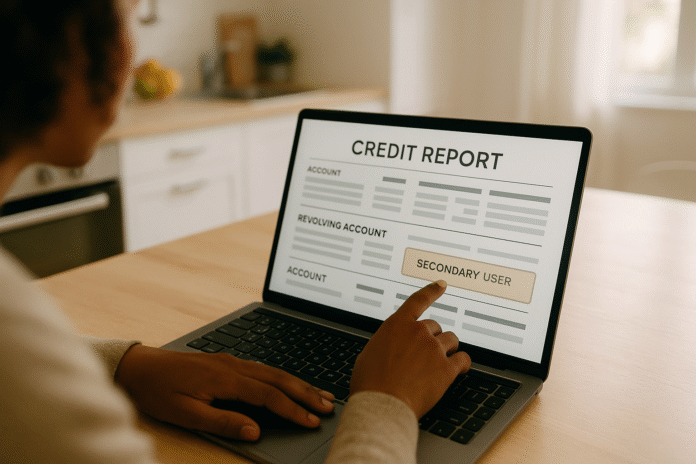
If you’ve been added to someone’s credit card, you may wonder exactly what shows up on your credit reports—and what it means for your scores. Here’s the short answer: an authorized user account typically appears as a revolving tradeline labeled “Authorized User,” showing the card’s limit, balance, payment history, and the account’s age when the issuer reports it to the bureaus. This guide explains how authorized user (AU) data is displayed, how models count it, where issues crop up, and the precise steps to fix them. It’s written for consumers, parents adding teens, and anyone preparing for a major loan. This is general U.S. information as of now—not legal or financial advice.
Quick way to spot an AU account on your report:
- Look for Responsibility/Ownership: Authorized User (sometimes labeled via an ECOA code).
- Confirm Account Type: Revolving and card details.
- Check Credit Limit & Balance and Payment History lines.
- Verify Date Opened and whether the full history is showing.
1. Where AU Accounts Show—and the Exact Label You’ll See
Authorized user accounts appear within the credit history section as a revolving tradeline with a responsibility/ownership field that reads Authorized User. In many reports, that status is tied to an ECOA (Equal Credit Opportunity Act) relationship code (often “A”) that explicitly marks you as a non-liable user. You’ll generally see the creditor’s name, the account type (revolving/credit card), date opened, credit limit, current balance, payment status, and a month-by-month payment history grid. In short: it looks like any other credit card tradeline except the report clearly notes your role as an authorized user rather than an owner.
Because formats vary by bureau and report provider, the wording may differ slightly—“Whose Account/Payment Responsibility: Authorized User,” “Ownership: Authorized User,” or an ECOA legend showing “A = Authorized User.” Expect to see the same core data fields: date opened, high credit/limit, balance, past due (if any), and payment history. These fields are what scoring models read when the account is included in your score, and they’re also what underwriters scan manually for mortgages and other large loans. If you don’t see an explicit label, the presence of a responsibility field, an ECOA code list, or a report user guide usually decodes it.
Why it matters
- The Authorized User label clarifies you’re not contractually responsible for the debt, even though the tradeline can influence your score.
- Underwriters and dispute investigators rely on this field to determine responsibility.
- If the label is wrong (e.g., listed as joint/individual), that’s disputable and worth correcting.
How to read it (mini-checklist)
- Responsibility/Ownership: Must say Authorized User (or ECOA “A”).
- Payment History: Late marks here can affect you—even though you aren’t liable.
- Limit/Balance: These feed utilization if the model counts AU data.
- Date Opened: Helps your average age of accounts (see Section 3).
Synthesis: The AU tag is the small label that drives big consequences. Verify it’s present and correct before you act on any score swings.
2. When AU Accounts Appear—and Why They Sometimes Don’t
Most AU accounts appear on your reports within 30–60 days after you’re added, because issuers report on statement cycles. Some issuers are faster (about a month) and others take two full cycles. Not all card issuers report authorized users, and some set age or data-match requirements (such as needing your SSN or a minimum age) before they’ll furnish your AU line to the bureaus. If the issuer doesn’t report AUs—or only reports to one or two bureaus—you’ll see gaps across Experian, Equifax, and TransUnion.
If your AU account doesn’t show after two cycles, start with the issuer: confirm they report AUs, verify your identifying info (name, date of birth, SSN) is correct, and ask which bureaus they furnish. Next, pull all three reports; it may appear on one and not the others. Younger AUs sometimes don’t get reported until they reach the issuer’s age threshold, and address mismatches or credit freezes can block attachment. Lastly, if you only just got added and the statement hasn’t closed, the line likely won’t display yet.
Troubleshooting steps
- Issuer check: Do they report AUs? To which bureaus? Any age restrictions?
- Data match: Confirm your SSN, DOB, and spelling with the issuer.
- Report pulls: Check all three bureaus; don’t rely on just one.
- Wait window: Allow two full cycles; add one more if the add occurred just after a statement closed.
Numbers & guardrails
- Typical posting window: 30–60 days from addition.
- If no show after 60 days, escalate with the issuer and then the bureaus.
Synthesis: Timing hinges on the issuer’s reporting schedule and data quality. Two cycles is normal; beyond that, verify details and furnishers.
3. What History Carries Over—Age, Limits, and Payment Grid
When an AU line is furnished, the full account history is commonly reflected on the authorized user’s reports, including the original date opened, credit limit, balance, and the rolling payment grid. That’s why AU status can meaningfully affect credit age and payment history metrics when the scoring model counts it. If the primary card is older than your profile and shows clean on-time payments, your file gets the benefit of that length and record. Conversely, any late marks or derogatories on that card can appear on your reports and weigh on scores.
Note that the displayed date opened typically mirrors the card’s true open date, even if you were just added. Because the tradeline is the same underlying account, the bureau record usually contains its full lifecycle. This is a feature (you can inherit age) and a risk (you can inherit blemishes). Issuers or bureaus can sometimes mismatch or truncate data; if you see a missing history, a wrong open date, or misapplied late marks, use the dispute process outlined in Section 8 to correct or suppress it.
Mini case
- You: Thin file, 1 card opened 6 months ago.
- AU add: Parent’s 8-year-old card, $15,000 limit, perfect history.
- Effect: Report now shows an 8-year tradeline with $15,000 limit—boosting your age and potentially your utilization cushion (see Section 5).
Common pitfalls
- Assuming the AU line will only help: negative data carries, too.
- Relying on AU age alone for large loans: mortgage underwriters may discount AU history (see Section 9).
Synthesis: AU lines often port the account’s entire past onto your reports—powerful for age and history, but only if the account is pristine.
4. How Scoring Models Treat AU Accounts (FICO, VantageScore & Lenders)
FICO Score 8 (and later generations) include authorized user tradelines but with anti-abuse logic meant to reduce “piggybacking” gaming; legitimate AUs can still benefit when the account is well-managed. Other models may treat AU data differently, and lenders choose which model/version to use. That means your AU line might materially help a bankcard decision using FICO 8, be neutral in a lender’s custom model, or get de-emphasized by underwriting overlays—especially on mortgages.
VantageScore 4.0 is widely used in consumer credit monitoring and lender workflows, but its precise treatment of AUs is proprietary. Historically, some non-FICO models limited or excluded AU data in response to tradeline rental abuse, while others adjusted weighting. Regardless of model, underwriters can and do re-evaluate AU tradelines manually for large loans, sometimes discounting them if they don’t reflect the applicant’s own repayment behavior.
What to expect
- FICO 8/9/10 Suite: AUs counted with safeguards (legitimate relationships still help).
- Model variance: Different lenders/models may downweight or examine AU impact.
- Underwriting judgment: Human review can override automated treatment.
Practical guardrails
- Build your own primary positive tradelines alongside any AU boost.
- Expect mortgage systems to flag AU lines for review (Section 9).
- Don’t buy tradelines hoping for guaranteed score jumps (Section 11).
Synthesis: Scores can count AUs, but lenders—and their models—decide how much it matters. Treat AUs as a supplement, not a substitute.
5. Utilization Math: Limits, Balances, and Why an AU Can Help (or Hurt)
If the model includes AU data, the AU card’s credit limit and balance flow into your revolving utilization—a major score factor. A high-limit card that reports low balances can lower your overall utilization (good), while a card that regularly carries a large balance can increase your utilization (bad). Closing or removing the AU line can also change your utilization by shrinking total available credit, sometimes causing a score dip even if nothing else changes.
The key is how the statement balance reports. Utilization is based on balances as reported to the bureaus, not what you paid five minutes later. If the primary cardholder allows balances to report at 40–80% of the limit, your utilization may spike. Conversely, if they report single-digit balances and large limits, your utilization improves—especially helpful for thin files.
Numbers & guardrails
- Aim for overall utilization under 30%; under 10% is often optimal for scores.
- Removing an AU card that contributes $15,000 in limit can increase your utilization overnight if your other limits total only $5,000.
- A single maxed-out AU card can be worse than no AU card at all.
Mini-checklist
- Confirm the AU card’s limit and typical statement balance.
- Time big paydowns before statement close to keep reported balances low.
- Recheck scores after removal/closure; expect utilization shifts.
Synthesis: Utilization is arithmetic. If the AU card improves the math, keep it clean; if it worsens the ratio, reconsider the arrangement.
6. Late Payments, Derogatories, and Who’s Actually Liable
Late payments and derogatories on the primary card can appear on your reports as an authorized user and hurt your scores, even though you’re not legally responsible for the debt. That split reality—data impact without liability—is why the AU label exists. If the primary misses payments, gets charged off, or racks up high utilization, your profile can take a hit until the tradeline is fixed or removed. Some issuers stop furnishing AU data when the account goes delinquent, but you can’t count on that protection.
If you see a misattributed late payment (e.g., the report lists you as joint/individual), dispute it and provide evidence that you’re only an AU. When the data is accurate but harmful, the pragmatic fix is to have the primary restore the account to good standing, or remove you from the card and allow reporting cycles to update. You can also add a consumer statement for context, but statements don’t affect scores.
Mini-checklist (if harm occurs)
- Confirm responsibility: Ensure the tradeline shows Authorized User.
- Coordinate with the primary: Bring the account current and lower balances.
- If necessary, remove yourself: Then allow 1–2 cycles for updates.
- Dispute mislabeling: If the report shows you as liable owner, dispute with evidence.
Why it matters
- Scores respond to data, not liability. The AU label protects you legally, not mathematically.
- Quick action limits the damage window.
Synthesis: AU negatives count in scoring even if you don’t owe the bill. Fix the account, or exit it, then let the reporting catch up.
7. Why Your Three Reports May Not Match
It’s common for AU data to differ across Experian, Equifax, and TransUnion. Lenders furnish data voluntarily and on their own cadence; some report AUs to all three, some to only one or two, and timing often varies by a week or a full cycle. Even when all three receive the account, you might see differences in last reported date, balance, or the presence of the AU label, creating score spreads that confuse consumers.
Don’t assume a missing AU tradeline means a universal error. First, look for it on each bureau separately. Next, compare reported balances and dates—if a balance is stale on one report, that can explain a score gap. Finally, verify the responsibility/ownership field; if it’s missing or mis-coded, that may be suppressing how a model reads the line. For upcoming credit applications, refresh your reports within 30 days of applying to minimize timing noise.
Mini-checklist to reconcile differences
- Pull all three reports the same week.
- Compare responsibility, limit, balance, and last updated fields.
- Ask the issuer which bureaus they furnish to (and on what schedule).
- Consider a fresh pull after the AU card’s next statement closes.
Why it matters
- Score gaps of dozens of points can stem from simple data timing or partial reporting.
- Underwriters see bureau-by-bureau details; you should, too.
Synthesis: Variance is normal. Align timing, confirm furnishing, and evaluate each bureau on its own merits.
8. Removing or Fixing an AU Line (Cleanly and Quickly)
To remove yourself from an AU account, contact the card issuer and request removal. If the issuer’s portal allows it, the primary can also remove you online. Once removed, the tradeline typically drops from your reports within one or two reporting cycles. If it lingers or is incorrectly labeled (e.g., still shows as joint), file disputes with the credit bureaus and, when helpful, with the issuer (the “furnisher”). Use clear documentation: account details, proof of AU status, and the date you were removed.
If the problem is incorrect data—wrong responsibility code, misapplied late mark, wrong open date—submit a dispute citing the specific field that’s inaccurate and why. Attach statements or issuer confirmations. For urgent mortgage timelines, ask the issuer for a rapid rescore through your lender (note: consumers can’t order this directly). Keep copies of confirmations and dispute letters.
Mini-checklist
- Step 1: Remove AU status with the issuer (phone/app).
- Step 2: Wait one full cycle; then check all three reports.
- Step 3: If still wrong, dispute with each bureau (attach proof).
- Step 4: For time-sensitive loans, ask your lender about a rapid rescore.
Pro tip
- Use official dispute letter templates and include marked-up report pages. Clear, specific requests speed resolution.
Synthesis: Start with the issuer, then use targeted bureau disputes. Most AU issues resolve within a cycle or two once the data is corrected at the source.
9. How Mortgage Underwriters Treat AU Accounts
Mortgage underwriting engines (like Fannie Mae’s DU and Freddie Mac’s LPA) identify AU tradelines and may require lenders to validate them. While your credit score may reflect AU benefits, lenders often discount or exclude AU accounts unless certain conditions are met—such as the account belonging to a co-borrower/spouse or evidence that you have been making the payments for 12 months. Lenders can also apply prudent judgment and analyze your profile without AU tradelines if they think the AU data inflates your apparent credit strength.
Practically, that means you shouldn’t rely on AU lines alone for a mortgage. Build your own primary history—at least two or three open, well-managed accounts—with clean on-time payments and low utilization. If you do list AU lines, be ready to provide documentation (statements showing your payments, relationship to the owner, or co-borrower status).
Lender reality check
- Automated findings may flag AU tradelines and ask for documentation.
- If you can’t document relationship or payment history, expect limited credit for the AU line.
- Policies evolve; confirm current lender overlays before application.
Mortgage prep checklist
- Maintain your own primary tradelines 12–24 months.
- Keep utilization low across all cards.
- Collect statements if you’ve been paying the AU card.
Synthesis: Scores open the door, but underwriters decide what’s real. AU lines help, yet documented primary history wins mortgages.
10. Adding Teens and Young Adults: Age Rules, Reporting, and Expectations
Parents often add teens or college-age children as AUs to jump-start credit. Whether that AU line appears—and helps—depends on the issuer’s age and reporting policies. Some issuers allow minors to be added but don’t furnish AU data until age 18; others require a minimum age to add the AU at all. Even when reported, the benefit still hinges on good management: on-time payments, low statement balances, and a clean history.
Set clear rules: spending limits, what counts as an emergency, and how to monitor activity. Consider giving the AU access without issuing a physical card (some banks allow virtual access or card suppression) to reduce misuse. Explain that AU benefits aren’t permanent—in underwriting, lenders value the child’s own accounts. Plan for a transition to a starter or secured card once they’re ready, and decide whether to keep the AU line for utilization cushion.
Family checklist
- Confirm age policy and whether the issuer furnishes AU data for minors.
- Use spending controls and enable alerts.
- Teach statement timing and utilization basics.
- Set a sunset date to transition to a primary card.
Guardrails
- A single late payment can offset months of benefit.
- If balances regularly report high, the AU line can hurt more than help.
Synthesis: AU status can be a responsible on-ramp for young borrowers—if the issuer reports and the family manages the account deliberately.
11. Tradeline “Renting,” Red Flags, and Safer Alternatives
“Piggybacking” by paying strangers to add you as an AU promises quick score boosts but carries serious risks. Lenders and scoring developers implemented anti-abuse measures that reduce the impact of suspicious AU relationships, and underwriters can discount these lines outright. These services may also violate issuer terms or raise fraud and privacy concerns. Even when they “work,” the effect can be short-lived, and you’re exposed to the account owner’s behavior—late payments, closures, or high balances.
A safer path is to build organic credit: become an AU only with trusted family or co-borrowers, keep balances low, and layer in your own primary accounts (secured or starter cards, credit-builder loans). If you already bought a tradeline and see erratic reporting, consider removing yourself and focusing on durable habits. For big goals like mortgages, prioritize documentable history that underwriters will actually count.
Safer alternatives
- Secured card with a deposit you can afford.
- Credit-builder loan through a bank or credit union.
- Authorized user with a verified relationship and clean track record.
Mini-checklist
- Avoid AU offers from strangers or marketplaces.
- Never share sensitive personal data with unvetted third parties.
- Build two or more primary tradelines you control.
Synthesis: Don’t rent a credit history. Sustainable, documentable credit you control beats risky shortcuts every time.
FAQs
1) Do authorized user accounts always show on all three credit reports?
No. Reporting AU data is issuer-dependent and voluntary, and timelines vary by bureau. Many major issuers furnish AUs to all three, but some report to only one or two—or not at all. Always check with the issuer and review Experian, Equifax, and TransUnion separately. If you don’t see the AU line after two cycles, verify your info with the issuer and pull fresh reports.
2) How long does it take for an AU account to appear, and can it be faster?
Typically 30–60 days from when you’re added, aligning with statement cycles. You may see it sooner if you were added right before the statement closes and the issuer reports promptly. If timing is critical (e.g., a mortgage), don’t assume—wait until you confirm the AU line appears on all relevant reports before applying.
3) Will I get the primary card’s full payment history and age on my report?
Often, yes—the full tradeline history is commonly reflected, including the original date opened. That can help your credit age and on-time history, but it also means any late payments or derogatories on the card can weigh on your scores. If the history appears incomplete or the open date is wrong, dispute the specific field with documentation.
4) Can late payments from the primary cardholder hurt my score even though I’m not liable?
They can. Scoring models react to what’s reported, not who owes the debt. As an AU, you aren’t contractually responsible, but negative data can still depress your scores until the account is corrected or you’re removed and the bureaus update your file. Verify the AU label and coordinate with the primary to fix delinquencies.
5) Does an AU card help my credit utilization?
It can. If the AU card reports a high limit and low balance, your overall utilization may drop, which is score-positive. If the card often reports high balances, your utilization can rise and hurt scores. Utilization is calculated from reported statement balances, so timing and payment behavior on the AU card matter.
6) If I remove myself as an AU, how quickly will the tradeline drop?
After the issuer removes you, expect the tradeline to update within one or two reporting cycles. If it lingers, file disputes with the bureaus and include evidence (issuer confirmation, dates) requesting removal or correction of responsibility. For time-sensitive loans, ask your lender about a rapid rescore after the issuer updates the data.
7) Do I need to use the AU card for it to help?
Not necessarily. Scoring models look at the account’s reporting, not whether you personally used the card. If the issuer furnishes AU data and the account is managed well (on-time payments, low balances), the tradeline can still help. Usage rules are best set within the family for budgeting and control, not for scoring.
8) Will AU accounts help me qualify for a mortgage?
They can contribute to your score, but mortgage underwriters often discount AU lines unless you can document a qualifying relationship (spouse/co-borrower) or that you paid the account for 12 months. Build your own primary history and be prepared to supply statements if an AU line is part of your profile.
9) Why do my three scores differ even though the AU account looks the same?
Even small differences—like a more recent balance update at one bureau—can move scores. Issuers furnish on different schedules, and models/versions vary. Pull reports close together, compare last updated dates, and confirm the AU label and balances match. Score spreads often narrow after the next reporting cycle.
10) Is buying a tradeline a good idea?
No. Paid AU schemes carry fraud and privacy risks, lenders may discount them, and scoring models have anti-abuse logic. Building your own primary tradelines, keeping utilization low, and paying on time are safer, more durable ways to qualify and keep good rates.
11) What if the AU account appears as “joint” or “individual” by mistake?
Dispute the responsibility field with each bureau and include evidence (screenshots, issuer letters) showing you are an authorized user. Ask the issuer to correct their furnishing if needed. Incorrect responsibility coding can affect both your legal exposure and how models interpret the tradeline.
12) Do AU accounts affect my debt-to-income (DTI) ratio?
Scores don’t use DTI, but lenders do. Mortgage guidelines may require proof that you’re not responsible for the AU debt, or evidence you’ve made the payments. If they can’t validate, they may include some or all of the payment in your DTI or disregard the AU line entirely. Clarify lender policy early.
Conclusion
Authorized user tradelines are deceptively simple: one label—Authorized User—and a familiar set of fields for a revolving account. But that small status flag can drive big outcomes. When furnished and counted, AU lines can lengthen your credit history, improve utilization, and diversify your profile. When mismanaged or misreported, they can import late payments, inflate balances, and trigger score drops—without you ever owing the bill. The best results come from intentional design: pick a well-managed card, confirm the issuer’s AU reporting, watch statement balances, and keep your own primary accounts in great shape. If something looks off, start with the issuer, then escalate with targeted bureau disputes. For mortgages and other major loans, remember that underwriters judge documentation and ownership—so treat AUs as a complement to your own tradelines, not a replacement. Take a few deliberate steps today—verify labels, audit balances, and plan your next primary account—and you’ll convert AU status from a mystery into a measurable advantage.
CTA: Pull all three reports this week, verify your AU labels, and set a plan to optimize balances before your next statement closes.
References
- What Is an Authorized User on a Credit Card? Experian, Feb 21, 2025. https://www.experian.com/blogs/ask-experian/what-is-credit-card-authorized-user/
- Will Being an Authorized User Help My Credit? Experian, Apr 30, 2024. https://www.experian.com/blogs/ask-experian/will-being-an-authorized-user-help-my-credit/
- Are Authorized-User Accounts Reported to All Three Bureaus? Experian, Oct 25, 2024. https://www.experian.com/blogs/ask-experian/are-authorized-user-accounts-reported-to-all-three-bureaus/
- Credit Report Terminology. Equifax, n.d. https://www.equifax.com/personal/education/credit/report/articles/-/learn/credit-report-terminology/
- How to Read Your Credit Report. TransUnion, n.d. https://www.transunion.com/how-to-read-your-credit-report
- How do I remove an authorized user from my credit card account? Consumer Financial Protection Bureau, last updated Dec 28, 2022. https://www.consumerfinance.gov/ask-cfpb/how-do-i-remove-an-authorized-user-from-my-credit-card-account-en-86/
- Sample letters to dispute information on a credit report. Consumer Financial Protection Bureau, 2023. https://www.consumerfinance.gov/consumer-tools/credit-reports-and-scores/sample-letters-dispute-credit-report-information/
- Sample letter to credit bureaus disputing errors on credit reports. Federal Trade Commission, n.d. https://consumer.ftc.gov/sample-letter-credit-bureaus-disputing-errors-credit-reports
- Fair Isaac Innovation Will Restore Authorized User Accounts to Calculation of FICO 08 Scores. FICO Newsroom, Jul 31, 2008. https://www.fico.com/en/newsroom/fair-isaac-innovation-will-restore-authorized-user-accounts-calculation-fico-08-scores
- Score differences across credit bureaus reflect true data differences. FICO Blog, Dec 12, 2011. https://www.fico.com/blogs/score-differences-across-credit-bureaus-reflect-true-data-differences
- Credit Where None Is Due? Authorized User Account Status and Piggybacking Credit. Board of Governors of the Federal Reserve System, 2010. https://www.federalreserve.gov/pubs/feds/2010/201023/201023pap.pdf
- B3-5.3-09 DU Credit Report Analysis (Authorized User Tradelines). Fannie Mae Selling Guide, current as referenced 2025. https://selling-guide.fanniemae.com/sel/b3-5.3-09/du-credit-report-analysis
- Guide Bulletin 2024-16 (Authorized user accounts guidance). Freddie Mac, Dec 4, 2024. https://guide.freddiemac.com/app/guide/bulletin/2024-16
- How Being an Authorized User Affects Your Credit. Bankrate, Apr 24, 2025. https://www.bankrate.com/credit-cards/advice/should-you-be-an-authorized-user/
- How To Build Credit. TransUnion, Mar 3, 2023. https://www.transunion.com/blog/credit-advice/how-to-build-credit
- VantageScore 4.0 User Guide (abridged). VantageScore, Sep 2022. https://cdn.vantagescore.com/uploads/2022/09/VantageScore-4.0-UserGuide_abr_Sep22.pdf
- Fair Isaac Blog: Will closing credit cards help improve my FICO Scores? FICO Blog, Oct 14, 2019 (utilization discussion). https://www.fico.com/blogs/score-better-future-increases-fico-score-understanding