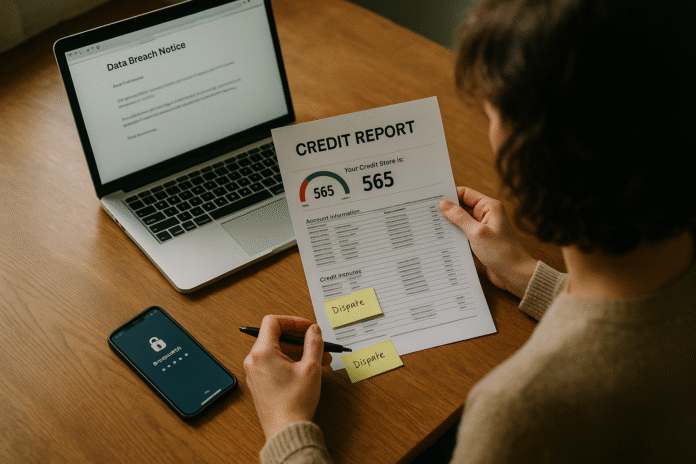
If a company says your data was exposed, you’re right to worry—but a data breach by itself doesn’t change your credit score. The risk comes if thieves use that data to open accounts, trigger hard inquiries, or run up bills that get reported in your name. The fastest way to limit damage is to monitor your files, place a credit freeze or fraud alert, and quickly dispute anything that isn’t yours. As of now, you can still get free weekly credit reports from each of the three nationwide bureaus, which makes catching problems early far easier. This guide explains the eight most common ways a breach shows up on credit reports—and exactly what to do next. Educational only; not legal or financial advice.
1. A breach doesn’t directly drop your score—fraudulent activity does
A breach puts your personal data at risk, but your credit report only changes when that data is misused—for example, to apply for credit, open accounts, or miss payments in your name. That misuse can create hard inquiries, new trade lines, late payments, and collections, all of which can dent your score. Because criminals often test stolen data in bursts, impacts can appear quickly after a breach notice, then cascade as accounts age. The most common downstream harm is new-account fraud, including mobile phone, buy-now-pay-later, or small-limit cards opened without your consent. As of 2023–2024, identity fraud losses in the U.S. were estimated in the tens of billions, underscoring why fast action matters. Start with monitoring, then move immediately to freezes and targeted disputes if you spot anything off.
1.1 Why it matters
- Credit scores depend heavily on payment history and new credit; fraudulent late payments or new accounts can weigh on both.
- Hard inquiries can trim points in the short term; compounded inquiries from multiple fraudulent apps are worse.
- Catching problems in the first 30–60 days limits score damage and simplifies disputes.
- Weekly free reports mean you can monitor without paying for subscriptions.
1.2 Mini checklist
- Read the breach notice for what data leaked (SSN vs. just email).
- Pull all three reports weekly for the next 3–6 months.
- If SSN or DOB leaked, freeze your credit at all three bureaus immediately.
- If you see anything unfamiliar, dispute and create an IdentityTheft.gov recovery plan.
Bottom line: the breach is a warning; the score impact comes from fraud. Use weekly monitoring and freezes to prevent misuse from landing on your reports.
2. Fraudulent hard inquiries and new accounts: spot them fast and remove them
The most visible early sign of misuse is a hard inquiry from a lender you don’t recognize, often followed by a new account. Each hard inquiry typically shaves a few points and stays on your reports for up to two years (FICO considers most of its impact for about one). When fraudsters shotgun applications, you may see several inquiries in days. Your goal is to dispute unauthorized inquiries and accounts immediately and to give bureaus and furnishers the documentation that compels removal—ideally an identity theft report from IdentityTheft.gov. If you legitimately applied for a loan, keep your shopping within recognized “rate-shopping” windows so real inquiries don’t over-penalize you (generally 45 days for FICO models; 14 days for some VantageScore versions).
2.1 How to dispute effectively
- Create an Identity Theft Report at IdentityTheft.gov to streamline removals.
- Dispute with the bureaus and the furnisher (the lender) in writing; include a copy of your ID, proof of address, and the FTC report.
- Ask the bureaus to block identity-theft-related info under the FCRA; furnishers must stop reporting items identified as identity theft unless verified.
- Keep copies and send by certified mail where possible.
2.2 Tools & templates
- Use the FTC’s sample dispute letters to the credit bureaus and companies.
- Track bureau responses; they generally investigate within ~30 days.
- If a furnisher keeps reporting despite your theft report, escalate to the CFPB.
Quick example: You spot a hard inquiry from “ABC Bank” and a card you never opened. You submit an IdentityTheft.gov report, freeze your credit, dispute with all three bureaus and ABC Bank, and within a few weeks the inquiry and account are removed and your score rebounds. IdentityTheft.gov
3. Credit freeze vs. fraud alert (and when to use both)
If your Social Security number or other key identifiers leaked, place a credit freeze—the strongest preventive step—at Equifax, Experian, and TransUnion. A freeze blocks new creditors from accessing your report, making unauthorized account openings far harder; since September 2018, freezes and unfreezes are free nationwide (also free for children and certain dependents). A fraud alert tells creditors to take extra steps to verify identity; an initial alert lasts one year and is also free, while an extended alert lasts seven years if you’ve filed an identity theft report. You can have both a freeze and an alert; the freeze is the real gate. As of August 2025, you can place freezes online, by phone, or by mail.
Freeze vs. Alert at a glance
| Feature | Credit Freeze | Fraud Alert |
|---|---|---|
| Cost | Free (U.S.) | Free |
| Effect | Blocks most new credit pulls | Prompts extra verification |
| Duration | Until you lift it | 1 year (initial) / 7 years (extended) |
| Best for | SSN/DOB exposed, high-risk | Suspected misuse, active monitoring |
3.1 Steps to do now
- Freeze each bureau (Equifax, Experian, TransUnion).
- Consider freezing Innovis as well.
- If you need to apply for credit, temporarily lift the freeze for that lender or time window.
- Add an extended fraud alert if you filed an Identity Theft Report.
3.2 Region notes
- U.K.: You can add CIFAS Protective Registration to prompt extra checks; it doesn’t affect your score.
- Minors (U.S.): Parents and guardians can place child freezes; check each bureau’s process.
A short lift beats no freeze at all; default to frozen and thaw as needed.
4. Don’t stop at the “big three”: freeze specialty bureaus (telecom, utilities, and banking)
Criminals increasingly open mobile, cable, and utility accounts after breaches because those checks often run through specialty consumer reporting agencies rather than the big three. Two to know: the National Consumer Telecom & Utilities Exchange (NCTUE) and LexisNexis Risk Solutions. Freezing your NCTUE file helps block fraudulent phone and utility accounts; freezing LexisNexis can deter account opening and insurance misuse that leverages their data. As of early 2025, both organizations provide consumer disclosures, disputes, fraud alerts, and freezes at no cost. If a breach involved your SSN, freezing these files adds an important second barrier.
4.1 Quick actions
- Request your NCTUE disclosure report and place a freeze.
- Freeze LexisNexis and note your PIN for future lifts.
- Keep your big-three freezes on; these are additional layers, not replacements.
4.2 Mini case
After a breach at a retailer, Mia froze the big three but kept receiving bills for a new cell plan she never opened. She learned the carrier queried NCTUE, not the main bureaus. Freezing NCTUE stopped new lines, and the carrier closed the fraudulent account after she provided her FTC theft report.
Actionable takeaway: freeze where the fraudsters shop—telecom/utility and data brokers—not just Equifax, Experian, and TransUnion. Consumer Financial Protection Bureau
5. Audit your files weekly—free—and set smart alerts
Monitoring isn’t a silver bullet, but weekly free reports make it practical to spot problems early. Use AnnualCreditReport.com to pull each bureau’s report; stagger them (for example, Mon = Experian, Wed = Equifax, Fri = TransUnion) so you have ongoing visibility. If the breached company offers free credit monitoring, accept it—but treat it as an alert layer, not a replacement for freezes. Build a simple audit routine: scan for unknown inquiries, accounts, mailing addresses, and collections; confirm balances and payment statuses on real accounts; and verify name spellings and SSN digits to rule out file mixing. Catching a rogue $0 balance “test” tradeline often prevents larger damage.
5.1 What to look for (5-minute checklist)
- New names/addresses or employers you don’t recognize.
- Hard inquiries from lenders you didn’t authorize.
- New accounts—even with $0 balances.
- Payment status anomalies (e.g., shows “late” when you paid).
- Collections you don’t recognize (especially medical).
5.2 If you find an error
- Freeze your files (if not already).
- File an IdentityTheft.gov plan and use sample letters to dispute.
- Calendar 30 days for bureau responses; escalate to CFPB if needed.
Weekly audits don’t take long, and they dramatically reduce the window in which fraud can hurt you.
6. Stop collection fallout—especially medical identity theft and medical debt
Fraud can generate collection accounts, which are particularly harmful if they report as unpaid. Medical identity theft is a common vector: someone uses your information for care, then bills end up in collections under your name. The good news: since 2022–2023, the nationwide bureaus removed paid medical collections, added a one-year waiting period before reporting new medical collections, and exclude medical collections under $500. A 2025 federal rule that would have removed most medical bills from credit reports was blocked by a court in July 2025, so status quo persists for now. If you see a medical collection that isn’t yours, dispute it with the collector and bureaus and work with providers to correct records.
6.1 How to respond to medical identity theft
- Ask providers and insurers for records; correct errors and update addresses.
- File at IdentityTheft.gov, then dispute with bureaus and furnishers; reference the $500 exclusion and one-year wait where relevant.
- If a collector reports a debt under $500 or less than a year old, cite bureau policy changes and request deletion. Consumer Advice
6.2 Current rule status
- CFPB finalized a rule in Jan 2025 to remove medical bills from credit reporting and ban their use in lending decisions.
- A federal court vacated/blocked that rule in July 2025; medical debts (above policy thresholds) may still appear and be used, unless state law says otherwise.
- Many states and lenders continue evolving policies; check local rules.
Key takeaway: use today’s medical-debt exclusions to your advantage, but don’t assume all medical collections are gone—verify and dispute. Urban Institute
7. Lock down tax and benefits exposure: get an IRS IP PIN and watch for government-program fraud
After big breaches, criminals often pivot to tax identity theft (filing a fake return to capture your refund) or unemployment/benefits fraud. The quickest protective step is to enroll in the IRS Identity Protection PIN (IP PIN) program: a six-digit code that must accompany your return; without it, the IRS rejects fraudsters’ filings. As of 2025, any taxpayer can opt in online via IRS Online Account, and confirmed victims are automatically issued a new IP PIN each year. If you get a suspicious IRS letter, don’t ignore it; respond to stop someone else from locking in your account. State tax and labor agencies have similar processes if unemployment claims pop up in your name.
7.1 Steps
- Create/verify your IRS Online Account and request an IP PIN.
- Save the code securely; you’ll get a new one each year.
- If you can’t verify online, use Form 15227 or visit a Taxpayer Assistance Center.
- Report unemployment/benefit fraud to your state agency and freeze your credit. IRS
7.2 Example
Jordan receives an IRS notice about a return he never filed. He freezes his credit, enrolls for an IP PIN the same day, and the IRS flags his account to block future misuse. The fraudulent return is stopped and his legitimate refund is processed later without further issues. IRS
Government-program fraud won’t always hit your credit file immediately—but stopping it prevents later collections and identity reuse.
8. Understand the recovery timeline: how long inquiries, accounts, and disputes affect your score
Planning your recovery helps set expectations. Hard inquiries generally matter for about one year and remain on reports for two; removing fraudulent ones shrinks their impact. New fraudulent accounts and late payments can hurt longer, but getting them deleted (not just “closed”) is your goal. If you must apply for legitimate credit soon after a breach, batch applications within a recognized rate-shopping window—up to 45 days for FICO models and ~14 days for some VantageScore versions—so multiple pulls count as one. Make on-time payments on your real accounts and keep utilization roughly in the 1–9% range to offset any temporary dip. Document everything; bureaus typically have ~30 days to investigate disputes.
8.1 Numbers & guardrails
- Hard inquiry impact: modest (often ~5 points or less), fades after 12 months.
- Dispute window: bureaus investigate in ~30 days; complex cases can extend slightly with new info.
- Rate-shopping: keep mortgage/auto/personal loan apps within 14–45 days depending on scoring model.
- Utilization: target single digits for fastest score recovery.
8.2 Mini plan
- Week 0: Freeze all files (big three + specialty), pull reports, enroll in IP PIN.
- Weeks 1–2: Dispute inquiries/accounts; send FTC letters; set calendar for 30-day responses.
- Weeks 3–6: Verify deletions; re-pull reports; escalate any non-removals to CFPB.
- Months 2–6: Keep files frozen; monitor weekly; thaw only to apply for credit. IdentityTheft.gov
When you know what lingers and for how long, you can protect your score while your disputes work through the system.
FAQs
1) Does a breach automatically lower my credit score?
No. Scores change when your credit report changes—think new accounts, late payments, or collections. A breach only increases the risk of those changes. That’s why freezes, alerts, and weekly monitoring are critical immediately after a breach notice. If you find misuse, file an IdentityTheft.gov report and dispute items right away.
2) Should I use a credit freeze or a fraud alert?
Use a freeze for the strongest protection and add a fraud alert if you want extra checks. Freezes block most new account openings by restricting access to your report; alerts tell lenders to verify identity. Initial alerts last one year; extended alerts run seven years with an identity theft report. Both are free in the U.S.
3) How do I remove fraudulent hard inquiries and accounts?
Create an IdentityTheft.gov plan, then dispute with the bureaus and the furnisher. Provide copies of your ID, proof of address, and your FTC theft report. Under the FCRA, furnishers should stop reporting information identified as identity theft unless it’s verified as accurate, and bureaus typically investigate within ~30 days.
4) Are free weekly credit reports still available?
Yes. As of 2024, Equifax, Experian, and TransUnion made free weekly online reports permanent via AnnualCreditReport.com. Use them to monitor after a breach and to confirm your disputes are resolved.
5) What about medical bills—will they still show up?
Paid medical collections are removed; new medical collections have a one-year waiting period; and medical collections under $500 are excluded. A 2025 federal rule to remove most medical bills from credit reports was blocked by a court in July 2025, so broader removal isn’t in effect (check state law). ExperianTransUnion Newsroom
6) Do I need to freeze specialty bureaus too?
If your SSN leaked, yes—freeze NCTUE (telecom/utilities) and LexisNexis in addition to the big three. Many mobile and utility providers query these files. Freezing them closes a common back door for fraudsters.
7) What is an IRS IP PIN, and why should I get one after a breach?
An IP PIN is a six-digit code that locks your IRS tax filing; returns without your IP PIN are rejected. Anyone can opt in, and confirmed victims are automatically issued one annually. Enrolling helps prevent tax-refund fraud tied to stolen identities.
8) How long do inquiries and disputes affect my score?
Hard inquiries remain for two years but usually matter for about one year; deleting fraudulent ones helps. Disputes generally resolve within ~30 days once submitted with documentation. Keep utilization low and on-time payments steady to offset any temporary dip.
9) I’m outside the U.S.—what’s the equivalent of a fraud alert?
In the U.K., CIFAS Protective Registration adds extra checks for lenders and service providers and doesn’t directly affect your score. Other countries have similar flags via their national credit reference agencies—check your local consumer-protection authority. Cifas
10) What if a company offers free credit monitoring after a breach—should I take it?
Yes, accept it, but don’t rely on monitoring alone. Monitoring alerts you to changes; a freeze prevents many new-account attempts. Use monitoring to spot problems, then take action with freezes, disputes, and—if needed—an extended fraud alert.
Conclusion
Data breaches are unsettling, but you can control what happens next. The breach itself doesn’t alter your score—misuse of your data does—and you have proven tools to stop it. Start with free weekly monitoring, then lock down access with credit freezes (big three plus specialty bureaus like NCTUE and LexisNexis). If fraud appears, move quickly: file at IdentityTheft.gov, dispute with bureaus and furnishers, and use extended fraud alerts to harden your file. For medical collections, leverage today’s exclusions (paid items; under-$500; one-year waiting period), and remember that broader federal rules are currently blocked—so verify and challenge anything that doesn’t belong. Finally, guard your tax life with an IRS IP PIN to prevent refund theft.
Put this plan on a calendar for the next 90 days—monitor weekly, confirm removals, and keep your files frozen. With a clear process and timely documentation, most breach-related credit damage is preventable or fixable. Your next step today: freeze your credit and pull all three reports—then set a recurring reminder to check them weekly.
References
- You now have permanent access to free weekly credit reports, Federal Trade Commission (Jan 4, 2024) — Consumer Advice
- Credit Freeze or Fraud Alert: What’s Right for Your Credit Report?, Federal Trade Commission (accessed 2025) — Consumer Advice
- Free credit freezes are here, Federal Trade Commission (updated Jun 23, 2022) — Consumer Advice
- AnnualCreditReport.com – Official site, AnnualCreditReport (accessed 2025) — https://www.annualcreditreport.com/ Annual Credit Report
- How do I dispute an error on my credit report?, Consumer Financial Protection Bureau (Dec 18, 2024) — Consumer Financial Protection Bureau
- Supervisory Highlights, Issue 32: FCRA and identity theft reporting, Federal Register summary of CFPB findings (May 3, 2024) — Federal Register
- 2024 Identity Fraud Study: Resolving the Shattered Identity Crisis, Javelin Strategy & Research (Apr 10, 2024) — javelinstrategy.com
- Synthetic identity fraud expanding with GenAI, Federal Reserve Bank of Boston (Apr 17, 2025) — Federal Reserve Bank of Boston
- Equifax, Experian and TransUnion remove medical collections under $500, TransUnion Newsroom (Apr 11, 2023) — TransUnion Newsroom
- Medical debt: paid and low-balance collections on credit reports, CFPB Research Brief (Jul 27, 2022) — Consumer Financial Protection Bureau
- CFPB finalizes rule to remove medical bills from credit reports, CFPB Newsroom (Jan 7, 2025) — Consumer Financial Protection Bureau
- Federal court vacates CFPB’s medical debt rule, Medicare Rights / Washington Post summaries (Jul 2025) — and https://www.washingtonpost.com/business/2025/07/22/medical-debt-credit-scores/ Medicare Rights Center
- Fraud Alerts (7-year extended alert), TransUnion (accessed 2025) — TransUnion
- USA.gov: Place or lift a credit freeze, U.S. General Services Administration (Aug 13, 2025) — USAGov
- NCTUE consumer portal: disclosures, fraud alerts, and freezes, National Consumer Telecom & Utilities Exchange (accessed 2025) — NCTUE
- LexisNexis Risk Solutions: Security Freeze, LexisNexis (accessed 2025) — LexisNexis Risk Solutions
- Get an Identity Protection PIN (IP PIN), Internal Revenue Service (Aug 7, 2025) — IRS
- IRS Online Account & IP PINs: protect against identity thieves, IRS Newsroom (Jul 17, 2025) — IRS
- Does applying for a credit card hurt your score?, Investopedia (Dec 2024) — Investopedia
- Best time to shop for a loan without dinging your score (rate-shopping windows), Investopedia (Sept 2025) — Investopedia