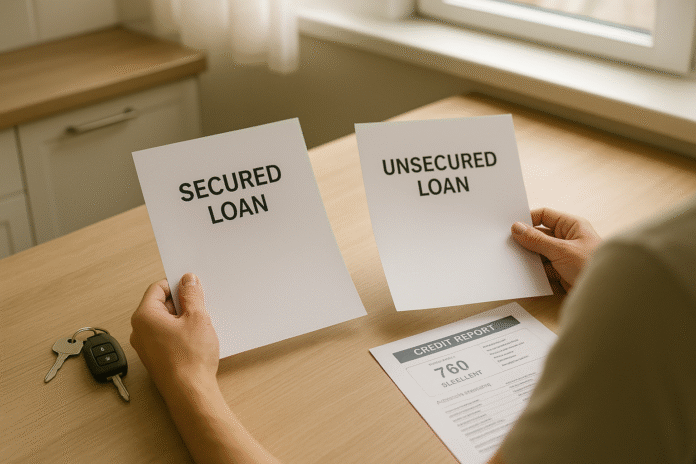
Choosing between secured and unsecured loans can feel confusing until you understand what really separates them—and how those differences affect cost, risk, approval odds, and credit. In simple terms, a secured loan is backed by collateral the lender can take if you don’t pay, while an unsecured loan relies primarily on your credit and income, with no collateral required. This guide breaks down 9 key differences borrowers care about most, from interest rates and borrowing limits to default consequences and timelines. It’s written for anyone weighing a personal loan, auto loan, home equity, or debt consolidation. Quick note: this is general education, not financial or legal advice—laws and lender policies vary by region and change over time.
1. Collateral vs. No Collateral (What “Secured” Really Means)
A secured loan requires you to pledge something of value—your car, home, savings, or another asset—that the lender can claim if you default; an unsecured loan does not. That single design choice drives many downstream differences in pricing, limits, and risk. In a secured loan, the lender files a legal “security interest” (often under the Uniform Commercial Code in the U.S.) to perfect its claim on the collateral, which reduces the lender’s risk and often leads to better terms. By contrast, unsecured loans lean more heavily on your creditworthiness and income because the lender has no asset to seize. Understanding this distinction helps you evaluate whether you’re comfortable putting an asset on the line to access lower rates or larger amounts—or whether you’d rather keep assets off the table and accept a potentially higher cost.
1.1 Why it matters
- Risk trade-off: With secured loans, failure to repay can lead to repossession or foreclosure; with unsecured loans, the lender typically must pursue collection or a lawsuit to recover funds.
- Documentation: Secured loans often involve appraisals, title work, or lien filings; unsecured loans usually skip collateral paperwork, streamlining approval.
- Common examples: Secured—mortgages, auto loans, home equity loans/HELOCs. Unsecured—personal loans, most credit cards.
1.2 Region-specific notes
- U.K.: Secured borrowing (e.g., homeowner loans) typically puts your home at risk if you miss payments; unsecured personal loans aren’t tied to an asset.
- India: Regulators and lenders distinguish clearly between secured and “unsecured loans,” i.e., loans not backed by tangible assets. Reserve Bank of India
Bottom line: collateral lowers lender risk and can unlock better terms—but you’re explicitly putting an asset at stake.
2. Eligibility & Underwriting: What Lenders Look For
Eligibility criteria differ because risk differs. Secured loans can sometimes be easier to qualify for if you have valuable collateral, since the asset mitigates the lender’s exposure. Unsecured loans hinge more on your credit profile (e.g., payment history, utilization, length of credit) and your debt-to-income (DTI) ratio. Lenders commonly assess DTI by dividing your total monthly debt payments by your gross monthly income; lower DTI generally signals more capacity to repay. Understanding how DTI and credit factors work helps you position an application: paying down revolving balances to reduce utilization, correcting errors on reports, or adding a co-borrower can improve approval odds for either loan type, especially unsecured.
2.1 Numbers & guardrails
- DTI calculation: Add monthly debt payments, divide by gross monthly income; many lenders favor lower DTIs (context varies by loan type).
- Credit factors: FICO cites five broad categories, with payment history (35%) and amounts owed/credit utilization (30%) carrying the most weight.
- Practical takeaway: Before applying, reduce card balances to lower utilization and avoid new hard inquiries outside a focused rate-shopping window for installment loans.
2.2 Mini-checklist to prep your file
- Pull your credit reports and scores; dispute errors.
- Calculate your DTI and identify quick wins (e.g., pay down high-utilization cards).
- Gather proof of income (pay stubs, tax returns) and assets.
- For secured loans, line up collateral docs (title, insurance, appraisal).
Bottom line: unsecured underwriting leans hardest on your credit and DTI; secured loans can offset weaker credit with solid collateral, though you’ll still need to prove ability to repay.
3. Interest Rates & APR: Why Secured Often Costs Less
Because collateral reduces lender risk, secured loans typically carry lower interest rates and APRs than comparable unsecured loans. Mortgages and auto loans (secured) usually price below personal loans (unsecured) for the same borrower profile. Conversely, unsecured personal loan APRs vary widely by credit and lender—commonly spanning from single-digit rates for excellent credit to the high 20s (and sometimes into the 30s) for weaker credit, as of September 2025. That spread means shopping is critical: two offers can differ by double-digit APR, dramatically changing total cost. Remember APR includes certain fees, providing a truer apples-to-apples comparison than rate alone.
3.1 How to compare offers quickly
- Focus on APR, not just interest rate.
- Confirm whether the rate is fixed or variable.
- Note origination fees and prepayment terms (see Section 8).
- Use the same loan amount/term when comparing.
3.2 Region & product nuance
- U.K. and India product menus differ (e.g., homeowner loans, gold loans). Regulatory limits and typical pricing vary; always review local disclosures.
Bottom line: secured loans generally price cheaper because of collateral; with unsecured loans, diligent rate shopping and fee awareness can shrink costs materially.
4. Borrowing Limits & Terms: How Much and How Long
Secured loans often allow higher borrowing limits and longer repayment terms because lenders are protected by collateral value. Think mortgage balances over decades or auto loans over multiple years, versus many unsecured personal loans capped in the low five figures with terms typically 2–7 years (varies by market and lender). Limits ultimately depend on collateral type (home equity vs. vehicle), loan-to-value (LTV) rules, income, and credit. Unsecured loans can be flexible and fast but may cap out sooner, reflecting the absence of collateral. When you need a larger sum or a long amortization to keep payments affordable, secured borrowing is frequently the tool—provided you accept the asset-at-risk trade-off. Halifax
4.1 Practical ways to set a realistic target
- Match term to asset life (e.g., don’t finance a short-lived purchase with a 10-year loan).
- Stress-test payments against a modest income shock (e.g., 10%).
- For equity-backed borrowing, leave a cushion (avoid maxing out LTV).
4.2 When unsecured limits are enough
If your need is smaller—say, consolidating a few credit cards—an unsecured personal loan may cover it without tapping home equity or risking your vehicle. Compare APRs and fees before deciding. Experian
Bottom line: for bigger, longer-term needs, secured credit tends to go further; for modest sums, unsecured may be simpler and safer for your assets.
5. Consequences of Default: Repossession vs. Collection
Default plays out differently. With secured loans, the lender can seize and sell the collateral (e.g., repo a car or foreclose on a home) and, if the sale proceeds don’t fully cover the balance, you might still owe the deficiency. With unsecured loans, the lender can’t directly take property; instead, they may send the debt to collections or sue. If they obtain a judgment, they can pursue remedies like wage garnishment or bank levies (subject to federal/state limits and exemptions). Either way, missed payments and defaults can seriously damage your credit for years, so early communication with your lender is vital.
5.1 What recent data shows (autos)
Auto finance is a major secured credit market; the CFPB’s 2025 report highlights repossession practices and market size, underscoring the real risk of losing a vehicle when payments lapse.
5.2 Guardrails & actions if you fall behind
- Contact the lender before you miss a payment; hardship options may exist.
- Know your rights around repossession, sale notices, and deficiency balances.
- For unsecured debts, respond to any lawsuit—judgments open the door to garnishment. Consumer Financial Protection Bureau
Bottom line: secured default threatens your asset and your credit; unsecured default threatens your credit and can escalate into legal collection—neither is benign.
6. Speed & Accessibility: How Fast You Can Get Funds
If you need money quickly, unsecured personal loans can be fast—often funded within one to three business days after approval, and sometimes the same day with certain lenders. Banks and credit unions may take longer than online lenders. Secured loans can be slower because of collateral steps like appraisals, title checks, or lien filings, especially for autos and real estate. That said, some secured products (e.g., share- or CD-secured loans at banks/credit unions) can fund quickly when collateral is already on deposit. As always, timelines depend on the lender’s process and how fast you submit documents.
6.1 Tips to accelerate funding
- Apply during business hours and respond to verification requests promptly.
- Opt for ACH/direct deposit over checks when possible. Citi
- Have ID, income documents, and bank details ready; for secured loans, prepare titles and insurance.
6.2 Watch-outs
- “Instant” marketing doesn’t guarantee instant cash—ACH and bank processing can still take a day or two. Investopedia
- Be cautious with unsolicited “live check” loans; cashing the check means you’ve accepted the terms. Consumer Financial Protection Bureau
Bottom line: unsecured personal loans can be the faster path; secured loans often trade speed for due diligence on collateral.
7. Credit Score Impact: Same Rules, Different Levers
Both secured and unsecured loans affect your credit similarly: on-time payments help build credit; late payments, defaults, and charge-offs hurt and can remain on your reports for up to seven years (bankruptcies even longer). Payment history and amounts owed/utilization are the heaviest-weighted FICO factors, so managing these two levers matters most. One strategic difference: using an unsecured loan to consolidate credit card balances can reduce revolving utilization (a big score driver), while a secured loan like a HELOC may add available credit but can raise overall leverage. Whatever you choose, automate payments, keep utilization low, and avoid scattered hard inquiries—focus your applications within recognized “rate-shopping” windows for installment loans.
7.1 Numbers & guardrails
- FICO weighting: Payment history 35%, amounts owed 30%, then length (15%), new credit (10%), mix (10%).
- Negative info timeline: Most delinquencies can appear on reports for seven years.
7.2 Mini-checklist to protect your score
- Set autopay for at least the minimum due.
- Keep revolving utilization ideally below ~30%; lower is better. Consumer Financial Protection Bureau
- Group rate shopping for the same loan type within the allowed window. Investopedia
Bottom line: the scoring system treats both loan types similarly; how you manage payments and revolving balances matters far more than whether a loan is secured.
8. Fees, Disclosures & Fine Print: What Drives “Total Cost”
APR tells most of the story, but fees and add-ons can move the goalposts. Personal loans (unsecured) may charge origination fees; mortgages and auto loans (secured) can include prepayment penalties, appraisal/title fees, and optional add-on products (e.g., GAP waivers, service contracts) that increase financed balance. Not every loan has these costs, and some penalties are restricted by law, but you won’t know unless you read the disclosure documents closely. Before you sign, check for prepayment terms, fee amounts, and whether add-ons are truly optional—and cancellable.
8.1 What to look for
- Origination fee: One-time, upfront fee (varies by lender and product).
- Prepayment rules: Mortgages/auto loans may include penalties; terms and legality vary by state and product. Consumer Financial Protection Bureau
- Add-ons: GAP insurance, extended warranties—optional and sometimes overpriced; you can often cancel.
8.2 Quick tactics to avoid surprises
- Compare APR and total of payments across lenders.
- Ask for itemized closing costs and confirm what’s negotiable.
- Avoid paying for extras you don’t need or can buy cheaper elsewhere.
Bottom line: two loans with similar rates can have very different all-in costs—fees and add-ons are where those differences hide.
9. Best-Fit Use Cases: When to Choose Secured vs. Unsecured
Matching loan type to purpose helps you minimize cost and risk. Secured loans often fit big-ticket, long-horizon needs—buying a home or car, or leveraging home equity for large projects—where lower rates and longer terms matter and you’re comfortable pledging an asset. Unsecured loans can be ideal for debt consolidation, medical bills, or medium-sized expenses where speed and flexibility trump maximum loan size. Your comfort with collateral risk, the size and urgency of your need, and your credit/DTI all figure into the choice. If you’re unsure, shop both, compare APR and fees, and weigh the real downside of losing an asset versus paying a higher rate without collateral.
9.1 Fast decision framework
- Need size & time: Larger/longer → consider secured; smaller/shorter → consider unsecured.
- Risk tolerance: If losing the asset would be catastrophic, think twice about securing the debt.
- Timeline: If you need funds in days, unsecured may be faster.
9.2 Regional notes & examples
- U.K.: Homeowner/secured loans vs. unsecured personal loans—compare risk of losing your home against rate savings.
- India: Gold-secured loans are common; regulators proposed tighter risk controls in 2025—know LTV and purity rules.
Bottom line: choose the structure that best balances cost, speed, limit, and asset risk for your situation, then shop intentionally for the best terms.
FAQs
1) What is the simple difference between secured and unsecured loans?
A secured loan is backed by collateral (house, car, savings), giving the lender the right to seize that asset if you default; an unsecured loan has no collateral and relies on your credit and income. This core difference drives pricing and limits across products like mortgages (secured) and personal loans (usually unsecured).
2) Which is cheaper: secured or unsecured?
All else equal, secured loans tend to have lower interest rates because the lender’s risk is reduced by collateral. Unsecured personal loan rates vary widely by credit, with typical ranges spanning single digits up to the 30% area as of September 2025—so shopping matters.
3) Can an unsecured loan lead to wage garnishment?
Yes—if you default and the creditor or collector sues and wins a judgment, they may garnish wages or levy bank accounts, subject to legal limits and exemptions. Always respond to court papers and learn your rights under federal and state law. Consumer Financial Protection Bureau
4) What happens if I default on a secured auto loan?
Your vehicle can be repossessed and sold. If the sale proceeds don’t cover what you owe, you may still be responsible for the deficiency balance, in addition to credit damage. Rules vary by state—know your notices and timeline.
5) How fast can I get funds from an unsecured personal loan?
Funding can arrive within one to three business days after approval with many online lenders; some offer same-day funding, while banks/credit unions can take longer. Timeframes depend on verification steps and chosen disbursement method.
6) Do prepayment penalties apply to unsecured loans?
They’re more commonly associated with mortgages or some auto loans, but policies vary. Read the agreement—some products restrict early payoff or impose fees, while others allow fee-free prepayment.
7) Do origination fees make unsecured loans a bad deal?
Not necessarily. Origination fees are one-time costs included in APR, which lets you compare apples-to-apples. If a low-fee offer has a higher APR after fees, it may still cost more over the same term. Check APR and total of payments—not just the fee line. Experian
8) Will either loan type help my credit score?
Yes—on-time payments help, missed payments hurt. Because payment history and amounts owed/utilization heavily influence FICO scores, consolidation that lowers revolving utilization can help, while any late payment can remain on your reports for up to seven years.
9) Is a secured loan easier to get with bad credit?
Sometimes. Collateral can offset lender risk and make approval more likely or cheaper, but you still must show ability to repay. Consider the real downside of losing the pledged asset if things go wrong. Consumer Financial Protection Bureau
10) Are add-on products like GAP insurance required with a secured auto loan?
No. GAP and extended warranties are optional; they increase the financed amount and cost. Understand benefits, shop coverage separately, and know cancellation rights before you agree.
Conclusion
“Secured vs unsecured” isn’t just semantics—it’s a set of trade-offs among cost, risk, speed, and borrowing power. Secured loans use collateral to lower lender risk, which can deliver lower APRs, higher limits, and longer terms, but they put an asset on the line and can take longer to arrange. Unsecured loans keep assets off the table and can fund quickly, but frequently cost more and cap out at lower amounts. In either case, your credit habits dominate long-run affordability: automate payments, keep revolving utilization low, and avoid scattered hard inquiries by rate-shopping within a defined window. As of September 2025, disclosures and consumer protections continue to evolve across regions and products, so read agreements closely—especially fee and prepayment terms—and don’t hesitate to ask lenders for itemized costs and clarifications. If your goal is minimizing interest and risk, compare at least three offers, review APR and total of payments side by side, and choose the structure that fits your need size and your tolerance for collateral exposure.
Ready to act? Gather your documents, compute your DTI, and request quotes from both secured and unsecured lenders—then pick the best total cost for your situation.
References
- Loans | FDIC — Federal Deposit Insurance Corporation, Aug 22, 2022. FDIC
- Secured vs. Unsecured Personal Loans — Experian, Jun 3, 2025. Experian
- What is a debt-to-income ratio? — Consumer Financial Protection Bureau (CFPB), Aug 30, 2023. Consumer Financial Protection Bureau
- Secured vs. Unsecured Loans: What’s the Difference? — Investopedia, updated 2023. Investopedia
- Repossession in Auto Finance (Report & Data Spotlight) — CFPB, Jan 23, 2025. Consumer Financial Protection Bureau
- What happens if my car is repossessed? — CFPB, current page. Consumer Financial Protection Bureau
- How are FICO® Scores Calculated? — myFICO, accessed 2025. myFICO
- How long does negative information remain on my credit report? — CFPB, Jun 6, 2023. Consumer Financial Protection Bureau
- Best Personal Loan Rates for September 2025 — Bankrate, 2025. Bankrate
- How Long Does It Take to Get a Personal Loan? — Bankrate, Jun 24, 2024. Bankrate
- What is a prepayment penalty? — CFPB, Sep 13, 2024. Consumer Financial Protection Bureau
- Do personal installment loans have fees? — CFPB, Sep 4, 2024. Consumer Financial Protection Bureau
- Am I required to purchase GAP insurance or other add-ons for an auto loan? — CFPB, Mar 11, 2024. Consumer Financial Protection Bureau
- Secured and unsecured borrowing explained — MoneyHelper (U.K.), current page. MaPS
- RBI proposes stricter rules on gold-secured loans — Reuters, Apr 9, 2025. Reuters