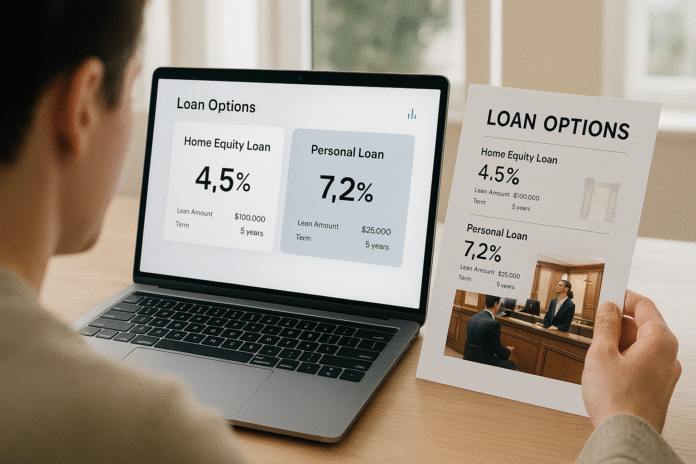
Choosing between online loans and traditional bank loans comes down to how fast you need money, the total cost of borrowing, and the level of guidance and protections you want. In brief, online lenders tend to be faster and more convenient, while banks often offer stronger relationship benefits and, for the best-qualified borrowers, competitive rates. This article breaks down 10 practical pros and cons to help you decide which route fits your situation. Quick note: this is general information for education only and not financial advice.
At a glance: Online loans are credit products issued by digital lenders through websites or apps, often with streamlined applications and rapid decisions. Traditional bank loans come from chartered banks (and often credit unions), with in-branch or hybrid processes and broader product sets. Many online personal lenders can fund within one to three business days, and sometimes the same day, while banks commonly take longer because of additional underwriting and verification steps.
1. Speed & Convenience
Online loans typically deliver faster applications and funding than banks; banks emphasize thorough review and relationship checks, which can slow timing but reduce errors. If your top priority is speed—say, a surprise medical bill or a car repair—online lenders are often engineered for same-day or next-day decisions and deposits, whereas bank timelines can stretch longer due to additional documentation and internal review cycles. As of September 2025, most reputable consumer finance guides note that many online lenders fund in 1–3 business days, with some offering same-day funding for qualified borrowers.
1.1 Why it matters
Faster funding can limit downstream costs—avoiding late fees, storage fees on a towed vehicle, or penalties from missed obligations. But speed can tempt overspending: a quick approval isn’t automatically a good deal. Banks’ slower cadence may result in lower rates for top-tier customers or better-fit products (e.g., a home equity line instead of a high-APR personal loan).
1.2 Numbers & guardrails
- Typical online personal-loan funding: same day to 3 business days.
- Some banks still take several business days to disburse personal loans; bank processes may require in-branch steps or longer verification.
- “Instant” loans are rarely literally instant—ACH transfers and bank cutoffs add time.
Mini case: You need $1,800 for a brake job. An online lender prequalifies you at noon and deposits funds the next morning, avoiding a week of rideshare costs. A bank pre-approves you in three business days with a slightly lower APR—but the delay would have cost more in interim expenses, erasing the rate advantage.
Bottom line: If timing is critical, online wins; if you can wait and want to explore broader options, a bank may pay off.
2. Interest Rate, APR & Fees
Banks can sometimes offer lower APRs to the most creditworthy borrowers, especially if you have deposit balances or collateral. Online lenders frequently use dynamic pricing and may offer highly competitive rates for mid-to-strong credit—but can also price higher (often up to ~35.99% APR for certain unsecured personal loans). Always compare APR, not just interest rate, since APR rolls in fees like origination.
2.1 Why it matters
A loan’s true cost lives in its APR and fee structure. Even a “lower” rate can be less attractive if a hefty origination fee reduces the proceeds you actually receive. Regulation Z (Truth in Lending Act) requires clear disclosures of APR and certain costs, enabling apples-to-apples comparison across lenders.
2.2 How to compare smartly
- Use prequalification (soft pull) to see rate ranges before applying.
- Compare APR, origination fee, prepayment penalty, and late fees.
- Ask about autopay discounts and relationship rate discounts at banks.
- Check whether fixed vs variable applies (common in business loans).
- Watch for add-on products you don’t need (insurance, club memberships).
Numeric example:
- Offer A (online): 20% APR, 0% origination, $10,000 for 36 months → payment ≈ $371; total interest ≈ $3,356.
- Offer B (bank): 18% APR, 5% origination ($500), net proceeds $9,500; payment on $10,000 ≈ $361; after accounting for the $500 fee, the effective cost narrows. The better deal isn’t obvious—APR and fees together tell the story.
Bottom line: Shop widely using prequalification and compare APR + fees side by side. Regulation Z exists to help you do exactly that.
3. Eligibility & Underwriting (Credit, DTI, and Collateral)
Online lenders often approve a broader credit spectrum by using alternative data and automated scoring, while banks tend to prioritize traditional metrics (FICO/VantageScore, debt-to-income, length of history) and may require collateral for the best rates or larger amounts. For many applicants with thin files or non-traditional income, online platforms sometimes present more options, though pricing may be higher. Federal Reserve surveys show that, even in 2024, access to credit remains uneven among lower-income and some demographic groups.
3.1 Numbers & guardrails
- Hard inquiry during a formal application can trim your score a few points; soft prequal checks don’t.
- As of 2025, average U.S. FICO scores hover around 715, with pressure from higher rates and student-loan delinquencies influencing credit health—context for approval odds and pricing. Reuters
- Banks may favor secured loans (auto title, CDs) or relationship underwriting to improve offers.
3.2 Mini-checklist
- Verify your DTI (aim <36–43% for best terms).
- Stabilize income documentation (W-2s, pay stubs, tax returns, contracts).
- Consider a co-borrower or collateral if borderline.
- If denied, ask for adverse action reasons and adjust before reapplying.
Bottom line: Online lenders can be more flexible with data; banks can reward strong, traditional profiles—especially when collateral or history is on your side.
4. Loan Amounts, Terms & Use Cases
Banks and online lenders both offer personal loans, but banks often have broader product shelves—home equity loans/lines, auto loans, mortgage products, and small-business credit—that can better match specific needs. Online personal loans commonly range from $1,000 to $50,000 (sometimes more), with terms of 2–7 years; banks may go larger when collateral is in play and can provide specialized products (e.g., HELOCs for renovation). For small businesses, SBA-backed loans through banks carry longer terms and capped pricing but take longer to close. Bankrate
4.1 Tools/Examples
- HELOC vs personal loan: HELOCs can be lower-cost for homeowners but take longer and put your home at risk.
- SBA 7(a): Common bank-intermediated business loan; typical SBA turnaround is days for SBA review, but total 30–90 days to fund is common.
- Online working-capital loans: Faster but often higher APR; useful for short-term gaps.
4.2 Numbers & guardrails
- SBA 7(a) loans: caps on rates, 75–85% guarantees (varies by amount), and 5–10 business days SBA turnaround (lender process adds time).
- Personal-loan term sweet spot: pick the shortest term you can afford to minimize interest.
Bottom line: Match the product to the project—quick cash flow fixes lean online; large, strategic financing may justify a bank’s slower, more tailored options.
5. Transparency, Prequalification & Credit Pulls
Online lenders popularized soft-pull prequalification, letting you see potential rates and terms without affecting your credit score; many banks now offer it as well. The formal application triggers a hard inquiry. Regulation Z (TILA) standardizes key disclosures so you can compare APRs, fees, and terms clearly before signing. Always download or save the Loan Estimate/Disclosure screens.
5.1 Common mistakes
- Confusing rate ranges with actual offers.
- Overlooking origination fees that reduce net proceeds.
- Authorizing multiple hard pulls in a short window.
- Ignoring prepayment penalties on some products.
5.2 Mini case & guardrails
A borrower sees 10.9–24.9% APR in prequalification. After verifying income, the firm offers 17.4% APR with a 5% origination fee; the net funds are lower than expected. The borrower compares a bank’s 15.9% APR and no fee—slower funding, but cheaper overall. Guardrail: get three prequal offers and calculate total cost before any hard pull.
Bottom line: Use soft pulls to comparison shop, then apply once—where the math (APR + fees + timing) clearly wins.
6. Customer Support & Relationship Banking
Banks often provide relationship pricing and ongoing advice; a banker who knows your profile can surface alternatives (e.g., a HELOC vs a personal loan, or SBA vs non-SBA credit for your business). Online lenders excel at self-serve dashboards, 24/7 access, and chat support, but human escalation paths may be thinner. For complex financing or edge cases (multiple incomes, new business, collateral questions), the relationship can be worth real money.
6.1 Why it matters
- Relationship benefits can include rate discounts, fee waivers, or bundled services.
- Banks may consider compensating factors (e.g., long deposit history).
- Online lenders often provide clear, app-based repayment tools and alerts.
6.2 Mini-checklist
- Ask banks about relationship tiers and automatic discounts.
- Check online lenders’ customer-service hours and escalation structure.
- Read complaint histories or regulator dashboards for patterns in service.
Bottom line: If you value coaching and multi-product planning, banks have an edge; if you prefer sleek, always-on DIY controls, online platforms shine.
7. Security, Privacy & Fraud Risks
Reputable banks and online lenders both employ multi-factor authentication and encryption; in the EU/UK, Strong Customer Authentication (SCA) is mandated for many online payments. Still, fraudsters target hurried borrowers with fake “instant loan” sites and phony fee requests. Follow NIST SP 800-63B principles (strong authentication) and rely on official portals and verified entities. If anyone asks for upfront payment via gift cards, crypto, or wire before you receive funds, it’s a red flag.
7.1 How to protect yourself
- Enable MFA and use long passphrases; avoid reusing passwords.
- Verify lender licensing (e.g., NMLS in the U.S.) and use official links.
- Watch for pressure tactics and advance-fee demands; report scams to the FTC.
7.2 Region notes
- EU/UK: SCA under PSD2 requires two-factor authentication for most online payments, reducing fraud risk.
Bottom line: Good security practices plus regulator guidance keep you safer—regardless of channel.
8. Regulation, Protections & Recourse
Banks operate under extensive prudential supervision and consumer-protection regimes. Online consumer lenders are also regulated—primarily through federal rules like TILA/Reg Z and state licensing—with rising scrutiny worldwide. In the UK, the FCA Consumer Duty pushes firms to prove good customer outcomes; in the EU, the updated Consumer Credit Directive (2023/2225) expands disclosures and creditworthiness checks, including for BNPL-style products. In the U.S., if something goes wrong, you can submit a complaint to the CFPB (and your state regulator). Note: FDIC insurance protects deposits, not loans, but can matter when you link a bank account or consider a bank-issued product.
8.1 Recourse roadmap (U.S.)
- Contact the lender’s support and document everything.
- Escalate via the lender’s formal complaint channel.
- File a complaint with the CFPB; you can track status online. Consumer Financial Protection Bureau
- Consider your state regulator/AG for additional oversight.
8.2 Region notes
- EU: CCD2 strengthens pre-contract information and affordability checks; full application by Nov 20, 2026.
- UK: Ongoing FCA Consumer Duty work targets clearer communications and better outcomes. FCA
Bottom line: Know your rights and avenues where you live; protections exist, but you must use them.
9. Funding, Repayment & Flexibility
Online lenders often support same-day to 3-day ACH funding and slick repayment features (autopay, biweekly options). Banks may have more repayment flexibility for existing customers, including hardship programs or temporary payment plans. For emergency needs, online speed helps; for longer horizons (e.g., home projects), bank structures can unlock lower payments with longer terms or secured products.
9.1 Practical tips
- Turn on autopay (sometimes a 0.25% rate discount—ask).
- Align due dates with your pay cycle.
- If hardship hits, contact the lender early; ask about deferrals or interest-only periods.
9.2 Example
Borrowing $15,000 for a roof repair: one online lender offers next-day funding at a higher APR; your bank offers a HELOC in ~2–4 weeks at a lower variable rate. If rain damage is imminent, online wins on timing; if you can wait and want a lower ongoing cost, the bank option likely wins. Bankrate
Bottom line: Choose funding and repayment mechanics that match your project’s urgency and duration.
10. Best-Fit Scenarios (When to Choose Which)
Choose an online loan when you need money fast, your credit is average-to-good, and the convenience of a digital process outweighs modestly higher pricing. Choose a bank loan when you value relationship advice, may put up collateral, or can access specialty products (HELOCs, SBA loans) at competitive rates. For small businesses, SBA-backed loans via banks can deliver longer terms and capped pricing, albeit with longer timelines. Bankrate
10.1 Quick decision checklist
- Timeline: Need funds now (online) vs can wait (bank).
- Cost: Compare APR+fees; don’t assume one channel is always cheaper.
- Complexity: Simple unsecured need (online) vs collateral/strategy (bank).
- Support: DIY app tools (online) vs human banker guidance (bank).
- Business loans: Consider SBA via banks for larger, longer-term needs. Small Business Administration
10.2 Mini case
A freelancer with fluctuating income prequalifies with three online lenders and one bank. The best online offer: 18.9% APR, 0% fee, funds tomorrow. The bank offers 16.5% APR, no fee, funds in a week, and suggests a HELOC for future projects. The freelancer chooses online now for urgency, then schedules a bank appointment to set up a HELOC later—using both channels strategically.
Bottom line: There isn’t one “winner.” Your context—timing, loan type, and support needs—decides.
FAQs
1) What’s the single biggest difference between online loans and bank loans?
Online loans usually emphasize speed and simplicity—fast prequalification and funding—while banks emphasize relationship banking and broader product options that may deliver better pricing for strong profiles or collateralized needs. If you’re facing a deadline, online may be favorable; if you can wait and want tailored advice, banks often shine.
2) Is prequalification a hard credit check?
No. Prequalification is typically a soft inquiry and won’t affect your score. The formal application requires a hard inquiry, which can temporarily reduce your score a few points. Always read the fine print to confirm the check type before you proceed.
3) Are online loans safe?
Reputable online lenders follow strong security practices and consumer-protection rules, but scammers mimic them. Protect yourself with MFA, long passphrases, and by verifying licensing. If anyone demands an upfront fee before funding or pressures you to pay via gift cards/crypto, walk away and report it. NIST Publications
4) Do banks always have lower rates than online lenders?
Not always. Banks may win for top-tier credit or with collateral/relationship discounts. Many online lenders price competitively too, especially for mid-prime borrowers. The only way to know is to compare APRs and fees across multiple offers using soft-pull prequalification.
5) How fast can I get money with an online loan?
Some online lenders offer same-day funding, with many delivering funds within 1–3 business days. Speed depends on verification, bank cutoffs, and your profile. “Instant” often still means next business day due to ACH timing.
6) What consumer protections apply?
In the U.S., TILA/Regulation Z requires standardized disclosures (including APR). You can submit complaints to the CFPB and your state regulator. In the UK, FCA Consumer Duty sets outcomes-based standards; in the EU, CCD2 strengthens pre-contract information and affordability checks.
7) Will applying hurt my credit score?
A hard inquiry can lower your score a few points for a short period. Soft inquiries (prequal) don’t. Multiple hard pulls within a short window can add up, so shop with soft pulls first and apply once to the best offer.
8) What fees should I watch for?
Common fees include origination, late fees, and occasionally prepayment penalties (more common outside mainstream personal loans). These roll into APR, which is your real cost metric. Always compare APR-to-APR across lenders before signing.
9) What about small-business borrowing—online vs bank?
Banks (often via SBA programs) can offer longer terms and rate caps, but 30–90 days to fund is typical. Online business lenders can move faster, but with higher pricing. Match timeline and cost to the use case; don’t overpay for speed unless the opportunity cost justifies it. Investopedia
10) Does FDIC insurance protect my loan?
No. FDIC insurance protects deposits (checking, savings, CDs) at insured banks, not loans. It matters for where your funds land and for bank stability, but it doesn’t insure your borrowing.
11) How do EU/UK rules affect online borrowing?
Expect strong identity checks (SCA) and expanding consumer disclosures under CCD2 in the EU. In the UK, Consumer Duty pushes clearer communications and proof of good customer outcomes. These frameworks shape lender practices and can improve borrower protections. European Banking AuthorityEUR-Lex
12) What’s the smartest way to shop for a loan?
Set a target monthly payment and total cost, prequalify with at least three lenders, compare APR + fees, verify funding timeline, and read disclosures before any e-signature. Pause if anything feels rushed or unclear, and escalate questions to a human. NerdWallet
Conclusion
Both online loans and traditional bank loans can be the right choice—just not for the same borrower, at the same time, for the same need. Online shines when speed and streamlined UX are decisive; banks shine when your profile or project benefits from relationship banking, collateralized structures, and broader product menus. Use this playbook to stack the deck: prequalify with multiple lenders (soft pulls), compare APR + fees, test funding timelines against your actual deadline, and choose based on total economic value—not just convenience. If you’re borrowing for a business, remember that SBA loans via banks may offer the right combination of maturity, payment comfort, and oversight—provided your timeline allows. And wherever you live, lean on your country’s consumer-protection framework to keep the process transparent and fair.
Ready to act? Prequalify with three lenders today, compare APR + fees, and pick the one that best fits your timeline and budget.
References
- “12 CFR Part 1026 — Truth in Lending (Regulation Z),” Consumer Financial Protection Bureau (updated Jan 2024). https://www.consumerfinance.gov/rules-policy/regulations/1026/
- “Economic Well-Being of U.S. Households in 2024 — Banking and Credit,” Board of Governors of the Federal Reserve System (June 12, 2025). https://www.federalreserve.gov/publications/2025-economic-well-being-of-us-households-in-2024-banking-and-credit.htm
- “Hard Inquiry vs. Soft Inquiry: What’s the Difference?,” Experian (Oct 28, 2024). https://www.experian.com/blogs/ask-experian/hard-inquiry-vs-soft-inquiry/
- “How Long Does It Take to Get a Personal Loan?,” Bankrate (June 24, 2024). https://www.bankrate.com/loans/personal-loans/how-long-does-it-take-to-get-a-personal-loan/
- “How Fast Can You Get a Loan in an Emergency?,” Bankrate (Feb 21, 2025). https://www.bankrate.com/loans/personal-loans/how-fast-can-you-get-an-emergency-loan/
- “The Fed — Economic Well-Being of U.S. Households (SHED),” Federal Reserve (May 28, 2025). https://www.federalreserve.gov/publications/report-economic-well-being-us-households.htm
- “Consumer Complaint Database,” Consumer Financial Protection Bureau (accessed Sept 2025). https://www.consumerfinance.gov/data-research/consumer-complaints/
- “Understanding Deposit Insurance,” Federal Deposit Insurance Corporation (Apr 1, 2024). https://www.fdic.gov/resources/deposit-insurance/understanding-deposit-insurance
- “Consumer Duty,” Financial Conduct Authority (UK) (2022–2025 resources). https://www.fca.org.uk/firms/consumer-duty
- “Consumer credit agreements (2023) — Directive (EU) 2023/2225,” EUR-Lex (Oct 30, 2023). https://eur-lex.europa.eu/EN/legal-content/summary/consumer-credit-agreements-2023.html
- “NIST Special Publication 800-63B: Digital Identity Guidelines — Authentication and Lifecycle Management,” NIST (2020; updated). https://csrc.nist.gov/pubs/sp/800/63/b/upd2/final
- “How to Report and Avoid Scams,” Federal Trade Commission (updated 2025). https://consumer.ftc.gov/scams
- “Types of 7(a) Loans,” U.S. Small Business Administration (accessed Sept 2025). https://www.sba.gov/partners/lenders/7a-loan-program/types-7a-loans
- “SBA Loan Rates 2025,” NerdWallet (updated Sept 2025). https://www.nerdwallet.com/article/small-business/sba-loan-rates
- “Instant Personal Loans: How Fast Can You Actually Get Funds?,” Investopedia (2023). https://www.investopedia.com/instant-personal-loans-how-fast-can-you-get-funds-7963254