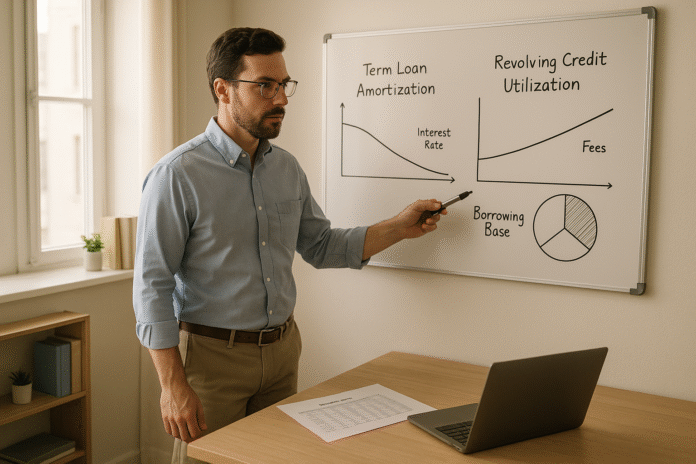
If you’re choosing between a term loan and a revolving credit line, you’re really choosing between long-term, lump-sum financing with scheduled repayment and flexible, reusable funding you can draw and repay as needed. In simple terms: a term loan gives you cash up front that you repay over time (often with amortization); a revolver/line of credit gives you a limit you can use, repay, and reuse, paying interest only on what you draw.
This guide is written for founders, finance leads, and owner-operators who want a practical, numbers-first comparison. You’ll learn how each product is structured, priced, and monitored; how collateral and covenants work; where taxes and accounting can surprise you; and a field-tested framework to decide. Quick disclaimer: this is for education, not legal, tax, or financial advice—speak with qualified advisors for your situation.
1. Structure & Repayment Mechanics
A term loan pays out once and repays on a fixed schedule; a revolving line lets you draw, repay, and redraw within your limit for the commitment period. In practice, term loans are the workhorse for long-life assets and projects, while revolvers are designed to smooth working capital ups and downs and seasonal needs. That structural difference drives everything from cash flow impact to the way lenders monitor your business. With term loans, expect payments that include both principal and interest (amortization) unless you’ve negotiated interest-only periods. On revolvers, expect interest-only on drawn amounts plus periodic fees tied to your undrawn commitment.
1.1 Why it matters
Because term loans amortize, your balance predictably declines, which can de-risk refinancing at maturity. Revolvers, by contrast, can float for years at a similar balance if you keep borrowing, which creates renewal risk (what if the bank reduces or doesn’t renew?). This also affects leverage optics: amortizing term debt lowers debt/EBITDA over time; a revolver may not.
1.2 Numbers & guardrails
- Term loan amortization: Payments start interest-heavy and shift toward principal over time; standard amortization tables show the split each period.
- Revolver interest: Accrues only on what you draw. If you draw $400,000 on a $1,000,000 line, you pay interest on $400,000, not the full limit.
- Commitment/unused fees: Many revolvers charge a fee on undrawn amounts (typical annualized range ~0.25%–1.0%).
1.3 Mini example
- Term loan: $500,000 over 5 years at a fixed rate with monthly amortization produces a steady payment schedule and a balance that trends to zero.
- Revolver: $1,000,000 limit; you draw $400,000 for inventory and repay after 60 days; you can draw again for payroll or a supplier deposit, paying interest only during the time money is out.
Synthesis: If you want predictable paydown and matching of cost to a long-life asset, a term loan’s structure fits. If you want flexible access to cash that you can reuse, a revolver fits—but plan for fees and renewal risk.
2. Purpose & Fit: Working Capital vs. Long-Life Assets
Use term loans for assets and initiatives with multi-year benefits: equipment, buildouts, acquisitions, large software implementations. Use revolving credit to bridge timing gaps—purchasing inventory before sales, covering receivables timing, or handling seasonal swings. This “purpose fit” aligns with how lenders underwrite each: term loans look to project cash flows and asset life; revolvers look to liquidity cycles and collateral that turns into cash quickly (A/R and inventory).
2.1 How the working capital cycle maps to a revolver
- Buy inventory → draw on the line.
- Sell goods → collect receivables.
- Use cash → repay the line.
- Repeat as needed within the commitment.
2.2 U.S. program note (as of September 2025)
For smaller businesses in the U.S., SBA programs can backstop financing: the 7(a) program supports general business loans up to $5 million; Express/CAPLines permit revolving lines (some up to 10 years). These can coexist with conventional loans.
2.3 Common mistakes
- Funding long-term needs (e.g., a 7-year machine) with a short-tenor revolver—this amplifies renewal risk.
- Using a revolver for permanent working capital without a plan to seasonally pay down; some lenders require a clean-down (see section 6).
Synthesis: Map the financing to the need: assets that last years → term loan; cash that turns over in weeks or months → revolver.
3. Cost of Capital: Rates, Fees & Prepayment
Term loans often offer fixed or floating rates with upfront fees; revolvers usually float and add ongoing fees on undrawn commitments. The true cost difference depends on how much of a line you actually use and for how long. If you rarely draw, fees dominate; if you’re frequently at high utilization, interest cost dominates. Understanding pricing components lets you compare apples to apples. Investopedia
3.1 Rate basis & benchmarks (SOFR replaced USD LIBOR)
Most new U.S. floating-rate business loans and lines reference SOFR instead of USD LIBOR, with a credit spread and sometimes a credit-spread adjustment. This transition is well-documented by the ARRC (Federal Reserve–sponsored).
3.2 Fees you’ll likely see
- Origination/underwriting fee (term loans and revolvers).
- Commitment/unused fee on a revolver: commonly ~0.25%–1.0% per year of undrawn amounts (billed quarterly).
- Annual/admin fees for ongoing monitoring (more common in asset-based lines).
3.3 Prepayment & make-whole (term loans more affected)
Fixed-rate term loans and many commercial mortgages may include yield-maintenance or other prepayment premiums that compensate lenders if you pay off early when rates fall; ensure you understand triggers and calculations.
3.4 Quick cost compare (illustrative)
- Revolver: $1.0M limit, average usage $300k at SOFR+3.0%; assume SOFR 1-month is X% (varies). Interest ≈ 300k×(X%+3.0%); unused fee 0.5% on $700k ≈ $3,500/year.
- Term loan: $500k at fixed (X%+2.0%), 5-year amortization; add one-time 1% origination ($5,000); no unused fee, but prepayment might cost you if you refinance early.
Synthesis: Revolvers can look cheap until you account for unused fees; term loans can be efficient if you plan to hold to maturity. Price the whole stack—rate + fees + prepayment risk.
4. Collateral, Liens & Borrowing Base
Term loans typically take a specific asset lien (e.g., equipment) or a blanket lien; revolvers—especially asset-based lending (ABL) facilities—lend against eligible accounts receivable and inventory through a borrowing base that sets availability. U.S. security interests in personal property are governed by UCC Article 9; lenders perfect their interest via UCC filings and other methods set out in statute.
4.1 Borrowing base in plain English
Regulators describe the borrowing base as eligible collateral multiplied by an advance rate (e.g., eligible A/R × % + eligible inventory × %), subject to ineligibles and caps. Banks monitor this closely and perform field exams.
4.2 Typical advance-rate ranges (illustrative, lender-specific)
In A/R- and inventory-backed lines, many lenders advance ~70%–90% of eligible A/R and a lower ~50% (often less) against eligible inventory, depending on aging, concentration, and liquidation history.
4.3 Short numeric example
If you have $1.2M in eligible A/R (after excluding >90-day invoices, cross-aged items, and affiliates) and $600k in eligible inventory, with 80% and 50% advance rates, the borrowing base = $1.2M×80% + $600k×50% = $960k + $300k = $1.26M. Your availability is the lesser of (a) this amount and (b) the committed line size.
4.4 Quick checklist
- Confirm lien scope and priority (blanket vs specific).
- Know ineligibles (old A/R, intercompany, consignment, slow-moving inventory).
- Understand reporting: borrowing base certificates, agings, inventory reports.
Synthesis: Term loans lean on asset value and a fixed amortization; ABL revolvers lean on daily/weekly collateral quality—great when your working capital is healthy, tough when it deteriorates.
5. Covenants, Reporting & Monitoring Intensity
Term loans typically include financial covenants (e.g., DSCR, leverage, minimum liquidity). Revolvers can use similar covenants, but ABL facilities rely heavily on collateral monitoring—borrowing base certificates, agings, and periodic field exams—to control risk. Knowing which regime you’re buying helps you plan staffing and system workload.
5.1 Common covenants (and what they mean)
- DSCR (Debt Service Coverage Ratio): Keep operating cash flow ≥ a multiple of debt service; 1.20x–1.35x is a common ballpark, deal-specific. Investopedia
- Leverage ratio (Debt/EBITDA): Caps overall debt relative to earnings capacity.
- Liquidity/current ratio: Ensures short-term solvency.
- Springing covenants: Tighten if utilization or leverage breaches thresholds.
5.2 ABL monitoring rhythm (what to expect)
Regulators note that ABLs often require daily or weekly borrowing base certificates, plus field exams and frequent sales/inventory reporting to spot collateral decay early. Plan for secure data feeds from ERP/AR and inventory systems and timely reconciliations.
5.3 Reporting cadence (typical)
- Monthly financials + covenant compliance certificates.
- Weekly A/R and inventory agings (ABL).
- Periodic field exams and appraisals (ABL).
Synthesis: If you want lighter ongoing reporting, a plain-vanilla term loan can be friendlier. If you can operationalize frequent reporting and like flexible availability, an ABL revolver can scale with your sales.
6. Availability, Draw Rules & Clean-Downs
Revolvers provide a committed limit you can draw, repay, and redraw within the commitment term, often with sublimits (e.g., for letters of credit). Availability is usually the lesser of your commitment or your borrowing base. Many banks also require periodic clean-downs to ensure the line funds short-term needs rather than permanent debt. Latham & Watkins
6.1 Mechanics to know
- Draws/repayments: Typically same-day or next-day via online portal/wire.
- Sublimits: Letters of credit or inventory caps may reduce cash availability.
- Cash dominion/lockbox (ABL): Lender sweeps collections to repay the line first.
6.2 Clean-ups (a.k.a. clean-downs)
The OCC’s receivables/inventory handbook notes lenders may require a complete payout and zero balance for ~30 consecutive days annually (timed to your low season), proving the line is truly short-term.
6.3 Availability example (illustrative)
- Commitment $1.5M; borrowing base $1.26M (from §4).
- Availability = $1.26M (less outstanding draws and LCs). If $200k is drawn and $100k in LCs, remaining availability = $960k.
Synthesis: Revolver access feels like cash on tap—until a clean-down, a borrowing-base squeeze, or an LC sublimit reduces what’s usable. Model availability, not just the headline limit.
7. Tax & Accounting Considerations (High-Level)
Interest on business debt is generally deductible, but in the U.S. Section 163(j) may limit current deductions to 30% of Adjusted Taxable Income (ATI), with carryforwards and exceptions—rules vary and change. Accounting-wise, term loans amortize and reduce principal predictably; revolvers are interest-only until you repay or term-out. Plan cash taxes and financial statement presentation with your CPA.
7.1 What to ask your tax advisor (as of September 2025)
- Will 163(j) limit my current-year interest deduction? Do I need Form 8990? IRS
- If limited, are there elections/strategies (e.g., real property trade/business elections) that make sense?
- How should I capitalize or allocate interest for projects or inventory? (Rules are nuanced; get advice.)
7.2 Planning & modeling notes
- Term loan: Build an amortization schedule to forecast principal/interest split and DSCR trajectory. Investopedia
- Revolver: Forecast borrowing base and utilization, not just cash; include unused fees in your budget.
Synthesis: Both products can be tax-efficient, but details matter. Align your financing with a forecast that respects ATI limits, amortization, and borrowing-base dynamics.
8. Risk Management: Rate, Liquidity & Renewal
Revolvers often float; term loans can be fixed or floating. Floating-rate exposure means your interest cost moves with SOFR plus a spread. Liquidity risk is also different: a revolver can be cut or not renewed if collateral worsens; a term loan that’s performing is less likely to be pulled but can be constrained by covenants. Know your risks and hedge where it pays.
8.1 Rate risk playbook
- Consider matching fixed term debt to long-life assets to lock predictability.
- If floating, evaluate caps or natural hedges (e.g., revenue indexed to inflation).
- Stress-test at +200–300 bps to ensure coverage at higher rates.
8.2 Liquidity & availability risk
- ABL availability can drop if receivables age or inventory turns slow—your line shrinks exactly when you need it. Regulators emphasize frequent monitoring and field exams to manage this risk.
- Keep collections discipline tight; poor AR hygiene erodes borrowing base.
8.3 Renewal & covenant risk
- Revolver: Renewal isn’t guaranteed; maintain lender transparency, hit reporting deadlines, and avoid covenant tripwires late in the term.
- Term loan: Watch DSCR and leverage trends—amortization helps, but covenant breaches can accelerate maturity.
Synthesis: If rate and renewal risk keep you up at night, favor fixed-rate term debt for core assets and keep your revolver sized for genuine short-term swings, not long-term funding.
9. A Practical Decision Framework (9-Point Checklist)
The fastest way to decide is to match asset life, cash-flow pattern, and operating cycle to the instrument. Use this 9-point checklist to make the call and to prep your lender conversation.
9.1 The checklist
- 1) Asset life vs. tenor: Multi-year asset or project? Term loan. Short-term timing gap? Revolver.
- 2) Cash-flow predictability: Stable and budgetable favors amortization; lumpy/seasonal favors a line.
- 3) Collateral profile: Hard assets (equipment/real estate) lean term; liquid working capital (A/R, inventory) leans ABL.
- 4) Monitoring appetite: Light reporting favors term; you’re OK with frequent BBCs/field exams → ABL.
- 5) Fee sensitivity: Low utilization + high unused fee? Resize the line or reconsider.
- 6) Prepayment plans: Likely to refinance early? Beware yield-maintenance/make-whole.
- 7) Rate view: Want certainty → fixed term loan; comfortable with float → revolver/float term (SOFR-based).
- 8) Tax angle: Model interest under 163(j) and confirm deductibility.
- 9) Small-business programs: In the U.S., compare SBA 7(a) loans and CAPLines for guarantees/tenors.
Synthesis: Most businesses end up with both: a right-sized revolver for day-to-day liquidity and one or more term loans for long-life assets. Use the checklist to right-size each and avoid fee or covenant surprises.
FAQs
1) What’s the simplest way to explain the difference?
A term loan is a one-time lump sum repaid on a schedule (often amortizing to zero by maturity). A revolving credit line is a reusable limit: borrow, repay, and borrow again within the commitment period, paying interest only on drawn amounts and often a small fee on the undrawn balance. If you need predictable paydown, go term; if you need flexibility, go revolver.
2) Which is cheaper—term loan or revolver?
It depends on utilization and fees. Revolvers can be cost-effective when you borrow briefly and repay quickly, but unused fees (commonly ~0.25%–1.0%) add up if you keep the line idle. Term loans avoid unused fees but can carry prepayment penalties if you refinance early while rates have fallen. Compare the all-in cost: rate, fees, and any prepayment exposure.
3) How does a borrowing base actually work?
Your availability equals the eligible collateral × advance rates, minus reserves. For example, lenders may exclude invoices over 90 days or concentrated customers from A/R; they may discount slow-moving or work-in-process inventory. The base is recalculated frequently via certificates and field exams, so availability rises and falls with collateral quality.
4) What is an “unused” or “commitment” fee on a line?
It’s a fee charged on your undrawn commitment (e.g., 0.5% annually on the unused portion), typically billed quarterly. It compensates the bank for setting aside capital and liquidity for you. This is standard market practice in corporate revolvers and many small-business lines.
5) Do lines of credit have “clean-down” requirements?
Many do. A clean-down (or clean-up) requires you to fully pay down the line and keep a zero balance for a set period (often ~30 consecutive days) once a year, proving it’s truly seasonal/short-term funding. Regulators explicitly discuss this practice in receivables/inventory lending guidance.
6) What covenants should I expect?
Expect financial covenants like DSCR and leverage ratios on term loans and many cash-flow revolvers. ABL lines often shift emphasis to collateral performance via borrowing-base tests, reporting, and field exams. Missing a covenant can trigger default or require a waiver and tighter terms. Proskauer
7) How do these facilities affect business credit scores and utilization?
For business credit, agencies look at payment history, utilization, and public filings (e.g., UCCs). High revolving utilization can be viewed negatively; keeping usage moderate and payments timely supports stronger scores and future borrowing terms. (Consumer scores also consider utilization, but business scoring models differ.) Experian
8) Is interest tax-deductible?
Generally yes for bona fide business interest, but U.S. rules like Section 163(j) can cap current deductions (commonly 30% of ATI, with exceptions and carryforwards). Always confirm classification, elections, and any capitalization with a tax professional and the latest IRS instructions.
9) Can I convert revolver balances into a term loan?
Often yes—banks sometimes “term-out” outstanding revolver balances at renewal to right-size the line and create a paydown plan for what has become permanent working capital. Expect new amortization and possibly a different rate. Policies vary by lender and credit profile.
10) Where do SBA loans and lines fit?
SBA guarantees can help eligible U.S. businesses access term loans (7(a) up to $5 million) and certain revolving lines (e.g., Express/CAPLines, with some terms up to 10 years). SBA support doesn’t change your obligation to repay; it reduces lender risk and can improve access and pricing.
Conclusion
Choosing between a term loan and a revolving credit line starts with matching structure to purpose. Term loans align with long-life assets and projects that justify steady amortization and predictable paydown. Revolving credit aligns with working capital that turns quickly—inventory, receivables, and seasonal swings—where flexibility beats rigidity. Costs differ not just by interest rate but by fees, prepayment exposure, and monitoring overhead. Risks differ, too: term loans reduce principal over time; revolvers can be cut back just when collateral weakens. Tax and accounting details like Section 163(j), amortization schedules, and borrowing-base math influence the real-world P&L and cash-flow impact.
If you operate year-round with lumpy cash collections, a right-sized revolver plus a term loan for equipment is often the sweet spot. If you’re scaling a capital project with clear milestones and payback, lead with a term loan and keep a modest revolver for surprises. Use the 9-point checklist above, run an all-in cost comparison (rates + fees + prepayment), and pressure-test covenants at conservative assumptions. Next step: build a one-page side-by-side for your top two offers (rate, fees, covenants, monitoring, prepayment) and choose the structure that best fits your cash cycle and risk tolerance.
References
- Understanding Term Loans: Definition, Types, and Key Points, Investopedia, n.d. Investopedia
- What Is Revolving Credit?, Investopedia, Mar 17, 2025. Investopedia
- 7(a) Loans — What Are the Terms?, U.S. Small Business Administration, May 30, 2025. Small Business Administration
- Types of 7(a) Loans (Express/CAPLines), U.S. Small Business Administration, n.d. Small Business Administration
- Transition from LIBOR / SOFR, Alternative Reference Rates Committee (NY Fed), n.d. Federal Reserve Bank of New York
- Commitment Fee — Formula & Examples, Wall Street Prep, n.d. Wall Street Prep
- Asset-Based Lending — Comptroller’s Handbook, Office of the Comptroller of the Currency, 2025. OCC.gov
- Accounts Receivable and Inventory Financing — Comptroller’s Handbook, Office of the Comptroller of the Currency, 2000 (with updates). OCC.gov
- U.C.C. Article 9 — Secured Transactions (Overview), Cornell Law School Legal Information Institute, n.d. Legal Information Institute
- Yield Maintenance: Definition & How It Works, Investopedia, n.d. Investopedia
- Basic Q&As on the Limitation on the Deduction for Business Interest Expense (Section 163(j)), Internal Revenue Service, Jan 10, 2023. IRS
- Accounts Receivable Line of Credit — Valuation & Advance Rates (Guide), Gibraltar Business Capital, n.d. Gibraltar Business Capital